Key takeaways
- Mounting compatibility: “Universal” usually means slotted or adjustable rails that accept most jobsite saws, while models like the POWERTEC MT4009 are tuned around DeWalt footprints. Measure your saw’s base bolt spacing before you order, and confirm whether mounting hardware ships in the box.
- Load rating with margin: Most stands here land between 330 and 350 lbs. Your saw might weigh 60, but add a sheet of ply, a clamped jig, and your forearm leaning in, and headroom stops being theoretical.
- Wheels and thresholds: Eight-inch wheels roll over cracked concrete, extension cords, and garage lips that smaller casters catch on. Rubber tread, as on the VEVOR, runs quieter and marks finished floors less than hard plastic.
- Fold geometry and stored profile: Look at how flat the stand collapses and whether it stands upright on its own against a wall. A one-motion foot-release fold is the difference between putting it away and leaning it in a corner for months.
- Working height and leg stability: Adjustable-height legs, like those on the HRVEOCEI, let you level on a sloped driveway and match your outfeed. Wide-stance legs with rubber feet resist the sideways nudge that ruins a long rip.
What's inside
Anyone who has tried to make a clean rip cut on a pair of sawhorses knows the feeling: the saw walks, the workpiece dips, and the finish line on that built-in bookcase moves another weekend away. A table saw is only as accurate as whatever it sits on, and in the compact garages and shared basement shops most of us actually work in, that base also has to disappear when the cars come back. That tension between rigidity and footprint is the real design problem, not the saw itself.
This guide looks at portable table saw stands through the lens of a working home shop, where the stand doubles as a staging surface, a mobility solution, and a storage decision. We compare rolling folding stands from DEWALT, VEVOR, POWERTEC, HRVEOCEI, and Goplus, plus the widely sold universal 330 lb rolling stand, and break down the specs that actually matter once the saw is bolted down and the dust is flying.
As an Amazon Associate we earn from qualifying purchases.


How to Choose a Portable Table Saw Stand (2026)
- Mounting compatibility: “Universal” usually means slotted or adjustable rails that accept most jobsite saws, while models like the POWERTEC MT4009 are tuned around DeWalt footprints. Measure your saw’s base bolt spacing before you order, and confirm whether mounting hardware ships in the box.
- Load rating with margin: Most stands here land between 330 and 350 lbs. Your saw might weigh 60, but add a sheet of ply, a clamped jig, and your forearm leaning in, and headroom stops being theoretical.
- Wheels and thresholds: Eight-inch wheels roll over cracked concrete, extension cords, and garage lips that smaller casters catch on. Rubber tread, as on the VEVOR, runs quieter and marks finished floors less than hard plastic.
- Fold geometry and stored profile: Look at how flat the stand collapses and whether it stands upright on its own against a wall. A one-motion foot-release fold is the difference between putting it away and leaning it in a corner for months.
- Working height and leg stability: Adjustable-height legs, like those on the HRVEOCEI, let you level on a sloped driveway and match your outfeed. Wide-stance legs with rubber feet resist the sideways nudge that ruins a long rip.
The Best Portable Table Saw Stands of 2026, Reviewed
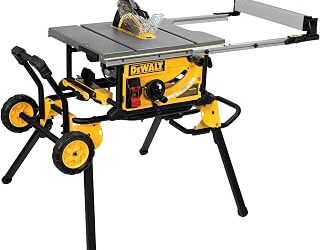
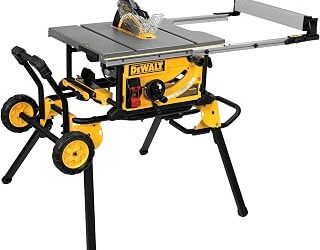
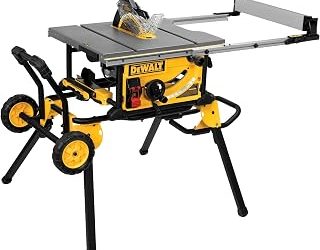
DEWALT DWE74911 Rolling Table Saw Stand
The benchmark for fit and finish: large pneumatic-style wheels, a genuinely one-handed fold, and tolerances tight enough that the saw feels like part of the frame rather than a passenger. Worth the premium if you move a jobsite saw in and out of a vehicle regularly.
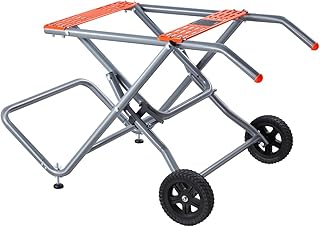
VEVOR Portable Table Saw Stand (350 lbs)
The best all-round value here, with the highest load rating of the group and 8-inch rubber wheels that handle rough concrete without chatter. Assembly rewards patience, but once the bolts are torqued the platform is impressively planted.
POWERTEC MT4009 Table Saw Stand with Wheels
Built with DeWalt saws in mind, so the mounting holes line up without drilling or shimming, and the 330 lb capacity covers any portable saw you’d realistically pair with it. A smart, low-drama upgrade for anyone already in the DeWalt ecosystem.
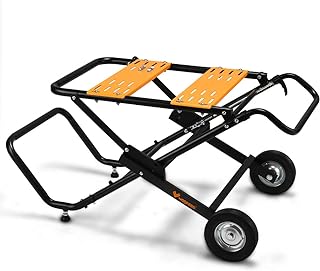
HRVEOCEI Portable Table Saw Stand (350 lbs)
Adjustable-height legs make this the pick for uneven garage floors and driveway work, and the universal rails accept most brands. Heavier than the field, which helps stability and hurts one-person stair carries.
Goplus Portable Table Saw Stand (331 lbs)
The lightest-duty entry and the friendliest price, folding compactly enough to slide beside a workbench. Ideal for occasional weekend cuts rather than daily production work.
Frequently Asked Questions
Will a universal stand fit my saw?
Most jobsite saws from DeWalt, Bosch, Skil, Ryobi, and Metabo HPT mount fine on slotted universal rails. Measure your base bolt spacing first; benchtop saws with very small footprints sometimes need an adapter board.
Is a rolling stand stable enough for full sheet goods?
For crosscuts and shorter rips, yes, provided the legs are locked and the wheels chocked. Full 4×8 sheets always need outfeed and side support, regardless of stand.
How much space does a folded stand take?
Expect roughly a 10 to 14 inch deep profile leaning against a wall, saw still attached on most models. That is the main advantage over fixed shop stands.
Do these stands reduce vibration?
Steel tube frames with rubber feet damp noticeably more than sawhorses. Bolting the saw down rather than clamping it is what actually kills the buzz.
Final Thoughts
For most home shops the VEVOR 350 lb rolling stand hits the sweet spot of capacity, wheel quality, and price. Spend up on the DEWALT DWE74911 if your saw travels weekly and you want the smoothest fold in the category, or choose the POWERTEC MT4009 for a drop-in fit with a DeWalt saw.