Key takeaways
- Flow over pressure: GPM is what carries dirt off panels and what feeds a foam cannon properly. Anything at or above roughly 1.4 GPM will produce usable foam; 2.0 GPM and up gives you thick, clinging lather without babying the trigger.
- Paint-safe working range: You rarely want more than 1,200–1,500 PSI at the panel. Higher-rated machines are fine as long as you have a 40-degree nozzle or an adjustable wand to dial it back — the rating is headroom, not a target.
- Pump and motor type: Brushless induction motors run cooler, quieter, and far longer than universal motors. If you detail more than a couple of cars a month, this is the single upgrade that pays for itself.
- Storage footprint: Hose management is the difference between a machine you use weekly and one you resent. Wall-mounted reels, integrated cord wraps, and onboard nozzle holders keep the garage from turning into a spaghetti bowl.
- Soap delivery: Onboard detergent tanks are convenient for maintenance washes; a quality brass-orifice foam cannon is what you want for pre-wash chemistry. Ideally the machine supports both.
What's inside
Detailing sits in an awkward middle ground. The pressure washers built for stripping deck stain will haze your clear coat, and the bargain units that promise gentleness often stall the moment you attach a foam cannon. Anyone who has watched a machine cycle on and off every four seconds while trying to lay down an even blanket of snow foam understands the frustration: the specification that matters for paint safety is not raw PSI, it is consistent flow, honest unloader behavior, and a pump that tolerates the trigger-heavy rhythm detailing demands.
This guide approaches the category the way we approach anything that lives in a garage, mudroom, or side yard — as equipment that has to earn its footprint. We looked at electric units in the practical detailing window, weighed how they handle foam, how they store, how quietly they run near a neighbor’s window, and whether the included nozzles are genuinely useful or filler. Below are the machines worth your money in 2026, followed by a buying framework and answers to the questions that come up most.
As an Amazon Associate we earn from qualifying purchases.


How to Choose a Pressure Washer For Detailing (2026)
- Flow over pressure: GPM is what carries dirt off panels and what feeds a foam cannon properly. Anything at or above roughly 1.4 GPM will produce usable foam; 2.0 GPM and up gives you thick, clinging lather without babying the trigger.
- Paint-safe working range: You rarely want more than 1,200–1,500 PSI at the panel. Higher-rated machines are fine as long as you have a 40-degree nozzle or an adjustable wand to dial it back — the rating is headroom, not a target.
- Pump and motor type: Brushless induction motors run cooler, quieter, and far longer than universal motors. If you detail more than a couple of cars a month, this is the single upgrade that pays for itself.
- Storage footprint: Hose management is the difference between a machine you use weekly and one you resent. Wall-mounted reels, integrated cord wraps, and onboard nozzle holders keep the garage from turning into a spaghetti bowl.
- Soap delivery: Onboard detergent tanks are convenient for maintenance washes; a quality brass-orifice foam cannon is what you want for pre-wash chemistry. Ideally the machine supports both.
The Best Pressure Washer For Detailing (2026)s Reviewed
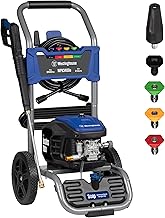
Westinghouse WPX3400e
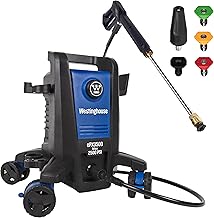
The brushless motor and 2.0 GPM flow rate make this the most capable all-rounder here — it produces genuinely dense foam and shrugs off long sessions without heat-soaking. The 3,400 PSI ceiling is more than any paint needs, so treat the 40-degree tip as your default and reserve the narrow nozzles for wheel wells and concrete.
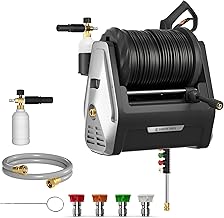
Giraffe Tools Wall Mounted Essential 100FT
A design-forward answer to garage clutter: the unit mounts to the wall and swallows 100 feet of hose on an automatic rewind reel, which means setup and teardown take seconds. At 2,900 PSI and 2.2 GPM it also has the strongest flow in this group, and the included foam cannon benefits accordingly.
Westinghouse ePX3500
The compact, upright ePX3500 is built for smaller spaces, with anti-tipping geometry that keeps it planted when you tug the hose and a steel wand that feels a class above the usual plastic. At 1.76 GPM it foams well and handles weekly maintenance washes comfortably.
Adam’s Active Pressure Washer 2.0
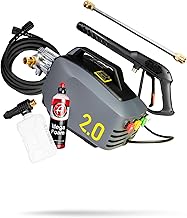
This is the enthusiast’s choice: 1,800 PSI and 2.0 GPM is close to the ideal detailing ratio — plenty of flow, restrained pressure — and the kit arrives with Mega Foam soap so you can dial in results immediately. Light enough to carry to a driveway or an RV pad without a second thought.
Hiclean 2100 PSI Electric Pressure Washer
The most space-conscious pick, and a sensible entry point if detailing is one job among many. The 2,100 PSI output with turbo and fan nozzles covers patios and fences as readily as bodywork, though heavy weekly use will find the limits of its smaller pump.
Frequently Asked Questions
How much PSI is safe for car paint?
Keep the spray at the panel between roughly 1,200 and 1,500 PSI using a 40-degree nozzle held 12 or more inches away. Healthy factory clear coat tolerates this easily; the real risks are narrow tips, close range, and existing chips or peeling film.
Do I need a foam cannon, or is the soap tank enough?
Onboard tanks apply a thin, watery detergent that works fine for light dust. A foam cannon delivers thick lather that dwells on the surface and lifts grit before your mitt touches it, which is where most swirl marks originate. If you care about finish quality, use the cannon.
Is electric powerful enough, or should I go gas?
For detailing, electric is the better tool. It is quieter, starts instantly, needs no fuel or oil changes, and the pressure range suits automotive work. Gas makes sense for large concrete surfaces, not paint.
Can I run these off a rain barrel or portable tank?
Not reliably. Nearly all consumer electric units require pressurized inlet water from a spigot; gravity feeding starves the pump and can damage it. Check the manual before attempting any siphon setup.
Final Thoughts
For most people, the Westinghouse WPX3400e is the best combination of flow, durability, and value — the brushless motor is the deciding factor. If your garage needs order as much as your car needs a wash, the wall-mounted Giraffe Tools Essential 100FT is worth the installation effort, and dedicated enthusiasts will appreciate how precisely Adam’s Active 2.0 is tuned for paint-safe detailing.