Key takeaways
- Flow rate before pressure: GPM is what rinses. Aim for 1.4 GPM minimum, and treat 2.0 GPM or higher as the comfortable zone for full vehicle work. Pressure above roughly 2000 PSI adds risk to trim and clear coat more than it adds cleaning power.
- Power source and site reality: Electric units are quieter, cleaner, and welcome in garages and HOA neighborhoods. Gas frees you from outlets entirely, which matters for fleet lots, farms, and job sites where the nearest receptacle is a hundred feet away.
- Soap delivery: An onboard detergent tank is convenient, but a proper foam cannon with an adjustable orifice gives you the thick, dwelling layer that safe washing depends on. Confirm the machine’s flow supports the cannon you plan to run.
- Portability and footprint: Weight, handle geometry, and wheel size determine whether the unit rolls up a sloped driveway or gets dragged. Measure your cargo space before committing to a full-size gas frame.
- Hose, cord, and fittings: Look for at least 25 feet of pressure hose and quick-connect couplers at both ends. Brass fittings and a metal pump head outlast plastic under daily commercial cycling.
What's inside
Mobile detailing lives or dies on water management. You are working in a client’s driveway, a condo parking deck, or a curbside strip with one hose bib and a neighbor watching, which means the machine you bring has to rinse a full sedan without wasting twenty minutes, foam evenly enough to lift road film, and load back into the van without a wrestling match. Most buyers overspend on peak PSI numbers printed on the box and end up with a unit that cycles hot, drinks more water than the tank can supply, or bounces around on uneven pavement while they are trying to work a panel.
This guide looks at pressure washers through the lens of real detailing days: flow rate over headline pressure, soap delivery that actually clings, cord and hose lengths that reach around a vehicle, and physical footprint that respects a packed cargo bay. Below are six machines worth considering in 2026, from gas-powered units for off-grid jobs to compact electrics built for tight residential work, with notes on where each one genuinely earns its place.
As an Amazon Associate we earn from qualifying purchases.


How to Choose a Pressure Washer For Mobile Detailing (2026)
- Flow rate before pressure: GPM is what rinses. Aim for 1.4 GPM minimum, and treat 2.0 GPM or higher as the comfortable zone for full vehicle work. Pressure above roughly 2000 PSI adds risk to trim and clear coat more than it adds cleaning power.
- Power source and site reality: Electric units are quieter, cleaner, and welcome in garages and HOA neighborhoods. Gas frees you from outlets entirely, which matters for fleet lots, farms, and job sites where the nearest receptacle is a hundred feet away.
- Soap delivery: An onboard detergent tank is convenient, but a proper foam cannon with an adjustable orifice gives you the thick, dwelling layer that safe washing depends on. Confirm the machine’s flow supports the cannon you plan to run.
- Portability and footprint: Weight, handle geometry, and wheel size determine whether the unit rolls up a sloped driveway or gets dragged. Measure your cargo space before committing to a full-size gas frame.
- Hose, cord, and fittings: Look for at least 25 feet of pressure hose and quick-connect couplers at both ends. Brass fittings and a metal pump head outlast plastic under daily commercial cycling.
The Best Pressure Washers For Mobile Detailing (2026) Reviewed
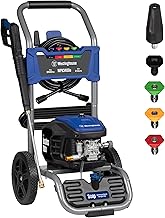
Westinghouse WPX3400e Electric
The brushless motor and 2.0 GPM flow make this the most capable electric option here for back-to-back vehicles, and the onboard soap tank keeps the setup tidy on a client’s driveway. Dial the pressure down for paint and save the full output for wheel wells, engine bays, and the concrete afterward.
Westinghouse WPX3400 Gas
At 2.6 GPM this is the rinse-and-go choice when you are working properties without reliable power, and the extra flow noticeably shortens the time spent chasing soap off panels. Accept the noise and maintenance tradeoff, and keep a downstream injector or foam cannon on hand since gas units run hotter and faster than most detailing work requires.
Sun Joe SPX3000
A long-running favorite for good reason: two detergent tanks let you stage wheel cleaner and body soap separately, and the compact upright frame slides into a van without eating a shelf. Flow is modest, so plan on slightly longer rinse passes than a 2.0 GPM machine.
Active 2.0 Electric
Purpose-built for the detailing crowd, pairing a sensible 1800 peak PSI with a full 2.0 GPM, which is exactly the ratio that cleans paint safely without dragging out the job. The compact chassis and detailing-oriented accessory ecosystem make it the easiest recommendation for someone building a mobile kit from scratch.
CRAFTSMAN CMEPW1700
The lightest, simplest option on this list, and a smart pick for apartment-based detailers or anyone who needs a machine one person can carry up a step with a bucket in the other hand. At 1.2 GPM it is best suited to cars and single-vehicle appointments rather than trucks or long driveway sessions.
Frequently Asked Questions
How much PSI is safe for car paint?
Stay between roughly 1200 and 1900 PSI at the nozzle, use a 40-degree tip, and hold the wand about a foot from the surface. Damage usually comes from tip choice and distance, not from the machine’s rating.
Do I need a gas model for mobile work?
Only if you regularly work sites without power. Electric units cover the majority of residential and commercial detailing, and their lower noise is an asset in neighborhoods with early morning appointments.
Can I run these from a water tank instead of a spigot?
Not directly. Most consumer pumps need pressurized feed water, so tank-fed setups require a separate supply pump. Check the manufacturer’s inlet specification before improvising.
Is a foam cannon better than an onboard soap tank?
For paint, yes. Onboard tanks are excellent for driveways, siding, and patio furniture, while a cannon produces the clinging foam that loosens grit before your mitt touches the panel.
Final Thoughts
For most mobile detailers, the Active 2.0 hits the ideal balance of gentle pressure and real rinsing flow in a package that travels well. Step up to the Westinghouse WPX3400e when you want more headroom for wheels and hard surfaces without giving up electric convenience, and choose the gas WPX3400 only when your work regularly takes you beyond the reach of an outlet.