Key takeaways
- Match the PSI with headroom: Choose a hose rated above your machine’s maximum output, not equal to it. A 3,100 PSI hose on a 3,100 PSI washer leaves nothing in reserve for pressure spikes when you release the trigger.
- Get the diameter right: Most electric and light gas units use 1/4 inch. Anything above roughly 3,000 PSI or 3 GPM wants 3/8 inch to avoid restricting flow and starving the wand.
- Check the fittings before you buy: M22 threaded connections come in 14mm and 15mm inner diameters, and they are not interchangeable. Quick-connect plugs are faster but require matching sockets on both the pump and the gun.
- Think about the jacket, not just the core: Polyurethane and hybrid polymer jackets stay pliable in cold weather and are far less likely to leave black scuff marks on pale pavers, siding, and painted decking than standard rubber.
- Buy length you will actually manage: Fifty feet handles most driveways and two-story rinses. One hundred feet is a genuine advantage on long runs and acreage, but it is heavier to drag and slower to coil.
What's inside
The hose is the part of a pressure washer nobody thinks about until it ruins an afternoon. You have staged the patio furniture on the lawn, mixed the detergent, dialed in the right nozzle, and then the line coils back on itself behind you like a garden snake with a grudge. Every ten feet you stop, walk back, and wrestle a kink out of vinyl that has gone stiff in the cold. Meanwhile the factory hose that shipped in the box is usually 20 or 25 feet of the cheapest material the manufacturer could justify, which means you spend the job dragging the machine instead of the wand.
This guide looks at replacement and extension hoses through the lens of the work they actually do around a well-kept house: rinsing teak and powder-coated aluminum without scarring the stone underneath, reaching a second-story soffit from a spigot at ground level, and coiling flat into a garage cabinet when the season ends. We compare six current options across pressure rating, inner diameter, fitting type, and jacket material, and flag which ones suit a light electric unit versus a gas machine that can push 4,000 PSI. Every pick below is chosen for real-world handling, not spec-sheet bravado.
As an Amazon Associate we earn from qualifying purchases.


How to Choose a Pressure Washer Hose (2026)
- Match the PSI with headroom: Choose a hose rated above your machine’s maximum output, not equal to it. A 3,100 PSI hose on a 3,100 PSI washer leaves nothing in reserve for pressure spikes when you release the trigger.
- Get the diameter right: Most electric and light gas units use 1/4 inch. Anything above roughly 3,000 PSI or 3 GPM wants 3/8 inch to avoid restricting flow and starving the wand.
- Check the fittings before you buy: M22 threaded connections come in 14mm and 15mm inner diameters, and they are not interchangeable. Quick-connect plugs are faster but require matching sockets on both the pump and the gun.
- Think about the jacket, not just the core: Polyurethane and hybrid polymer jackets stay pliable in cold weather and are far less likely to leave black scuff marks on pale pavers, siding, and painted decking than standard rubber.
- Buy length you will actually manage: Fifty feet handles most driveways and two-story rinses. One hundred feet is a genuine advantage on long runs and acreage, but it is heavier to drag and slower to coil.
The Best Pressure Washer Hoses (2026) Reviewed
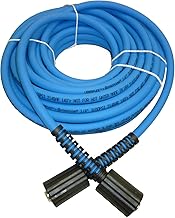
UBERFLEX Kink Resistant Hose, 1/4″ x 50 ft
This is the one to buy if kinking is the specific thing driving you up the wall. The hybrid polymer construction is genuinely limp in the hand, it stays that way in cool weather, and the two included 22MM fittings mean most owners can swap it in without a trip to the hardware store. Made in the USA, and it feels like it.
YAMATIC 3/8″ Hose, 4000 PSI x 50 ft
The pick for gas machines and pro-adjacent work. Steel-braided rubber handles water from 15°F to 212°F, so hot-water setups and freezing morning starts are both fair game, and the 360-degree swivel quick connect stops the hose from twisting itself into knots as you move around a structure.
Flexzilla Replacement Hose, 1/4″ x 50 ft
Flexzilla built its reputation on hoses that lie flat, and this pressure washer version delivers the same easy handling in a lightweight package with M22 fittings. The ZillaGreen jacket is unmistakable in a cluttered garage, which is a small thing until you have three coiled hoses on the same hook.
Simpson Monster 3/8″ x 100 ft, 4500 PSI
Serious equipment for large properties. Dual-braided steel over polyester gives it a 4,500 PSI ceiling, and the non-marring polyurethane jacket plus 4-inch bend protectors mean you can drag 100 feet across finished surfaces without leaving a trail of gray streaks behind you.
YAMATIC 1/4″ Hose, 3200 PSI, M22-14mm
The straightforward direct replacement for popular consumer units from Ryobi, Greenworks, Troy-Bilt, and Craftsman. Solid brass fittings resist the cross-threading and stripping that kills cheaper hoses, and 3,200 PSI covers virtually every electric washer sold today.
Frequently Asked Questions
Can I connect two pressure washer hoses together?
Yes, with a coupler that matches your fittings, though every joint is a potential leak point and you will lose a small amount of pressure. Two 50-foot hoses joined is fine; four is asking for trouble.
Will a longer hose reduce my pressure?
Slightly. Friction loss over 100 feet is real but modest at correct diameter. If you notice a meaningful drop, the culprit is usually a hose that is too narrow for your machine’s flow rate rather than the length itself.
Do I need M22-14mm or M22-15mm?
Check the inner diameter of the existing fitting on your pump. Most consumer electric washers use 14mm; many gas units use 15mm. The threads look identical, so measure rather than guess.
How should I store a pressure washer hose?
Drain it fully, coil it loosely in wide loops rather than tight figure-eights, and keep it out of direct sun and freezing temperatures. Water left inside over winter can split even a well-built hose.
Final Thoughts
For most homeowners with an electric washer, the UBERFLEX 50-foot hose is the upgrade that makes the machine feel new again, with the Flexzilla a close alternative if you want the same flat-lying behavior in a lighter package. If you are running a gas unit or covering real acreage, step up to the YAMATIC 3/8-inch 4000 PSI hose or the Simpson Monster at 100 feet and stop dragging the washer around behind you.