Key takeaways
- Match diameter to your machine: Most electric washers under 3,000 PSI use 1/4-inch hose, while gas units and commercial machines expect 3/8-inch for adequate flow. Oversizing a small washer adds weight without gaining performance.
- Buy above your pressure rating: Choose a hose rated at least 20 percent higher than your washer’s maximum PSI. A 3,100 PSI hose on a 3,000 PSI machine leaves almost no margin for pressure spikes at the trigger.
- Check the fittings, not just the hose: Solid brass M22 couplers with a 14mm or 15mm inner diameter are the detail that determines compatibility. Confirm which your washer uses, and favor swivel quick-connects if you work around corners and planting beds.
- Prioritize cold flexibility: Hybrid polymer and steel-braided rubber stay pliable in early spring; cheap PVC turns into a coiled spring. If you wash in shoulder seasons, flexibility matters more than raw pressure rating.
- Be honest about length: Fifty feet handles most townhouses and single-story facades. Reach for 100 feet only if you have a long drive, a third story, or a detached structure — extra length costs you flow and adds drag.
What's inside
Every well-kept exterior has an unglamorous dependency: the hose that connects a pressure washer to the surface you’re trying to preserve. Homeowners obsess over the machine’s PSI rating and then hand the job to a stiff, coiled length of vinyl that fights back at every step, whips a garden bed, or leaves a black scuff mark across the bluestone patio you spent a season sourcing. Worse, the failure points are predictable — brittle plastic collars, hose memory that refuses to lie flat, and rubber that stiffens the moment the temperature drops below comfortable.
This guide takes the hose seriously as a piece of equipment rather than an accessory. Below are six replacement and extension hoses worth putting on a well-run property, spanning compact 1/4-inch lines for consumer electric washers to 3/8-inch steel-braided runs built for gas machines and long driveways. We look at kink behavior, fitting quality, working pressure, cold-weather flexibility, and how each hose treats the surfaces it drags across.
As an Amazon Associate we earn from qualifying purchases.


How to Choose a Pressure Washer Hose (2026)
- Match diameter to your machine: Most electric washers under 3,000 PSI use 1/4-inch hose, while gas units and commercial machines expect 3/8-inch for adequate flow. Oversizing a small washer adds weight without gaining performance.
- Buy above your pressure rating: Choose a hose rated at least 20 percent higher than your washer’s maximum PSI. A 3,100 PSI hose on a 3,000 PSI machine leaves almost no margin for pressure spikes at the trigger.
- Check the fittings, not just the hose: Solid brass M22 couplers with a 14mm or 15mm inner diameter are the detail that determines compatibility. Confirm which your washer uses, and favor swivel quick-connects if you work around corners and planting beds.
- Prioritize cold flexibility: Hybrid polymer and steel-braided rubber stay pliable in early spring; cheap PVC turns into a coiled spring. If you wash in shoulder seasons, flexibility matters more than raw pressure rating.
- Be honest about length: Fifty feet handles most townhouses and single-story facades. Reach for 100 feet only if you have a long drive, a third story, or a detached structure — extra length costs you flow and adds drag.
The Best Pressure Washer Hoses (2026) Reviewed
UBERFLEX Kink Resistant Hose, 1/4″ x 50 ft.
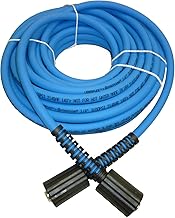
This is the one to buy if kink resistance is your primary complaint, with a flexible jacket that lies flat straight out of the box and genuinely resists memory after storage. Made in the USA with two 22mm fittings included, it’s the most refined-feeling 1/4-inch hose here and the easiest to route around furniture and containers.
YAMATIC 3/8″ Hose, 4,000 PSI, 50 ft.
A serious steel-braided rubber hose for gas washers, rated from 15°F to 212°F, which makes it viable for both cold mornings and hot-water units. The 360-degree swivel quick connect is the standout feature — it eliminates the torque that normally twists a hose into a knot mid-job.
Flexzilla Replacement Hose, 1/4″ x 50 ft., 3,100 PSI
Flexzilla’s hybrid polymer construction stays supple in the cold and weighs noticeably less than rubber, so it’s the friendliest option for extended detail work on siding or fencing. M22 fittings and the recognizable ZillaGreen jacket also make it easy to spot against a lawn or gravel drive.
YAMATIC 1/4″ Hose, 3,200 PSI, M22-14mm
The pragmatic replacement pick for Ryobi, Greenworks, Craftsman, and Troy-Bilt electric washers, with solid brass fittings that outlast the plastic couplers most machines ship with. At 3,200 PSI it carries a sensible safety margin over typical consumer output.
100 ft. Steel Braid Hose, 4,200 PSI, 3/8″ QC
Commercial-grade reach for long driveways, outbuildings, and multi-story facades, with a steel braid layer that holds its shape under pressure and an included adapter set covering 3/8-inch and 1/4-inch connections. Expect real weight — this is a hose you position once and work around, not one you carry.
Frequently Asked Questions
Can I use a garden hose as a pressure washer hose?
No. A garden hose supplies water to the inlet at low pressure; the outlet hose carries thousands of PSI and requires reinforced construction. Substituting one is a genuine safety risk.
Does a longer hose reduce pressure?
Slightly. Every added length introduces friction loss, which is modest at 50 feet but noticeable at 100 feet, especially on 1/4-inch line. Stepping up to 3/8-inch diameter offsets most of it.
What does M22 mean?
M22 is a 22mm threaded coupler, the most common pressure washer connection. Confirm whether yours has a 14mm or 15mm internal orifice, since the threads match but the cores do not.
How should I store a pressure washer hose?
Drain it, coil it loosely in wide loops, and keep it out of direct sun and freezing temperatures. Tight coils and UV exposure are what create permanent kinks.
Final Thoughts
For most homes, the UBERFLEX 50-foot hose is the best all-round upgrade — flexible, well-made, and gentle on finished surfaces. Choose the Flexzilla if lightweight cold-weather handling matters most, or the YAMATIC 3/8-inch 4,000 PSI hose if you’re running a gas machine and want a swivel connection that stays out of your way.