Key takeaways
- Orifice size over PSI: A nozzle’s orifice number must match your machine’s GPM and pressure rating. Undersized and you spike pressure and stall the pump; oversized and you lose all your punch. Check your washer’s plate before buying a 4.0 orifice tip.
- Spray angle by material: Zero degrees is a pinpoint chisel for mortar stains and rust — never for surfaces. Fifteen handles concrete, 25 covers most siding and fencing, and 40 is your safe default for painted wood, stucco, and anything you’d hesitate to sand.
- Quick connect fit: A 1/4-inch quick-connect stem is the near-universal standard and lets you swap tips mid-job without tools. Confirm your wand has the matching socket, or budget for an adapter.
- Turbo tips for square footage: A rotating or oscillating nozzle spins a zero-degree stream in a cone, giving you the bite of a pencil jet across a 25-degree footprint. It’s the single biggest time saver on driveways and patios, and overkill on delicate finishes.
- Hot water and build quality: If you run a hot-water machine, verify the temperature rating — many budget tips soften well below 200°F. Stainless inserts and brass bodies hold their spray pattern far longer than zinc alloy.
What's inside
Exterior surfaces are part of your home’s design language, whether or not you think of them that way. The bluestone patio, the cedar siding, the powder-coated railing on the back steps — all of it reads as texture and tone from the moment someone pulls into the driveway. Yet most people spend a weekend blasting those surfaces with whatever nozzle came bagged with their machine, then wonder why the concrete looks striped, the deck boards feel furry, and the vinyl has a faint cloudy haze that no amount of rinsing fixes.
The nozzle is the only part of a pressure washer that actually touches your house, and it dictates everything: spray angle, impact force, coverage rate, and how gently or aggressively the water lands. This guide covers the nozzle sets and turbo tips worth owning in 2026, how to match a spray angle to a material without gambling on your siding, and the specs that genuinely matter once you get past the PSI number printed on the packaging.
As an Amazon Associate we earn from qualifying purchases.


How to Choose Pressure Washer Nozzles (2026)
- Orifice size over PSI: A nozzle’s orifice number must match your machine’s GPM and pressure rating. Undersized and you spike pressure and stall the pump; oversized and you lose all your punch. Check your washer’s plate before buying a 4.0 orifice tip.
- Spray angle by material: Zero degrees is a pinpoint chisel for mortar stains and rust — never for surfaces. Fifteen handles concrete, 25 covers most siding and fencing, and 40 is your safe default for painted wood, stucco, and anything you’d hesitate to sand.
- Quick connect fit: A 1/4-inch quick-connect stem is the near-universal standard and lets you swap tips mid-job without tools. Confirm your wand has the matching socket, or budget for an adapter.
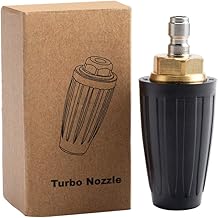
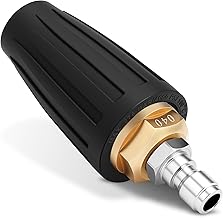
- Turbo tips for square footage: A rotating or oscillating nozzle spins a zero-degree stream in a cone, giving you the bite of a pencil jet across a 25-degree footprint. It’s the single biggest time saver on driveways and patios, and overkill on delicate finishes.
- Hot water and build quality: If you run a hot-water machine, verify the temperature rating — many budget tips soften well below 200°F. Stainless inserts and brass bodies hold their spray pattern far longer than zinc alloy.
The Best Pressure Washer Nozzles (2026) Reviewed
Tool Daily 5-Piece Nozzle Tips Set
A clean, no-drama starter kit covering 0, 15, 25, and 40 degrees plus a soap tip, rated to 4000 PSI at 2.5 GPM with color-coded stems that make angle selection obvious even when you’re wet and impatient. This is the set I’d hand to someone who owns one machine and wants to stop guessing.
Simpson 80144 Turbo Nozzle
The one to buy if you’re serious about hardscape. Rated to 4500 PSI and hot-water capable to 212°F, its oscillating jet clears large concrete spans noticeably faster than a fan tip, and the build quality is a clear step above the generic turbo crowd. Worth the premium if you clean more than a few hundred square feet a year.
Twinkle Star Nozzle Tips Set
Essentially the same 2.5 GPM, 1/4-inch spread as the category leaders at a lower entry point, and the machining on the quick-connect stems is tighter than the price suggests. A sensible second set to keep in the garage so your good tips stay in the case.
Hourleey 7-Tip Set with Holder
Seven angles instead of the usual five, and — more usefully — a wall-mount holder that ends the annual ritual of losing the 40-degree tip in the gravel. Rated to 4000 PSI on a 1/4-inch quick connect, it’s the most organized option here.
AURORA CAR Turbo Nozzle
A 360-degree rotating tip with a 4.0 orifice built for 4.0 GPM machines, aimed squarely at brick, concrete, and vinyl. It delivers most of the speed advantage of a premium turbo at a fraction of the cost, though expect a shorter service life under heavy weekly use.
Frequently Asked Questions
Which nozzle is safe for vinyl siding?
Start with 40 degrees and keep the tip 12 to 18 inches off the surface, working in overlapping horizontal passes. Move to 25 degrees only for stubborn mildew, and never aim upward into the seams.
Do I need a turbo nozzle if I already have a 15-degree tip?
Only if you clean large flat areas. A turbo covers ground roughly 40 to 50 percent faster on concrete, but it’s too aggressive for wood, paint, and most siding.
What does the orifice number mean?
It’s a flow rating tied to your machine’s GPM and pressure, not the spray angle. A 4.0 orifice suits a 4.0 GPM washer; installing it on a 2.5 GPM unit will noticeably soften your stream.
How often should nozzles be replaced?
When the pattern starts to fray or your machine’s pressure gauge climbs without a change in setup, the orifice has worn. For homeowner use, that’s typically every two to three seasons.
Final Thoughts
For most homes, the Tool Daily five-piece set covers every surface you’ll realistically encounter and costs less than one professional wash. Add the Simpson 80144 if you have real hardscape to maintain — it’s the most durable turbo here and the fastest way through a stained driveway. The Hourleey seven-tip kit with its holder is the pick if you’d rather solve the storage problem once and never hunt for a tip again.