Key takeaways
- Fence quality over motor size: Nearly every saw in this range runs a 15-amp motor, so power is rarely the differentiator. The rack-and-pinion or rail-guided fence is what separates a saw that stays square from one you fight all afternoon.
- Rip capacity vs. your material: A 32-inch rip capacity lets you break down a full sheet of plywood on-center; a 24-inch capacity means you’ll pre-cut sheets with a track saw first. Decide which workflow you’re actually going to use.
- Blade diameter and depth of cut: Ten-inch blades clear roughly 3-1/8 inches at 90 degrees, enough for stacked stock and thick slabs. An 8-1/4-inch blade trims that down but cuts weight and cost meaningfully.
- Stand design: A rolling stand matters more than most buyers expect. If your shop is a shared garage, a folding cart that wheels out and locks flat determines whether the saw gets used or stays in a corner.
- Safety and dust hardware: Look for a riving knife rather than just a splitter, plus a proper dust port. Included push sticks and blade guards are baseline, not bonuses.
What's inside
Anyone who has tried to build a floating shelf, a slab bench, or a run of built-in cabinetry knows the moment where the project stalls: you need forty identical rip cuts and a circular saw isn’t going to get you there. A table saw is the piece of equipment that turns rough lumber into furniture-grade parts, and it’s also the tool most people put off buying because the price spread is baffling. Two saws with identical 15-amp motors and 10-inch blades can sit hundreds of dollars apart, and the spec sheets rarely explain why.
This guide sorts that out. We’ve focused on the saws that deliver the most usable capability per dollar in 2026, from budget jobsite models that handle plywood carcasses and pine shelving to contractor-grade machines with fence systems accurate enough for hardwood joinery. Below you’ll find what actually drives price, followed by honest notes on each pick so you can spend where it matters and skip what doesn’t.
As an Amazon Associate we earn from qualifying purchases.



How to Choose the Best Price For Table Saw (2026)
- Fence quality over motor size: Nearly every saw in this range runs a 15-amp motor, so power is rarely the differentiator. The rack-and-pinion or rail-guided fence is what separates a saw that stays square from one you fight all afternoon.
- Rip capacity vs. your material: A 32-inch rip capacity lets you break down a full sheet of plywood on-center; a 24-inch capacity means you’ll pre-cut sheets with a track saw first. Decide which workflow you’re actually going to use.
- Blade diameter and depth of cut: Ten-inch blades clear roughly 3-1/8 inches at 90 degrees, enough for stacked stock and thick slabs. An 8-1/4-inch blade trims that down but cuts weight and cost meaningfully.
- Stand design: A rolling stand matters more than most buyers expect. If your shop is a shared garage, a folding cart that wheels out and locks flat determines whether the saw gets used or stays in a corner.
- Safety and dust hardware: Look for a riving knife rather than just a splitter, plus a proper dust port. Included push sticks and blade guards are baseline, not bonuses.
The Best Price For Table Saw (2026) Picks Reviewed
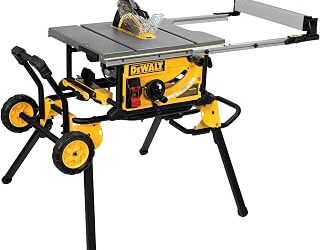
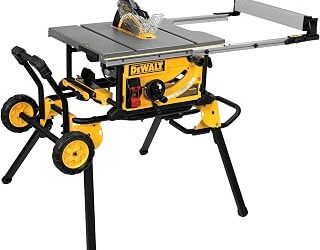
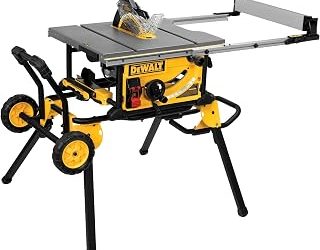
DEWALT DWE7491RS 10-Inch with Rolling Stand
This is the benchmark for anyone building furniture rather than framing walls: 32-1/2 inches of rip capacity, a rack-and-pinion fence that returns to the same reading repeatedly, and 4,800 RPM through a 10-inch blade for clean crosscuts in hardwood. The foldable rolling stand is genuinely one-handed, which makes it the practical choice for a garage shop that has to be reclaimed for a car each night.
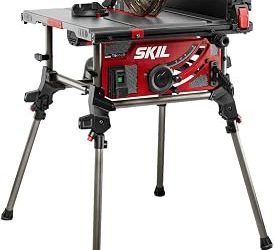
SKIL TS6307-00 15 Amp Portable Jobsite Saw
SKIL undercuts the DEWALT considerably while keeping the features that affect cut quality, including a rack-and-pinion fence and a worm-drive-style feel under load. The folding stand is less refined and the dust collection is average, but for cabinet parts and shelving it delivers most of the accuracy at a noticeably lower entry point.
DEWALT DWE7485 8-1/4-Inch Compact Saw
The compact DEWALT trades blade diameter and rip capacity for a footprint you can lift onto a bench alone, and it keeps the same fence engineering that makes its bigger sibling trustworthy. Choose it if you work mostly in 3/4-inch sheet goods and dimensional lumber, or if storage space is the real constraint in your shop.
10-Inch 15A 5000 RPM Portable Saw with Angle Stop
A sensible first table saw: 5,000 RPM, a full 0-45 degree bevel range, and cutting depth from 2-9/16 to 3-11/32 inches, which covers thick slabs and stacked stock. The included angle stop and push stick mean you can make accurate, safe cuts on day one without an accessory order.
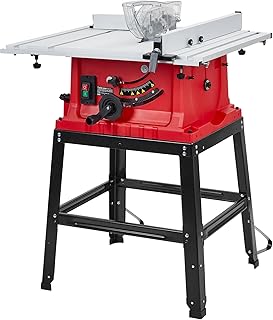
10-Inch 15 Amp Saw with 36 x 25-Inch Tabletop
The oversized 36 by 25-inch table is the standout here, giving longer boards real support before and after the blade instead of the tipping you get on small-deck saws. Combined with adjustable depth, a protective cover, and clean handling in plastics and non-ferrous metal, it’s a strong value for mixed-material projects.
Frequently Asked Questions
Is a 10-inch saw worth the extra cost over 8-1/4-inch?
If you cut hardwood thicker than an inch, work with slabs, or want wider dado and bevel range, yes. For plywood casework and trim, an 8-1/4-inch saw is fully adequate and easier to move.
Do I need to upgrade the blade immediately?
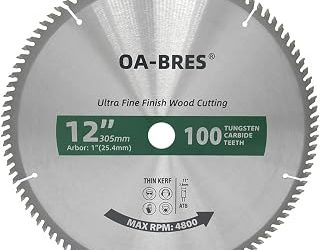
Usually. Stock blades are typically 24-tooth general-purpose combination blades. A 40- to 60-tooth blade transforms cut quality in plywood and veneered panels for a modest outlay.
Can these saws run on a standard household circuit?
Yes. Every saw here draws 15 amps on 120 volts. Give it a dedicated circuit where possible and avoid long, thin extension cords, which cause voltage drop and motor strain.
How much should I budget for dust control?
Plan for a shop vacuum with a hose adapter at minimum. Jobsite saws vent a fair amount of fine dust regardless of the port, so a decent vacuum plus a shop-air filter is money well spent.
Final Thoughts
If accuracy and long-term use are the priority, the DEWALT DWE7491RS with its rolling stand remains the most complete package at its price and the one worth stretching for. The SKIL TS6307-00 is the smarter buy for anyone who wants a capable rack-and-pinion fence without the premium, and the compact DEWALT DWE7485 is the pick when shop space, not capacity, is the real limiting factor.