Key takeaways
- Match the tool, not the tank: Brad and finish nailers sip air, so 2.0–2.6 SCFM at 90 PSI is ample. Only spray guns, sanders, and impact wrenches justify a larger tank and higher airflow.
- Watch the noise number: Anything above 80 dBA is genuinely unpleasant indoors. Ultra-quiet models in the 60 dBA range let you work in a finished room, talk over the motor, and stay on speaking terms with neighbors.
- Insist on oil-free: Oil-free pumps skip the drain-and-refill ritual, won’t mist residue near a freshly primed wall, and start reliably in a cold garage. For home use the maintenance savings outweigh the modest lifespan tradeoff.
- Think about where it lives: Weight, handle geometry, and wheels decide whether a compressor gets used or resented. Pancake tanks stack neatly on shelving; vertical hot-dog styles claim less floor.
- Separate inflation from nailing: A cordless 12V or battery inflator handles tires, mattresses, and sports gear far more conveniently than dragging out a tank compressor. Many households are best served by owning both.
What's inside
Air compressors have a reputation problem in design-forward homes. They read as garage equipment: loud, oily, industrial. Yet the moment you start doing your own work — pinning up picture rail, laying a herringbone floor, refinishing a mid-century dresser, keeping tires honest on the school run — a compressor becomes the quiet engine behind projects that would otherwise sit half-finished. The trouble is that most buying advice is written for contractors framing houses, not for someone who wants to nail trim on a Saturday without waking the baby or filling a finished basement with fumes.
This guide narrows the field to compressors that genuinely suit domestic life: small tanks that fit under a stair, oil-free pumps you never have to service, decibel levels that stay conversational, and cordless inflators compact enough to live in a hall closet or a trunk. Below you’ll find picks for two distinct jobs — brad nailers and finish work on one side, tire and inflatable duty on the other — plus the specs worth reading and the ones worth ignoring.
As an Amazon Associate we earn from qualifying purchases.


How to Choose an Air Compressor for Home Use (2026)
- Match the tool, not the tank: Brad and finish nailers sip air, so 2.0–2.6 SCFM at 90 PSI is ample. Only spray guns, sanders, and impact wrenches justify a larger tank and higher airflow.
- Watch the noise number: Anything above 80 dBA is genuinely unpleasant indoors. Ultra-quiet models in the 60 dBA range let you work in a finished room, talk over the motor, and stay on speaking terms with neighbors.
- Insist on oil-free: Oil-free pumps skip the drain-and-refill ritual, won’t mist residue near a freshly primed wall, and start reliably in a cold garage. For home use the maintenance savings outweigh the modest lifespan tradeoff.
- Think about where it lives: Weight, handle geometry, and wheels decide whether a compressor gets used or resented. Pancake tanks stack neatly on shelving; vertical hot-dog styles claim less floor.
- Separate inflation from nailing: A cordless 12V or battery inflator handles tires, mattresses, and sports gear far more conveniently than dragging out a tank compressor. Many households are best served by owning both.
The Best Air Compressors for Home Use, Reviewed
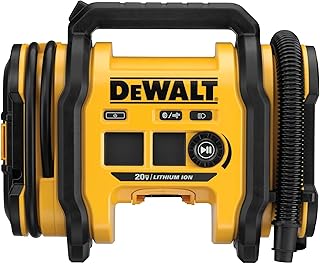
DEWALT 20V MAX Tire Inflator (DCC020IB)
If you already own DEWALT batteries, this is the easiest recommendation in the category — automatic shut-off at your target pressure means you set it and step away, and the LED light makes roadside work at dusk survivable. Sold as a bare tool, so factor in a battery if you’re starting fresh.
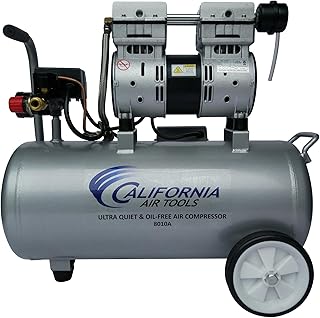
California Air Tools 8010A
At roughly 60 dBA, this 8-gallon aluminum-tank unit is the one to buy if your workspace shares walls with living space; it hums rather than shrieks. The aluminum tank resists rust and keeps the whole thing wheelable by one person.
DEWALT 6-Gallon Pancake (DWFP55126)
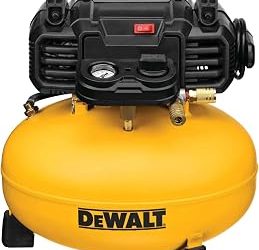
The default choice for trim, crown molding, and light roofing, with 165 max PSI giving you a longer usable run between motor cycles. High-flow couplers help it recover fast when two nailers are running.
BOSTITCH 6-Gallon Kit (BTFP02012-WPK)
A sensible starting point for first-time buyers because the accessory kit means you’re not ordering hoses and fittings separately. Lighter and noticeably tamer than legacy pancakes, and the oil-free pump asks nothing of you.
AstroAI Dual-Power Portable Inflator
The 12V DC/120V AC switch is the standout detail — plug into the car for tires, into a wall outlet for air mattresses and pool floats. Dual metal motors keep it from heat-soaking partway through a full inflation.
Frequently Asked Questions
Is 6 gallons enough for home projects?
For nailers, staplers, blowguns, and inflation, yes — comfortably. You’d want more capacity only for continuous-demand tools like sanders or full-panel spray finishing.
Can I run a compressor indoors?
An oil-free, ultra-quiet model like the California Air Tools 8010A is designed for it. Keep it on a rubber mat to kill vibration transfer through floors, and give it clear air around the intake.
Do I need a tank compressor just for tires?
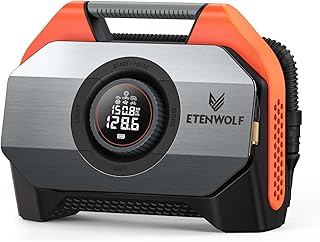
No. A cordless unit — the DEWALT DCC020IB or the high-capacity ETENWOLF VORTEX S6 — does the job faster and stores in a fraction of the space.
How much maintenance is involved?
With oil-free pumps: drain the tank’s moisture valve after each session and keep the intake filter clean. That’s the entire routine.
Final Thoughts
For finish carpentry in a home you actually live in, the California Air Tools 8010A wins on noise alone, with the DEWALT DWFP55126 pancake as the more portable, higher-pressure alternative. Pair either with the DEWALT DCC020IB for tires and inflatables, and you’ve covered essentially every air-powered job a house will throw at you.