Key takeaways
- Drawer glides: Ball-bearing slides are the dividing line between a chest you enjoy and one you fight. Look for stated per-drawer load ratings — anything under 40 lbs suggests friction slides that will sag once loaded with sockets and wrenches.
- Caster quality and locking: Two locking casters is the minimum; four is better if your floor slopes. Larger diameter wheels roll over cords, thresholds, and expansion joints without stalling. Soft rubber or TPR compounds stay quiet and won’t mark epoxy.
- Footprint versus capacity: Measure your doorway, your aisle, and the arc a drawer needs to fully extend. A 26-inch cabinet that can’t open its top drawer in a tight bay is worse than a 20-inch one that can.
- Modular or monolithic: Stacking systems like TSTAK and VERSASTACK reconfigure and travel; welded steel cabinets hold more and stay put. Decide whether your tools need to leave the building before you commit.
- Security and liners: A single central lock protects a bank of drawers in one motion. Foam or rubber liners stop the rattle, protect finishes, and keep precision tools from wandering during a roll.
What's inside
Tool storage occupies an awkward position in the modern home. It has to earn its footprint in a garage that doubles as a gym, a mudroom that doubles as a laundry, or a basement workshop that shares a wall with the guest room. The result is a familiar frustration: buyers shop for a rolling tool chest expecting a workhorse, then discover the drawers bind under load, the casters chatter across sealed concrete, or the whole cabinet is six inches too deep to clear a door frame. Price tags rarely signal which of these problems you’re buying into.
This guide looks at rolling tool chests through a practical lens — drawer mechanics, caster quality, footprint, and whether the finish still looks intentional two years in. We’ve grouped picks across the range, from modular stacking systems that move between the truck and the bench to full seven- and eight-drawer cabinets built to park permanently. Each recommendation below is chosen for value: solid engineering at a price that makes sense for a home shop rather than a commercial bay.
As an Amazon Associate we earn from qualifying purchases.




How to Choose a Rolling Tool Chest For The Money (2026)
- Drawer glides: Ball-bearing slides are the dividing line between a chest you enjoy and one you fight. Look for stated per-drawer load ratings — anything under 40 lbs suggests friction slides that will sag once loaded with sockets and wrenches.
- Caster quality and locking: Two locking casters is the minimum; four is better if your floor slopes. Larger diameter wheels roll over cords, thresholds, and expansion joints without stalling. Soft rubber or TPR compounds stay quiet and won’t mark epoxy.
- Footprint versus capacity: Measure your doorway, your aisle, and the arc a drawer needs to fully extend. A 26-inch cabinet that can’t open its top drawer in a tight bay is worse than a 20-inch one that can.
- Modular or monolithic: Stacking systems like TSTAK and VERSASTACK reconfigure and travel; welded steel cabinets hold more and stay put. Decide whether your tools need to leave the building before you commit.
- Security and liners: A single central lock protects a bank of drawers in one motion. Foam or rubber liners stop the rattle, protect finishes, and keep precision tools from wandering during a roll.
The Best Rolling Tool Chest For The Money (2026)s Reviewed
8-Drawer Rolling Tool Chest with Detachable Top Box
The detachable top box is the smart move here — you get carry-anywhere access for a working kit plus a stationary base for the rest of the collection, all arriving assembled. Eight drawers with liners, a tray divider, and side hooks make this the most organized option in its price band, though the shallow upper drawers suit hand tools better than power tools.
CRAFTSMAN VERSASTACK 30-Gallon Rolling Chest (CMST17870)
A genuinely well-resolved piece of industrial design: the quick-access lid opens without unstacking whatever sits on top, and 30 gallons swallows an impressive amount of gear. The best pick for anyone already running VERSASTACK boxes, or anyone who values bulk volume over drawer-by-drawer sorting.
DEWALT TSTAK Rolling Tool Box (DWST17820)
The telescopic handle and deep carrier body make this the most travel-ready option in the roundup — it handles gravel driveways and job-site steps better than any caster-only cabinet. TSTAK compatibility means it grows with you, and the clean yellow-on-black reads as tidy rather than cluttered in a visible garage.
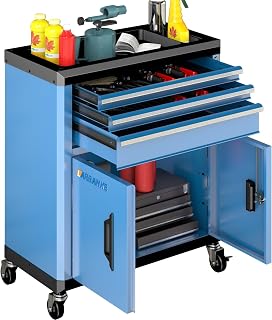
LARBANKE 3-Drawer Rolling Cabinet with Doors
The three-drawer, two-door layout is underrated: cabinet space handles the awkward stuff that never fits in a drawer, from cordless kits to spray cans. Lockable, lined, on 360° casters, and fitted with connecting rods so it stacks cleanly with LARBANKE’s 5- and 7-drawer chests when the collection expands.
7-Drawer Heavy-Duty Rolling Tool Cabinet
This is the mechanic’s-cart archetype done properly — seven drawers, a locking bank, and a chassis rigid enough to take a real load without racking. The matte black finish keeps it visually calm in a garage that’s also a living space, and it’s the pick for a permanent bench-side home.
Frequently Asked Questions
How much weight can a home-grade rolling tool chest hold?
Most cabinets in this range handle 300–600 lbs total, with individual drawers rated between 40 and 100 lbs. Distribute heavy items low to keep the center of gravity down, especially on a chest you plan to move often.
Will the casters damage my garage floor?
Rubber and TPR casters are safe on epoxy, sealed concrete, and tile. Hard nylon wheels can leave marks under sustained load — if your floor is finished, check the wheel material before buying, or budget for replacement casters.
Do I need a locking chest?
If children, tenants, or shared access are part of your situation, yes. A central locking bar is worth prioritizing; it secures every drawer at once rather than requiring you to remember which ones matter.
Are modular stacking systems worth the premium?
Only if your tools travel. For a fixed workshop, a welded steel cabinet gives you more storage per dollar. For anyone splitting time between home projects and off-site work, modularity pays for itself quickly.
Final Thoughts
For most home shops, the 8-Drawer Rolling Tool Chest with detachable top box offers the best balance of organization and value, arriving assembled and ready to load. Choose the CRAFTSMAN VERSASTACK 30-Gallon if you want maximum capacity with minimum fuss, or the DEWALT TSTAK DWST17820 if your tools need to leave the garage as often as they stay in it.