Key takeaways
- Handrail geometry: A rail should rise well above the top step so the hand grips at chest or shoulder height, not at the knees. Look for a continuous loop or tall vertical post rather than a token side bar, and check that the grip diameter suits arthritic hands.
- Pedal depth and texture: Depth matters more than step count. Aim for pedals wide enough to hold the whole foot, with raised anti-slip texturing rather than a smooth painted surface that turns treacherous in socks or slick-soled slippers.
- Locking mechanism: Prioritize a positive safe-lock or spreader brace that clicks audibly into place. One-handed opening is a real advantage for anyone bracing against a counter while unfolding.
- Weight capacity versus actual weight: A 330 lb rating is ample for most users, and higher ratings buy stability rather than strength. Balance that against the ladder’s own mass; anything past roughly 15 lb becomes a reason to leave it standing where it shouldn’t be.
- Footprint and finish: A ladder stored in plain sight gets used safely. Slim folding profiles, matte black frames, and warm wood-tone treads read as furniture rather than tools, which keeps them out of basements and within reach.
What's inside
Aging in place rarely fails on the big renovations. It fails on the small, daily reaches: the vase on the top shelf, the smoke detector battery, the seasonal linens tucked above the closet rod. Most households solve this with whatever is nearest, a dining chair or a wobbly two-step relic from a previous decade, and that improvisation is where falls happen. For older adults, the margin between a confident step up and a lost balance point is measured in inches of tread depth and the presence of something solid to hold.
This guide looks at step ladders through the lens of how they actually live in a home: what they feel like underfoot, whether the handrail lands where a hand naturally reaches, how much they weigh when carried down a hallway, and whether they can sit in a pantry or entry without looking like shop equipment. Below are the models worth considering in 2026, followed by the criteria that separate a genuinely safe ladder from one that simply passes a load test.
As an Amazon Associate we earn from qualifying purchases.




How to Choose a Step Ladder For Elderly (2026)
- Handrail geometry: A rail should rise well above the top step so the hand grips at chest or shoulder height, not at the knees. Look for a continuous loop or tall vertical post rather than a token side bar, and check that the grip diameter suits arthritic hands.
- Pedal depth and texture: Depth matters more than step count. Aim for pedals wide enough to hold the whole foot, with raised anti-slip texturing rather than a smooth painted surface that turns treacherous in socks or slick-soled slippers.
- Locking mechanism: Prioritize a positive safe-lock or spreader brace that clicks audibly into place. One-handed opening is a real advantage for anyone bracing against a counter while unfolding.
- Weight capacity versus actual weight: A 330 lb rating is ample for most users, and higher ratings buy stability rather than strength. Balance that against the ladder’s own mass; anything past roughly 15 lb becomes a reason to leave it standing where it shouldn’t be.
- Footprint and finish: A ladder stored in plain sight gets used safely. Slim folding profiles, matte black frames, and warm wood-tone treads read as furniture rather than tools, which keeps them out of basements and within reach.
The Best Step Ladder For Elderly (2026)s Reviewed
HBTower Folding Step Stool with Handrail
The most quietly practical option here: a compact steel two-step with a proper handrail and generously wide anti-slip pedals, light enough to carry one-handed between rooms. Ideal for kitchen cabinets and closet shelves where full ladder height is overkill.
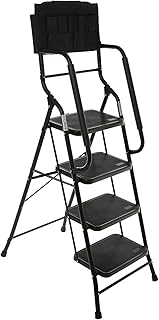
HBTower 4 Step Ladder with Handrails
A taller sibling with dual handrails and an attachable tool bag, finished in matte black that disappears against a pantry wall. The four-step height covers most upper-cabinet and light-fixture work without forcing a stretch at the top.
HillhutApex Aluminum 3 Step Ladder (Walnut)
The design-forward pick, pairing an aluminum frame with walnut-toned treads that let it stand openly in a hallway or study. At 330 lb capacity with a firm handgrip and textured pedals, it earns its place aesthetically without trading away stability.
WiberWi 4 Step Ladder, 500 lb Capacity
The steel frame and 500 lb rating give this one a planted, immovable feel that reassures nervous users more than any spec sheet does. Wide non-slip pedals and twin handrails make it a strong choice for taller reaches and larger-framed adults.
Heavy Duty Step Stool with Handle
A single-step design built around a tall grab handle, holding 350 lb and standing barely taller than a footstool. Best for users who need a modest boost with maximum support, or as a second stool kept permanently in the kitchen.
Frequently Asked Questions
How many steps are safest for an older adult?
Two to four. Beyond four steps, the top platform sits high enough that a handrail no longer supports the upper body, and the balance demand rises sharply.
Is steel or aluminum better?
Steel feels more planted and typically carries higher ratings; aluminum is easier to lift and reposition. Choose steel for a stool that stays put, aluminum for one that travels between floors.
Can these be used on carpet?
Yes, but check that all feet compress evenly and the frame does not rock. Low-pile carpet is fine; thick plush can hide an uneven set and is worth avoiding.
What capacity should I look for?
Roughly 300 lb minimum. Higher ratings such as 500 or 800 lb translate mainly into a stiffer, less flexible frame, which is genuinely reassuring underfoot.
Final Thoughts
For most homes, the HBTower 4 Step Ladder with Handrails hits the right balance of reach, grip, and storability. Choose the HillhutApex Aluminum 3 Step in walnut if the ladder needs to live in a visible room, or the WiberWi 4 Step for the most planted, confidence-inspiring platform of the group.