Key takeaways
- Read capacity per shelf, not per unit: A “5000 lb” rating is the total across five decks, which is 1000 lb each at best and usually assumes evenly distributed weight. Match the per-shelf number to your heaviest single item, then add margin.
- Depth drives what fits: 16 to 20 inches suits paint, hardware, and small totes. 24 inches swallows standard storage bins, coolers, and power tool cases without overhang. Deeper units eat aisle space, so measure your walkway before you commit.
- Boltless beats bolted for most people: Rivet and keyhole systems assemble with a rubber mallet in under an hour and let you move shelf heights later. Bolted frames are marginally more rigid but punish you on both assembly and reconfiguration.
- Choose the deck material for your climate: Powder-coated steel and MDF handle dry garages fine. If your space floods, sweats, or sits near salt air, plastic resin shelving won’t rust or delaminate.
- Plan for anchoring and clearance: Tall units carrying top-heavy loads should be strapped to a stud. Leave two inches behind the frame for baseboard trim, conduit, and outlet access.
What's inside
A garage is the only room in the house where we tolerate chaos, and it shows. Bikes lean on paint cans, seasonal bins stack four high until nobody can reach the bottom one, and the workbench slowly disappears under whatever came home last weekend. The floor is the problem. Every square foot of concrete you use for storage is a square foot you can’t walk through, and horizontal sprawl has no ceiling on how bad it gets. Vertical storage is the fix, but the shelving aisle is a mess of vague load claims, mystery steel gauges, and units that arrive as 60 loose bolts and a diagram with no words.
This guide narrows the field to six garage shelving units worth your weekend, chosen on the specs that actually predict whether a shelf will still be flat in five years: per-shelf capacity, deck material, depth, and how the frame locks together. We cover boltless steel racks built for engine parts and tire sets, wide industrial units that span a full wall, and one all-plastic option for damp basements and coastal humidity where steel eventually loses. Below you’ll find current picks, then a buying framework so you can size and place them correctly the first time.
As an Amazon Associate we earn from qualifying purchases.




How to Choose a Storage Shelves For Garage (2026)
- Read capacity per shelf, not per unit: A “5000 lb” rating is the total across five decks, which is 1000 lb each at best and usually assumes evenly distributed weight. Match the per-shelf number to your heaviest single item, then add margin.
- Depth drives what fits: 16 to 20 inches suits paint, hardware, and small totes. 24 inches swallows standard storage bins, coolers, and power tool cases without overhang. Deeper units eat aisle space, so measure your walkway before you commit.
- Boltless beats bolted for most people: Rivet and keyhole systems assemble with a rubber mallet in under an hour and let you move shelf heights later. Bolted frames are marginally more rigid but punish you on both assembly and reconfiguration.
- Choose the deck material for your climate: Powder-coated steel and MDF handle dry garages fine. If your space floods, sweats, or sits near salt air, plastic resin shelving won’t rust or delaminate.
- Plan for anchoring and clearance: Tall units carrying top-heavy loads should be strapped to a stud. Leave two inches behind the frame for baseboard trim, conduit, and outlet access.
The Best Storage Shelves For Garage (2026)s Reviewed
71.3″ Heavy Duty Garage Shelving, 5000 lb
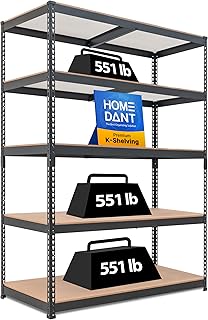
This is the workhorse of the group: a nearly six-foot span at 24 inches deep, with a boltless steel frame rated for serious tool chests, batteries, and bulk hardware. The wide beam length means fewer uprights blocking access, which makes it the most usable choice if you’re storing long or awkward items.
46″W 5-Tier Wood and Steel Utility Shelf
A smart middle ground at 71.2 by 46 by 19.7 inches, pairing a steel frame with wood decking that stays quiet under shifting loads and won’t let small parts fall through. The shallower 19.7-inch depth is deliberate and welcome in single-car garages where every inch of walkway counts.
79″ W Garage Shelving, 4 Tier, 6000 lb
The highest total capacity here and the widest footprint, with four tall bays instead of five, so oversized bins and equipment fit upright. Treat this as a wall-length install rather than a corner unit, and anchor it given the height and load.
CX Craftsman 5-Tier Plastic Storage Shelves
At 200 lb per shelf and fully rust-proof, this is the right answer for damp basements, humid climates, and anywhere road salt drips off a vehicle. Assembly is genuinely tool-free, and the 24-inch depth still takes standard totes.
Black 47.7″ 5 Tier Adjustable Metal Shelving
The most flexible pick, with a boltless design that reconfigures easily and clean black finish that reads more pantry than warehouse. It moves indoors without looking out of place, which matters if the unit might migrate to a closet or laundry room later.
Frequently Asked Questions
How much weight can garage shelving actually hold?
Quality steel units carry 800 to 1500 lb per shelf when the load is spread evenly; plastic units run 150 to 250 lb. Concentrated weight in one spot cuts those numbers significantly, so distribute heavy items across the deck.
Do I need to anchor shelves to the wall?
Anchor anything over 70 inches tall, and always anchor if children or vehicles share the space. A single strap into a stud at the top rail prevents the tip-over risk that comes with loading upper tiers heavy.
Is steel or plastic better for a garage?
Steel for load capacity and longevity in dry spaces. Plastic for moisture, salt exposure, or unheated basements where condensation would eventually rust a steel frame.
Can these units be stacked or combined?
Most boltless systems support side-by-side installation to run a continuous wall, and many allow half-height configurations from the same parts. Verify before assuming stacking is supported, since not all frames are rated for it.
Final Thoughts
For most garages, the 71.3″ 5000 lb steel unit delivers the best balance of span, depth, and capacity, while the 79″ 6000 lb four-tier version is the pick when you need to claim an entire wall for oversized gear. If your space runs damp, skip steel entirely and go with the CX Craftsman plastic shelving, which trades capacity for immunity to the rust that eventually claims everything else down there.