Key takeaways
- Tooth count and grind: A 40 to 50 tooth combination grind handles both ripping and crosscutting in hardwood without stalling. Reserve 60 to 80 tooth blades for crosscuts, plywood, and finish work, since they clear chips too slowly for deep rips in dense stock.
- Kerf thickness: Thin kerf blades cut roughly 3/32 inch and reduce load noticeably on 1.5 HP and smaller saws. If you run 3 HP or more, a full kerf blade tracks straighter and resists deflection through 8/4 material.
- Carbide quality: Micrograin, high-density carbide holds a keen edge far longer in abrasive species like hickory and white oak. Cheap carbide dulls fast, and a dull tooth is what causes burning, not the wood itself.
- Vibration control and plate flatness: Laser-cut expansion slots, copper plugs, and a precision-ground plate keep the blade from wandering as it heats. Flatter plate, cleaner shoulder, less sanding.
- Coating and hook angle: Anti-friction coatings shed pitch and resist resin buildup, which is what turns a good blade into a scorching one. A moderate positive hook, around 10 to 15 degrees, balances feed speed against tearout on figured grain.
What's inside
Hardwood punishes the wrong blade. Where pine forgives a dull edge, white oak scorches, hard maple burnishes into glassy burn lines, and quartersawn walnut splinters along the show face right where you least want it. Anyone who has milled a set of table aprons only to find fuzzy shoulders and tearout on the outside corner knows the cost: extra sanding, tighter tolerances blown, and joinery that no longer closes cleanly. The blade is the cheapest variable in that whole equation, and the one most people ignore.
This guide looks at 10-inch table saw blades through a furniture-making lens, where the cut quality determines how much handwork comes after. We cover what actually matters in dense stock, including tooth geometry, kerf thickness, carbide grade, and how a blade behaves in an underpowered contractor saw versus a cabinet saw. Then we walk through six blades worth owning, from all-day combination grinds to ultra-fine finish blades for veneered panels and miter work.
As an Amazon Associate we earn from qualifying purchases.





How to Choose a/an Table Saw Blade For Hardwood (2026)
- Tooth count and grind: A 40 to 50 tooth combination grind handles both ripping and crosscutting in hardwood without stalling. Reserve 60 to 80 tooth blades for crosscuts, plywood, and finish work, since they clear chips too slowly for deep rips in dense stock.
- Kerf thickness: Thin kerf blades cut roughly 3/32 inch and reduce load noticeably on 1.5 HP and smaller saws. If you run 3 HP or more, a full kerf blade tracks straighter and resists deflection through 8/4 material.
- Carbide quality: Micrograin, high-density carbide holds a keen edge far longer in abrasive species like hickory and white oak. Cheap carbide dulls fast, and a dull tooth is what causes burning, not the wood itself.
- Vibration control and plate flatness: Laser-cut expansion slots, copper plugs, and a precision-ground plate keep the blade from wandering as it heats. Flatter plate, cleaner shoulder, less sanding.
- Coating and hook angle: Anti-friction coatings shed pitch and resist resin buildup, which is what turns a good blade into a scorching one. A moderate positive hook, around 10 to 15 degrees, balances feed speed against tearout on figured grain.
The Best Table Saw Blade For Hardwood (2026)s Reviewed
Freud LU83R010 Thin Kerf Combination
This is the blade I recommend most often for anyone building furniture on a contractor or hybrid saw, because the thin kerf takes real strain off the motor while the 50-tooth combination grind still leaves crosscut shoulders clean enough for glue-up. The TiCo carbide and anti-vibration slots keep it stable and cool through 4/4 and 6/4 hardwood, which is where most burning problems start.
CMT 256.050.10 Combination
CMT’s 50-tooth combination grind is a genuinely refined all-rounder, with an ATB and raker configuration that rips cleanly and crosscuts without the fuzz you get from a general-purpose blade. The plate quality is excellent, making it a strong choice if you want one blade mounted permanently and dislike swapping.
Freud LU85R010 Crosscut
When the cut face is the finished face, this is the blade. The high tooth count and precise grind produce near-polished crosscuts in maple, cherry, and walnut, and it handles veneered panels with minimal chipping on the underside.
10-Inch 80T Wood Cutting Blade
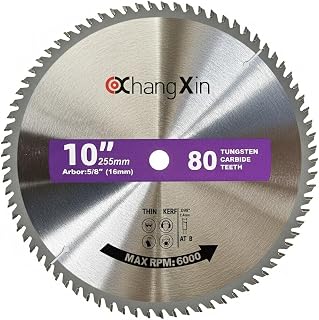
A sensible budget option for ultra-fine crosscutting, especially on miter saws where you need crisp returns on trim and case parts. It is not a ripping blade, so keep it for finish cuts and let a combination blade do the heavy work.
WEN BL1080 80-Tooth
The BL1080 delivers surprisingly tidy results for the money, leaving miter joints tight enough that a light pass with a block plane finishes them. Feed slowly in hardwood to avoid heat buildup, and it will serve well as a dedicated finish blade.
Frequently Asked Questions
How many teeth do I need for hardwood?
Forty to fifty teeth is the sweet spot for general hardwood work. Go to 24 or 30 teeth for dedicated ripping in thick stock, and 60 to 80 for crosscuts and sheet goods.
Why is my hardwood burning even with a new blade?
Usually alignment or feed rate rather than the blade. Check that your fence is parallel to the blade, keep the feed steady, and clean pitch off the teeth regularly.
Thin kerf or full kerf?
Match it to your saw. Under 2 HP, thin kerf cuts better because the motor is not fighting the blade. At 3 HP and above, full kerf gives you a stiffer plate and straighter cuts in thick material.
Is a multi-blade set worth buying?
Yes, if you work across framing, casework, and finish tasks. A 32T, 60T, and 80T three-pack covers most jobs and teaches you quickly which grind suits which cut.
Final Thoughts
For most furniture makers, the Freud LU83R010 thin kerf combination blade is the smartest single purchase, with the CMT 256.050.10 an equally capable alternative if you prefer a full kerf plate. Add the Freud LU85R010 for crosscuts on show surfaces, and you have a two-blade setup that covers everything from rough milling to final trim.