Key takeaways
- Tooth count: For plywood, more teeth means smaller bites and less veneer lift. Sixty teeth is a solid all-around minimum on a 10-inch blade; 80 teeth is where you land for cabinet-grade ply and melamine. Go below 40 and you’re ripping solid stock, not finishing sheet goods.
- Grind geometry: An ATB (alternate top bevel) grind acts like a pair of knives scoring the veneer on each side of the kerf, which is exactly what plywood needs. High-ATB and triple-chip grinds go further on brittle laminate faces. Flat-top grinds belong in a rip blade or a dado stack.
- Arbor and diameter fit: Most North American table saws use a 5/8-inch arbor, and nearly every blade here matches. Diameter matters just as much: an 8-1/4 or 8-1/2 inch blade suits compact and jobsite saws, while 10-inch is standard for contractor and cabinet saws. Undersizing costs you depth of cut.
- Carbide quality and kerf: Tungsten carbide tips hold an edge through abrasive plywood glue lines far longer than steel. A thin kerf around 0.090 inch reduces load on smaller motors and wastes less material, though full kerf tracks straighter in thick stock.
- Speed rating and plate quality: Check the max RPM against your saw, and look for laser-cut expansion slots or anti-vibration features. A blade that runs quiet runs flat, and a flat plate is what keeps burn marks off the edge of a shelf.
What's inside
Plywood punishes the wrong blade. You feed a sheet of birch ply across the table, everything sounds fine, and then you flip the offcut over to find a ragged fringe of splinters along the bottom face, veneer chipped away in flakes you can’t sand out. It happens because most blades shipped with a saw are built for framing lumber, where speed matters and a fuzzy edge disappears inside a wall. Sheet goods are the opposite problem: thin face veneers, cross-laminated plies, and cuts that usually end up visible in a finished cabinet, bookcase, or floating shelf.
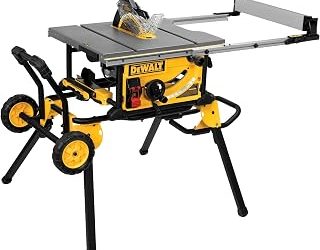
This guide looks at table saw blades through the lens of furniture work, where a clean edge is the whole point. We cover the tooth counts and grinds that actually reduce tearout on plywood, MDF, and melamine, what to check before you buy for your specific saw, and six blades worth considering for 2026, from compact 8-inch options for jobsite saws to full-size 10-inch finish blades for cabinet-grade panels.
As an Amazon Associate we earn from qualifying purchases.


How to Choose a Table Saw Blades For Plywood (2026)
- Tooth count: For plywood, more teeth means smaller bites and less veneer lift. Sixty teeth is a solid all-around minimum on a 10-inch blade; 80 teeth is where you land for cabinet-grade ply and melamine. Go below 40 and you’re ripping solid stock, not finishing sheet goods.
- Grind geometry: An ATB (alternate top bevel) grind acts like a pair of knives scoring the veneer on each side of the kerf, which is exactly what plywood needs. High-ATB and triple-chip grinds go further on brittle laminate faces. Flat-top grinds belong in a rip blade or a dado stack.
- Arbor and diameter fit: Most North American table saws use a 5/8-inch arbor, and nearly every blade here matches. Diameter matters just as much: an 8-1/4 or 8-1/2 inch blade suits compact and jobsite saws, while 10-inch is standard for contractor and cabinet saws. Undersizing costs you depth of cut.
- Carbide quality and kerf: Tungsten carbide tips hold an edge through abrasive plywood glue lines far longer than steel. A thin kerf around 0.090 inch reduces load on smaller motors and wastes less material, though full kerf tracks straighter in thick stock.
- Speed rating and plate quality: Check the max RPM against your saw, and look for laser-cut expansion slots or anti-vibration features. A blade that runs quiet runs flat, and a flat plate is what keeps burn marks off the edge of a shelf.
The Best Table Saw Blades For Plywood (2026)s Reviewed
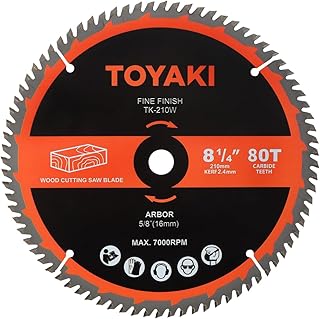
8-1/4-Inch 80-Tooth Ultra-Fine Finish Blade
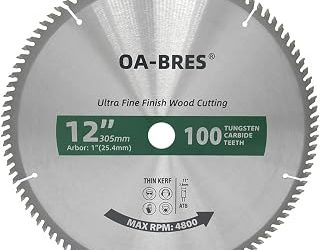
An 80-tooth grind on an 8-1/4-inch plate is an unusually high tooth density, and it shows in the edge quality on thin ply and hardwood-veneered panels. This is the blade for compact jobsite and portable table saws where you still want cuts clean enough to go straight into a finished piece.
KENDO 10-Inch Blade Set, 40T and 60T
Two blades covering both halves of a furniture build: the 40-tooth for ripping solid stock and breaking down sheets, the 60-tooth ATB for finish cuts in plywood, MDF, and laminate. If you’re setting up a shop from scratch, this pairing saves you from compromising with one middling blade.
Benchmark Abrasives TCT 8-1/2-Inch 60-Tooth
A tungsten carbide-tipped blade sized for smaller saws that handles plywood, hardwood, and MDF panels without the chatter cheap thin-plate blades produce. Sixty teeth at this diameter is a sensible balance between cut quality and feed speed for general cabinet work.
10-Inch 80-Tooth Fine Finish Blade (Red)
Rated to 7,000 RPM with carbide teeth ground for crosscutting and fine finish work, this one earns its place on melamine and prefinished ply where chipout is unforgiving. Keep it for final dimensioning rather than heavy ripping and it will reward you.
FOXBC 10-Inch 80-Tooth Table Saw Blade
FOXBC has built a following among furniture makers for consistent grinds at a sane price, and this ultra-finish 80-tooth is the reason. Expect glue-ready edges on veneered plywood with minimal sanding, which matters when you’re cutting a dozen matching shelves.
Frequently Asked Questions
How many teeth do I need for plywood?
Sixty to 80 teeth on a 10-inch blade covers nearly all plywood work. Sixty is more forgiving on feed rate and heat; 80 gives the cleanest possible face on thin veneers and laminates.
Will a high tooth count blade burn my cuts?
It can, if you feed too slowly or the blade is dirty. Keep the stock moving steadily, clean pitch off the carbide regularly, and check that your fence is parallel to the blade.
Do I need a zero-clearance insert?
For plywood, it’s the single best upgrade after the blade itself. Supporting the veneer right at the kerf eliminates most of the bottom-face tearout that no blade can fully prevent on its own.
Can these blades cut melamine and MDF?
Yes. High tooth-count ATB blades handle both well, though MDF is abrasive and will dull carbide faster than plywood. Expect to sharpen or replace sooner if MDF is your main material.
Final Thoughts
For most furniture shops running a 10-inch saw, the FOXBC 80-tooth is the straightforward pick for cabinet-grade plywood, and the KENDO 40T/60T set is the smarter buy if you need one purchase to cover both ripping and finish work. Working off a compact saw, the 8-1/4-inch 80-tooth blade delivers finish-quality edges without asking you to upgrade the machine.