Key takeaways
- Rip capacity: This is the single number that determines whether you can break down a 4×8 sheet of plywood without a helper. Anything at or above 30 inches lets you rip a full sheet in half cleanly; 24 inches and under means you’ll be pre-cutting with a track saw or circular saw first.
- Fence quality: A saw is only as accurate as its fence. Look for a rack-and-pinion system that stays parallel to the blade when you lock it down. Cheap stamped fences drift under pressure and cause burn marks, tapered cuts, and kickback.
- Blade size and cut depth: A 10-inch blade gives you roughly 3.1 to 3.4 inches of cut at 90 degrees — enough for 4×4 stock and thick hardwood. An 8-1/4-inch blade sacrifices some depth but drops weight noticeably, which matters if the saw moves between a shop and a job site.
- Stand and portability: Rolling stands with a fold-and-go action are worth the premium if your shop doubles as a parking spot. Fixed leg stands are more rigid but require dedicated square footage.
- Dust collection and safety hardware: A 2-1/2-inch shroud port keeps fine dust off your work surface and out of your lungs. Confirm the saw ships with a riving knife, anti-kickback pawls, a blade guard, and a push stick — replacing these piecemeal gets expensive.
What's inside
Anyone who has tried to build a floating shelf, a slatted bench, or a set of cabinet doors in a garage bay knows the bottleneck isn’t vision. It’s the rip cut. Circular saws wander, miter saws can’t handle sheet goods, and the gap between “I sketched it” and “I built it” usually comes down to whether you own a saw that can produce a straight, repeatable edge. Table saws solve that, but the buying process is muddied by spec sheets that all blur together: identical amp ratings, wildly different fences, stands that either fold flat or fight you every time.
This guide sorts the current crop of 10-inch and compact jobsite saws by what actually matters for furniture and interior work — fence accuracy, rip capacity, dust control, and how much floor space the thing eats when you’re done. Below you’ll find the models worth watching, followed by a practical buying framework and short reviews of the standouts.
As an Amazon Associate we earn from qualifying purchases.



How to Choose a Table Saw Deals (2026)
- Rip capacity: This is the single number that determines whether you can break down a 4×8 sheet of plywood without a helper. Anything at or above 30 inches lets you rip a full sheet in half cleanly; 24 inches and under means you’ll be pre-cutting with a track saw or circular saw first.
- Fence quality: A saw is only as accurate as its fence. Look for a rack-and-pinion system that stays parallel to the blade when you lock it down. Cheap stamped fences drift under pressure and cause burn marks, tapered cuts, and kickback.
- Blade size and cut depth: A 10-inch blade gives you roughly 3.1 to 3.4 inches of cut at 90 degrees — enough for 4×4 stock and thick hardwood. An 8-1/4-inch blade sacrifices some depth but drops weight noticeably, which matters if the saw moves between a shop and a job site.
- Stand and portability: Rolling stands with a fold-and-go action are worth the premium if your shop doubles as a parking spot. Fixed leg stands are more rigid but require dedicated square footage.
- Dust collection and safety hardware: A 2-1/2-inch shroud port keeps fine dust off your work surface and out of your lungs. Confirm the saw ships with a riving knife, anti-kickback pawls, a blade guard, and a push stick — replacing these piecemeal gets expensive.
The Best Table Saw Deals (2026)s Reviewed
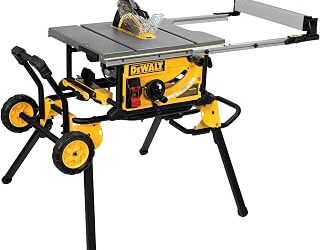
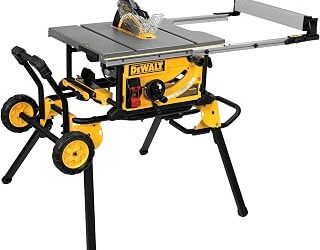
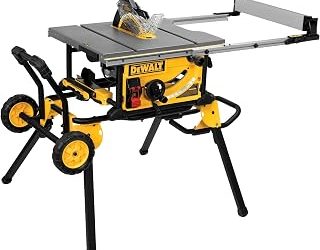
DEWALT DWE7491RS 10-Inch with Rolling Stand
The 32-1/2-inch rip capacity and rack-and-pinion fence make this the benchmark for anyone building casework, and the foldable rolling stand deploys in seconds without tools. At 4,800 RPM with a 15-amp motor, it powers through hard maple and thick plywood without bogging, which is why it remains the default recommendation for serious hobbyists.
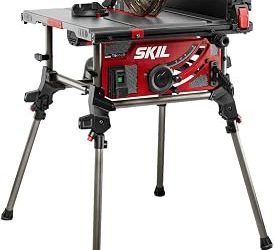
SKIL TS6307-00 15 Amp Portable Jobsite Saw
SKIL’s version pairs a genuinely useful folding stand with a smooth-adjusting fence, and it undercuts the DEWALT meaningfully on price. The standout feature is its worm-drive-inspired power delivery, which keeps blade speed steady mid-cut — a real advantage when ripping wet or resinous lumber.
DEWALT DWE7485 8-1/4-Inch Compact
The compact DEWALT trades blade diameter for a footprint you can actually carry up a flight of stairs one-handed. If your projects lean toward shelving, trim, and 3/4-inch sheet goods rather than thick stock, this is the smartest use of shop space in the lineup.
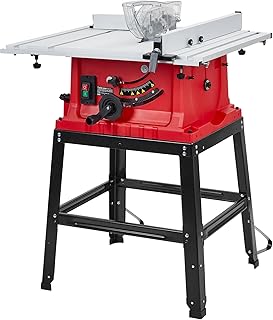
DOVAMAN DTS10A 10-Inch with Stand
A copper-wound motor and 3.35-inch cut depth at 90 degrees put the DOVAMAN in genuine 10-inch territory at a budget price, and the one-side table extension adds support for wider panels. Expect to spend an hour dialing in the fence and blade alignment out of the box — do that, and it performs well above its cost.
10-Inch 5000 RPM Table Saw with Stand and Protective Cover
The generous 36 x 25-inch tabletop is the draw here, giving you meaningful outfeed support that most saws in this bracket skip entirely. Bevel adjustment from 0 to 45 degrees and a full-coverage protective cover make it a reasonable pick for an occasional-use garage shop.
Frequently Asked Questions
Is a 10-inch saw always better than an 8-1/4-inch model?
Not always. The 10-inch gives you more depth of cut and broader blade selection, but the 8-1/4-inch saws are lighter and easier to store. Choose based on the thickest stock you realistically cut.
Do I need a dedicated dust collector?
A shop vacuum connected to the saw’s dust port captures most debris. Fine dust control matters most in a shared or enclosed space, where a proper collector with a fine-particle filter is worth the investment.
Should I upgrade the stock blade?
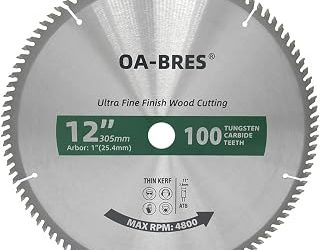
Yes, eventually. Factory blades are typically 24-tooth general-purpose. A 40- to 60-tooth carbide blade transforms cut quality on plywood and hardwood for a modest cost.
Can these saws cut plastic and acrylic?
Several are rated for it, but use a high-tooth-count blade, slow your feed rate, and expect to test on scrap first to avoid chipping and melting.
Final Thoughts
If you want one saw that handles full sheets and fine furniture joinery without compromise, the DEWALT DWE7491RS earns its price through fence accuracy and rip capacity alone. The SKIL TS6307-00 is the value play for anyone who wants comparable power and a solid folding stand for less, while the compact DEWALT DWE7485 is the right answer for tight shops where storage matters as much as capability.