Key takeaways
- Fence quality above all: The rip fence is the single component that determines whether your joinery closes. Look for a rack-and-pinion or telescoping design that locks parallel to the blade every time, not a friction-clamp fence you have to tap into alignment.
- Rip capacity for sheet goods: Furniture work means plywood. A 24-inch capacity handles most casework, but 32 inches lets you rip a full sheet down the center in one pass — a genuine difference in how confident you feel starting a cabinet.
- Blade size and cut depth: A 10-inch blade gives roughly 3-1/8 inches at 90 degrees, enough for stacked hardwood and thick tabletop stock. An 8-1/4-inch blade trades some depth for lighter weight, which is a fair swap if you work mostly in 3/4-inch material.
- Stand and storage footprint: A rolling stand that collapses vertically is worth more than an extra amp of motor. If the saw is hard to move, it stays buried under offcuts and you stop using it.
- Dust control and safety hardware: A proper dust port that mates with a shop vac keeps your layout lines visible. Confirm the saw ships with a riving knife, anti-kickback pawls, and a blade guard — and plan to use all three.
What's inside
Most people who buy a first table saw are not chasing a workshop. They’re chasing a bookshelf that sits flush against the wall, a floating nightstand with clean shoulders, a bench for the entryway that doesn’t wobble. The gap between that vision and the finished piece is almost always a straight, repeatable cut — and that is exactly the thing a circular saw and a chalk line will not give you consistently. The frustration isn’t lack of ambition. It’s a fence that drifts a sixteenth of an inch and takes the whole project with it.
This guide looks at table saws through the lens of home furniture making rather than framing lumber: how well each one handles plywood and hardwood, how much floor space it eats when you’re done, and how quickly it goes from folded to square. We’ve weighed rip capacity, fence accuracy, dust management, and the honest reality of a garage that also has to fit a car. Below are the machines worth your first investment in 2026, plus the specs that actually matter when you’re starting out.
As an Amazon Associate we earn from qualifying purchases.



How to Choose a Table Saw For Beginner Woodworking (2026)
- Fence quality above all: The rip fence is the single component that determines whether your joinery closes. Look for a rack-and-pinion or telescoping design that locks parallel to the blade every time, not a friction-clamp fence you have to tap into alignment.
- Rip capacity for sheet goods: Furniture work means plywood. A 24-inch capacity handles most casework, but 32 inches lets you rip a full sheet down the center in one pass — a genuine difference in how confident you feel starting a cabinet.
- Blade size and cut depth: A 10-inch blade gives roughly 3-1/8 inches at 90 degrees, enough for stacked hardwood and thick tabletop stock. An 8-1/4-inch blade trades some depth for lighter weight, which is a fair swap if you work mostly in 3/4-inch material.
- Stand and storage footprint: A rolling stand that collapses vertically is worth more than an extra amp of motor. If the saw is hard to move, it stays buried under offcuts and you stop using it.
- Dust control and safety hardware: A proper dust port that mates with a shop vac keeps your layout lines visible. Confirm the saw ships with a riving knife, anti-kickback pawls, and a blade guard — and plan to use all three.
The Best Table Saw For Beginner Woodworking (2026)s Reviewed
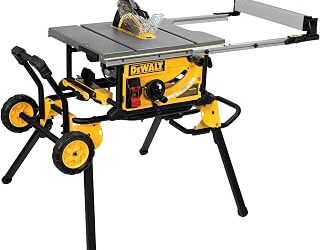
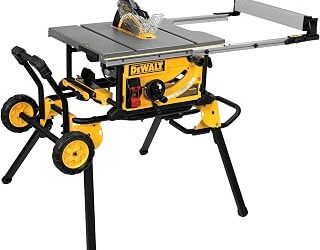
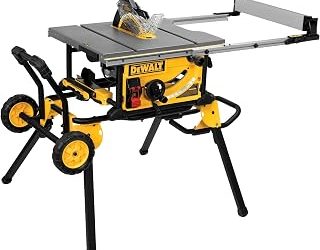
DEWALT DWE7491RS 10-Inch with Rolling Stand
The 32-1/2-inch rip capacity and rack-and-pinion fence make this the most forgiving saw here for cabinet and casework — you can break down a sheet of plywood without a track saw or a helper. The foldable rolling stand is genuinely one-person friendly, which matters more than the spec sheet suggests when your shop is also a garage.
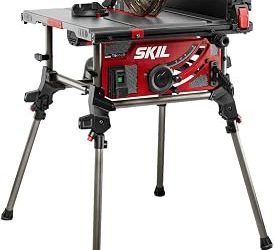
SKIL TS6307-00 10-Inch Jobsite Saw
SKIL’s standout feature is a worm-drive-style gearing arrangement and a fence that stays reliably square through repeated adjustment, at a noticeably lower entry price than the DEWALT. The folding stand is simple and stable, making this the value pick for someone building furniture a weekend at a time.
DOVAMAN DTS10A 10-Inch Table Saw
A copper motor, 3.35-inch cut depth at 90 degrees, and a one-side extendable table give this saw more range than its price implies. Expect to spend your first hour dialing in the fence and miter gauge — do that patiently and it holds tolerances well for hobby work.
DEWALT DWE7485 8-1/4-Inch Compact
The lightest serious option on this list, and the one to pick if your saw has to live on a shelf between projects. The 8-1/4-inch blade limits you on thick stock, but for 3/4-inch hardwood and plywood furniture it’s more than sufficient, and the fence quality carries over from DEWALT’s larger models.
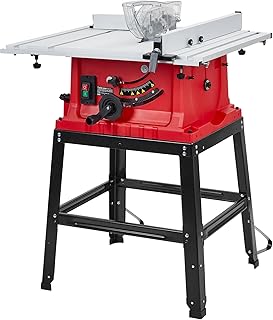
10-Inch 15-Amp Table Saw with Stand and Protective Cover
A 36 x 25-inch tabletop is unusually generous at this price, and the included cover is a small mercy in a dusty garage. Full 0–45 degree bevel and adjustable depth cover standard furniture cuts; the tradeoff is a fence that rewards a careful setup routine.
Frequently Asked Questions
Do I need a 10-inch blade or is 8-1/4 inches enough?
For furniture built from 3/4-inch plywood and dimensional hardwood, 8-1/4 inches is enough. Choose 10 inches if you plan to cut thick tabletop stock, resaw, or stack cuts for joinery.
Is a jobsite saw accurate enough for furniture?
Yes, provided you calibrate it. Check that the blade is parallel to the miter slot, the fence is parallel to the blade, and the stops are true at 90 and 45 degrees. A tuned jobsite saw outperforms a neglected cabinet saw.
What blade should I install first?
Swap the stock blade for a 40- to 50-tooth combination blade. It cuts plywood cleanly enough to skip edge banding cleanup and still rips hardwood without burning.
How much space do I actually need?
Plan for roughly four feet of clearance in front and behind the blade for infeed and outfeed on furniture-length stock. Rolling stands let you reclaim that space between sessions.
Final Thoughts
If you intend to build real furniture and have room for one good machine, the DEWALT DWE7491RS is the saw you won’t outgrow — its fence and 32-1/2-inch rip capacity remove the two biggest sources of beginner frustration. The SKIL TS6307-00 delivers most of that accuracy for meaningfully less, and the compact DEWALT DWE7485 is the right answer for small shops where the saw has to disappear at the end of the day.