Key takeaways
- Rip capacity: Cabinet sides and full-depth shelves push you toward 30 inches or more to the right of the blade. Anything under 24 inches means flipping sheets or breaking them down with a circular saw first.
- Fence rigidity: This is the single biggest predictor of clean cabinet joinery. Lock the fence, push hard against the far end, and watch for deflection. A rack-and-pinion fence that stays parallel through its full travel beats extra horsepower every time.
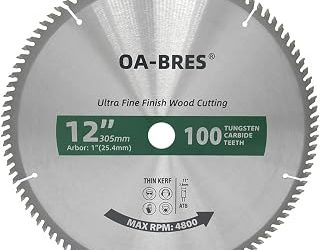
- Motor and blade pairing: A 15 amp universal motor handles 3/4-inch plywood and hardwood face frames comfortably. Swap the stock blade for a 60 to 80 tooth ATB or triple-chip grind, which is what stops tearout in veneer and melamine.
- Dust management: Cabinet shops generate enormous amounts of fine sheet-goods dust. Look for a shrouded blade and a 2-1/2 inch port you can tie into a shop vac or dust extractor, ideally with a HEPA filter.
- Mobility and setup speed: If you’re working in a garage or moving between installs, a rolling stand that deploys in seconds keeps the saw in use instead of parked against a wall.
What's inside
Cabinet work punishes imprecision. A face frame that’s off by a sixteenth telegraphs into every door reveal, and a sheet of prefinished plywood that drifts against a flexing fence turns into scrap you paid forty dollars for. The frustrating part is that most table saw advice is written for framing crews, where a rough rip on a 2×4 is a win. Cabinetmakers need something different: a fence that lands where the scale says it will, a top flat enough to trust, and enough rip capacity to break down full sheets without a helper.
This guide looks at the saws that actually earn shop space for casework, from a full-size portable with 32-1/2 inches of rip to a compact jobsite unit for installers working out of a van. We also cover the supporting cast: a miter saw for trim and moldings, a hobby saw for small-scale detail, and a universal stand that makes an older saw feel current. Below each pick you’ll find what it does well and where its limits show up.
As an Amazon Associate we earn from qualifying purchases.


How to Choose a Table Saw For Cabinet Making (2026)
- Rip capacity: Cabinet sides and full-depth shelves push you toward 30 inches or more to the right of the blade. Anything under 24 inches means flipping sheets or breaking them down with a circular saw first.
- Fence rigidity: This is the single biggest predictor of clean cabinet joinery. Lock the fence, push hard against the far end, and watch for deflection. A rack-and-pinion fence that stays parallel through its full travel beats extra horsepower every time.
- Motor and blade pairing: A 15 amp universal motor handles 3/4-inch plywood and hardwood face frames comfortably. Swap the stock blade for a 60 to 80 tooth ATB or triple-chip grind, which is what stops tearout in veneer and melamine.
- Dust management: Cabinet shops generate enormous amounts of fine sheet-goods dust. Look for a shrouded blade and a 2-1/2 inch port you can tie into a shop vac or dust extractor, ideally with a HEPA filter.
- Mobility and setup speed: If you’re working in a garage or moving between installs, a rolling stand that deploys in seconds keeps the saw in use instead of parked against a wall.
The Best Table Saw For Cabinet Making (2026)s Reviewed
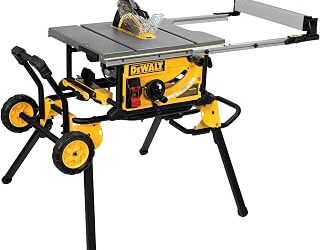
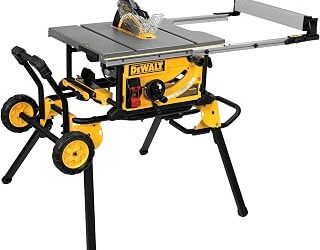
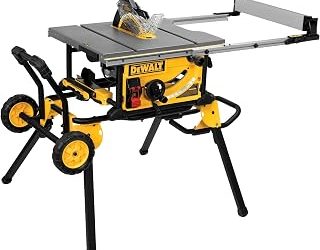
DEWALT DWE7491RS 10-Inch Table Saw with Rolling Stand
This is the default recommendation for serious cabinet work outside a dedicated shop, thanks to a 32-1/2 inch rip capacity that swallows a full sheet crosscut and a rack-and-pinion fence that returns to the same setting reliably. The 4800 RPM 15 amp motor has no trouble in hardwood, and the foldable rolling base means you can reclaim the floor when you’re finished.
DEWALT DWE7485 8-1/4 in. Compact Jobsite Saw
At around 54 pounds, this is the saw for installers and small-shop builders who value portability over capacity, and its fence quality punches well above its footprint. The 24-1/2 inch rip and 8-1/4 inch blade limit you on wide sheet goods and thick stock, so pair it with a track saw for breaking down panels.
10-Inch Compound Miter Saw with Extension Table
A table saw handles ripping; a miter saw handles the crown, light rail, and scribe molding that finish a cabinet run. This single-bevel 15 amp model with a 36-tooth blade and extension table covers 0 to 45 degrees cleanly and keeps repetitive trim cuts off your table saw sled.
MXBAOHENG Mini Table Saw S3
Strictly a specialty tool, this seven-speed precision saw with 1/2 inch depth capacity is for inlay banding, drawer detail, jig parts, and scale models. Nobody should attempt cabinet carcasses with it, but for delicate cuts that feel reckless on a full-size blade it earns its bench space.
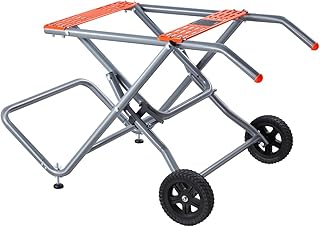
VEVOR Portable Table Saw Stand
If you already own a decent contractor saw sitting on sawhorses, this universal rolling stand is the cheapest meaningful upgrade available, with a 350 pound capacity and 8 inch rubber wheels that clear cords and debris. Verify your saw’s mounting dimensions before ordering, since universal fit still requires a little measuring.
Frequently Asked Questions
Is an 8-1/4 inch saw big enough for cabinet making?
It can be, if you break down sheets with a track saw or circular saw and guide first. The smaller blade limits depth of cut to roughly 2-1/2 inches at 90 degrees, which rules out thick hardwood ripping but handles plywood casework and 3/4 inch face frame stock fine.
Do I need a true cabinet saw?
Only if you’re producing volume. A stationary cabinet saw brings a cast iron top, induction motor, and better dust extraction, but a well-tuned portable with a quality blade and a zero-clearance insert produces joinery accurate enough for professional results.
What blade should I use for plywood and melamine?
A 60 to 80 tooth blade with a high alternate top bevel or triple-chip grind, run with a zero-clearance insert to support fibers at the exit point. Keep a 24 to 40 tooth rip blade for solid stock so you’re not burning edges.
How important is dust collection for cabinet work?
Very. Sheet goods release fine adhesive-laden dust that lingers in the air and settles on finishes. Connect a shop vac with a HEPA cartridge at minimum, and consider a cyclone separator to keep filters from clogging mid-project.
Final Thoughts
For most cabinetmakers, the DEWALT DWE7491RS is the clear choice: the rip capacity and fence accuracy align directly with what casework demands, and the rolling stand solves the storage problem in a shared garage. Installers and mobile builders will be better served by the compact DWE7485, and anyone already running a serviceable saw should put the money into the VEVOR rolling stand and a good 80 tooth blade before shopping for a new machine.