Key takeaways
- Tooth Count: Fewer teeth (24T) remove material fast but leave a rougher surface; higher counts (40T–60T) deliver cleaner edges ideal for visible furniture parts.
- Kerf Width: Thin-kerf blades waste less stock and demand less motor power, making them smart choices for contractor saws and jobsite setups with limited amperage.
- Arbor Size: Most 10-inch saws use a 5/8-inch arbor, but 8-1/4-inch saws are common on portable rigs — confirm your saw’s spec before ordering.
- Blade Diameter: A 10-inch blade handles boards up to roughly 3-1/8 inches thick at 90 degrees; step down to 8-1/4 inches only if your saw requires it.
- Carbide Quality: Industrial-grade carbide tips hold an edge longer and resist chipping, which matters most if you cut abrasive species like maple or oak regularly.
What's inside
Choosing a rip blade shouldn’t feel like an engineering exam, yet most woodworkers end up staring at tooth counts and kerf specs wondering which one actually matters for the cut they need. A blade mismatch means burned edges, tear-out, and wasted hardwood — frustrations that compound quickly when you’re building furniture to sell or finishing a renovation on deadline.
This guide breaks down the five strongest rip blades on Amazon right now, covering everything from budget-friendly multi-packs to precision carbide options built for glue-line joints. You’ll find a comparison chart, a no-nonsense buying guide, and honest assessments of each pick so you can match the right blade to your projects without second-guessing yourself.
As an Amazon Associate we earn from qualifying purchases.

How to Choose a Table Saw Rip Blade (2026)
- Tooth Count: Fewer teeth (24T) remove material fast but leave a rougher surface; higher counts (40T–60T) deliver cleaner edges ideal for visible furniture parts.
- Kerf Width: Thin-kerf blades waste less stock and demand less motor power, making them smart choices for contractor saws and jobsite setups with limited amperage.
- Arbor Size: Most 10-inch saws use a 5/8-inch arbor, but 8-1/4-inch saws are common on portable rigs — confirm your saw’s spec before ordering.
- Blade Diameter: A 10-inch blade handles boards up to roughly 3-1/8 inches thick at 90 degrees; step down to 8-1/4 inches only if your saw requires it.
- Carbide Quality: Industrial-grade carbide tips hold an edge longer and resist chipping, which matters most if you cut abrasive species like maple or oak regularly.
The Best Table Saw Rip Blades (2026) Reviewed
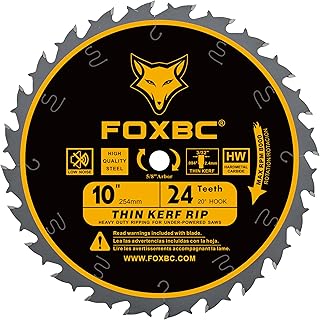
FOXBC 10-Inch 24-Tooth Thin Kerf Rip Blade
The FOXBC 24T rip blade punches well above its price point for straight-line ripping. Its thin kerf design reduces strain on lower-powered saws while maintaining a stable feed, and the flat-top tooth geometry produces an even bottom in the cut — a real advantage when you’re dimensioning rough lumber for tabletops or cabinet sides.
Amana Tool Glue Line Ripping Blade (610301)
Amana’s 30T glue-line blade is the professional’s choice when the rip edge needs to mate seamlessly without further jointing. The triple-chip grind and 22-degree hook angle minimize splintering on both the face and back of the cut, and the blade runs noticeably quieter than most competitors — a small comfort on long production days.
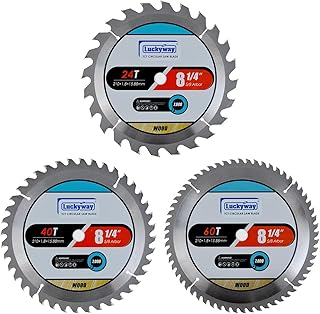
Luckyway 8-1/4 Inch 3-Pack
This Luckyway set is hard to beat for value. You get framing (24T), ripping (40T), and finishing (60T) blades in one purchase, all with carbide tips and 5/8-inch arbors. If you own a compact saw and want versatility without assembling a personal blade library, this pack covers nearly every crosscut-and-rip scenario in a small shop.
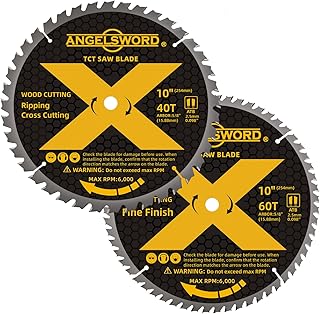
ANGELSWORD 10 Inch 2-Pack (40T / 60T)
The ANGELSWORD two-pack targets woodworkers who rip hardwoods and then want an equally refined crosscut option. The 40T blade handles ripping duties with cleaner results than a 24T, while the 60T finish blade leaves surfaces ready for finish — useful when you’d rather skip a sanding pass on drawer fronts or box joints.
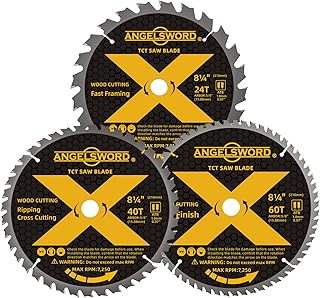
ANGELSWORD 8-1/4 Inch 3-Pack
Identical concept to the Luckyway bundle but sized for 8-1/4-inch saws, the ANGELSWORD three-pack gives portable saw owners a framing blade, a ripping blade, and a finishing blade in one purchase. Build quality holds up well against rough framing cuts, and the 60T blade performs surprisingly cleanly on plywood rips where tear-out would otherwise plague you.
Frequently Asked Questions
What is a rip blade used for?
A rip blade cuts along the grain of the wood, removing material efficiently to bring boards to a target width. It features fewer, deeper-gullet teeth designed to clear chips quickly during long, straight cuts.
Can I use a rip blade for crosscutting?
You can, but the results will be rough. Rip blades tear across grain fibers instead of severing them cleanly, leaving a fuzzy edge that requires heavy sanding or a separate crosscut blade for a polished result.
Does thin kerf affect cut quality?
Slightly, but most woodworkers won’t notice on ripping tasks. Thin kerf blades deflect marginally more than full-kerf blades, but modern carbide tips and anti-kickback designs have narrowed the gap considerably — and the reduced material waste is a genuine cost savings over time.
How often should I replace or sharpen my rip blade?
A quality carbide blade sharpens cleanly three to five times before the tips become too small to hold an edge. Signs you need attention include increased burning, heavier motor strain, and visible chipping along the cut surface.
Final Thoughts
For most home furniture builders, the Amana Tool Glue Line Ripping Blade delivers the best cut quality where it matters most — at the joint edge. Budget-conscious shoppers who want variety should grab the Luckyway 3-Pack, while the FOXBC 24T remains the sweet spot for straightforward ripping without overthinking it.