Key takeaways
- Match the orifice to your machine: This is the one spec people skip and regret. A 4.0 orifice paired with a 2.0 GPM electric washer bleeds pressure and barely spins; a 3.0 orifice on a 4.0 GPM gas unit strains the pump. Check your washer’s GPM and PSI on the data plate first, then buy the tip that fits it.
- Stainless over brass or plated steel: Turbo nozzles live in a spray of grit and mineral-heavy water. Stainless bodies and ceramic-lined inserts resist pitting far longer, and a worn orifice is what turns a crisp jet into a soft, useless spread.
- Look at the bearing, not just the PSI rating: The rotation is the entire point. Cheap units seize after a season of hard water. Sealed bearings and a smooth, audible hum under load are the signals of a nozzle that will still spin next spring.
- Hot water capability if you clean grease: Driveway oil, grill pads, and garage floors respond to heat. Only some nozzles are rated to 212°F — running hot water through one that isn’t will warp seals fast.
- Single tip or full kit: If you already own a fan-tip set, buy the turbo alone. If you’re starting from scratch or want to move from siding to concrete without swapping hardware, a quick-changeover kit earns its shelf space.
What's inside
The exterior of a home reads like a first sentence, and grime edits it badly. Pale mineral streaks down a stucco wall, a patio that has quietly shifted from warm gray to green, brick steps wearing a film of pollen and traffic dust — none of it is structural, all of it is visible. Most homeowners already own a pressure washer capable of fixing this. What they usually lack is the right tip. A standard fan nozzle spreads pressure thin and leaves the zebra striping that anyone who has washed a driveway on a Saturday will recognize instantly.
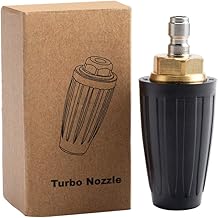
A turbo nozzle solves that geometry problem. It fires a zero-degree pencil jet and spins it in a tight cone, so you get the impact of a concentrated stream across the coverage of a wide one, typically cutting cleaning time in half. This guide covers what actually matters when choosing one — orifice sizing, build material, bearing quality, temperature tolerance — and reviews the models worth your attention in 2026, from single-tip workhorses to multi-nozzle kits that handle the whole exterior in one pass.
As an Amazon Associate we earn from qualifying purchases.


How to Choose a Turbo Nozzle Pressure Washer (2026)
- Match the orifice to your machine: This is the one spec people skip and regret. A 4.0 orifice paired with a 2.0 GPM electric washer bleeds pressure and barely spins; a 3.0 orifice on a 4.0 GPM gas unit strains the pump. Check your washer’s GPM and PSI on the data plate first, then buy the tip that fits it.
- Stainless over brass or plated steel: Turbo nozzles live in a spray of grit and mineral-heavy water. Stainless bodies and ceramic-lined inserts resist pitting far longer, and a worn orifice is what turns a crisp jet into a soft, useless spread.
- Look at the bearing, not just the PSI rating: The rotation is the entire point. Cheap units seize after a season of hard water. Sealed bearings and a smooth, audible hum under load are the signals of a nozzle that will still spin next spring.
- Hot water capability if you clean grease: Driveway oil, grill pads, and garage floors respond to heat. Only some nozzles are rated to 212°F — running hot water through one that isn’t will warp seals fast.
- Single tip or full kit: If you already own a fan-tip set, buy the turbo alone. If you’re starting from scratch or want to move from siding to concrete without swapping hardware, a quick-changeover kit earns its shelf space.
The Best Turbo Nozzle Pressure Washer (2026)s Reviewed
AURORA CAR Turbo Nozzle, 4000 PSI
A clean, no-frills pick for gas washers in the 3.5 to 4.0 GPM range, with a 4.0 orifice that keeps rotation strong instead of stalling out mid-pass. It handles brick, poured concrete, and vinyl siding with equal composure, which makes it the sensible default if you want one tip for the whole property.
Simpson 80144 Turbo Nozzle, 4500 PSI
The specialist’s choice, and the one I’d point a serious owner toward. Its oscillating jet is measurably faster on large flatwork, and the 212°F hot-water rating means it belongs on a heated unit tackling oil-stained driveways or restaurant-grade grease.
Tool Daily Stainless Turbo Nozzle, 3600 PSI
Tuned for the 3.0 GPM machines most homeowners actually own, with a stainless body that shrugs off hard water better than its price suggests. Especially good on wood decking, where the 360° rotation lifts gray weathering without the gouging a zero-degree tip leaves behind.
AURORA CAR Turbo Nozzle & 6-in-1 Quick Changeover
The most practical bundle here: a full-strength turbo tip plus a six-pattern selector that indexes with a twist, so you move from 40° rinse on windows to concentrated blast on pavers without walking back to the toolbox. Best value if you’re outfitting a washer from zero.
Stainless Steel 360° Turbo Nozzle, 3.0 GPM
A compact, well-machined tip aimed at car care and garden work, where control matters more than raw force. It’s the one to keep on hand for wheel wells, fence panels, and planters that a 4.0 orifice would overwhelm.
Frequently Asked Questions
Will a turbo nozzle damage my siding or deck?
It can, if you crowd it. Keep the tip 10 to 12 inches off vinyl and painted wood, work in overlapping passes, and test an inconspicuous corner first. Soft cedar and older paint need more distance than brick or concrete.
How do I know which orifice size I need?
Find your washer’s GPM rating, then match the manufacturer’s chart. As a rough guide, 3.0 GPM machines take a 3.0 orifice and 4.0 GPM machines take a 4.0. Undersizing spikes pressure; oversizing kills it.
Why did my turbo nozzle stop spinning?
Usually mineral scale or grit in the bearing, sometimes a mismatched orifice starving the rotor. Flush it with clean water after each use, and consider an inline filter if you’re on well water.
Is a turbo nozzle worth it over a standard 15° tip?
For flatwork and masonry, clearly yes — you cover far more area per minute without striping. For rinsing and detergent application, a fan tip remains the better tool, which is why kits are popular.
Final Thoughts
If you want the strongest performer and run a capable gas or hot-water machine, the Simpson 80144 is the tip to buy. For most homeowners, the AURORA CAR 6-in-1 changeover kit delivers the widest range of real-world use for the money, while the Tool Daily stainless nozzle is the smart match for standard 3.0 GPM washers and gentler surfaces like decking.