Key takeaways
- The A-LuGei 69-Piece, 5-Size Tray Divider Set suits deep garage drawers and rolling carts, with enough pieces to outfit several drawers in one pass.
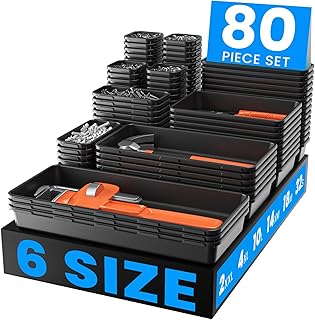
- The A-LuGei 6-Size, 80-Piece Organizer gives the widest range of footprints, useful when a single chest holds everything from hex keys to caulk tubes.
- The A-LuGei 46-Piece, 5-Size Set is the right scale for a smaller chest, a workbench drawer, or crossover use in a utility or bathroom cabinet.
- The A-LuGei 6-Size Extra-Thick Tray Set is worth the step up if your drawers carry real weight and you want trays that hold their geometry over years.
What's inside
A tool chest is one of the few pieces of furniture in a home that gets judged purely on performance. Nobody photographs it for a mood board, but you interact with it more intimately than your sofa: hands in drawers, weight on the lid, a hundred small decisions about where a thing belongs. When it works, a project moves. When it doesn’t, you spend fifteen minutes hunting a 10mm socket and lose the thread of what you were doing. Organization is the difference, and it’s a design problem as much as a storage one.
Below is a practical framework for setting up a chest in 2026, whether you’re working from a compact three-drawer unit in a hall closet or a rolling cabinet in a two-car garage. We’ll cover how to inventory before you buy anything, how to zone drawers by how often you reach into them, which divider systems actually hold their shape, how to tame sockets and loose metal, and when a modular rolling system beats a fixed chest. Light gear recommendations are folded in where they earn their place.
Our Recommended Picks
As an Amazon Associate we earn from qualifying purchases.



Empty Everything Before You Organize Anything
Start by pulling every drawer completely onto a floor or bench. This feels excessive; it is the step that makes the rest work. You cannot design around a collection you haven’t seen. Sort into four piles: daily tools, project-specific tools, consumables (fasteners, blades, tape), and things you’ve kept out of guilt. That last pile is usually 20 to 30 percent of the chest. Duplicate pliers, a stripped screwdriver, mystery brackets from furniture you no longer own. Clear it out and you often find you don’t need a bigger chest at all.
Zone Drawers by Reach Frequency, Not by Category
The instinct is to group by type: all wrenches together, all electrical together. Better practice is to organize by how often your hand goes there. Top drawers, at chest or waist height, hold the eight to twelve tools you touch in nearly every job. Middle drawers hold the second tier: sockets, drill bits, specialty drivers. Bottom drawers absorb the heavy and the rare, since weight low in the cabinet also stabilizes the whole unit. One exception worth keeping: consumables deserve their own drawer regardless of frequency, because they’re the thing you’re most likely to overbuy when you can’t see what you already have.
Divider Trays Are the Structural Layer
A drawer without internal structure is a bin, and everything in it migrates. Modular tray sets solve this without committing you to a permanent layout, which matters because your tool collection will change. Look for multiple footprint sizes so you can tile a drawer edge to edge with minimal dead space, and for plastic thick enough that a loaded tray doesn’t flex when you lift it out.
- The A-LuGei 69-Piece, 5-Size Tray Divider Set suits deep garage drawers and rolling carts, with enough pieces to outfit several drawers in one pass.
- The A-LuGei 6-Size, 80-Piece Organizer gives the widest range of footprints, useful when a single chest holds everything from hex keys to caulk tubes.
- The A-LuGei 46-Piece, 5-Size Set is the right scale for a smaller chest, a workbench drawer, or crossover use in a utility or bathroom cabinet.
- The A-LuGei 6-Size Extra-Thick Tray Set is worth the step up if your drawers carry real weight and you want trays that hold their geometry over years.
Give Sockets and Loose Metal a Vertical Home
Sockets are the single worst offender in any chest. Loose in a drawer they become noise, and even in a tray they roll out of sequence. Magnetic holders solve this by moving them off the horizontal plane entirely. A set like the EACELIY Magnetic Socket Organizer covers 1/4″, 3/8″, and 1/2″ drives in SAE and metric, shallow and deep, and mounts directly to the steel side of a chest or cart. That frees an entire drawer and puts your sockets at eye level, sorted by size, where a missing one is obvious at a glance.
Decide Whether Your Storage Needs to Move
A fixed chest is right if your work happens in one spot. If projects pull you across a yard, up stairs, or into a truck bed, a modular system earns its keep. The Keter Stack N Roll 3-Piece System stacks into a single tower on all-terrain wheels with a telescoping handle, then separates so you carry only the box you need. It’s weatherproof, which matters more than people expect for anything stored in a garage or shed through a humid summer.
Tips
- Photograph each drawer once it’s set. It becomes your reference for putting things back and a record for insurance.
- Leave one tray empty in your top drawer as a staging spot for whatever project is currently active.
- Label the drawer face, not the trays. Faces stay put; trays get rearranged.
- Set a five-minute reset at the end of each session. Small, frequent resets prevent the full teardown you’ll otherwise face twice a year.
Frequently Asked Questions
How many divider trays should I buy?
Measure your drawer interiors and plan for roughly 70 to 80 percent coverage. Multi-size sets in the 46 to 80 piece range typically outfit three to six drawers, depending on depth and how much you tile.
Should I use foam inserts instead of trays?
Foam is excellent for a fixed, curated kit where every tool has one cutout. Trays are better for evolving collections, because you can reconfigure in seconds without cutting anything.
Do magnetic socket holders scratch the chest?
Quality holders use coated magnets that don’t mar powder-coated steel. Wipe the mounting surface clean first, since trapped grit is what actually causes scratching.
What’s the ideal weight distribution in a rolling chest?
Keep the heaviest items in the bottom third and avoid loading one side disproportionately. A top-heavy cart can tip when a drawer is fully extended, especially on uneven garage floors.
Conclusion
A well-organized tool chest isn’t about owning more storage; it’s about matching structure to how you actually work. Cull honestly, zone by reach, add modular trays as your framework, lift sockets onto magnets, and choose mobility only if your projects demand it. Do that once, maintain it in five-minute increments, and the chest stops being a place where tools disappear and starts being the thing that keeps a project moving.