Key takeaways
- Rigidity over raw capacity: A 2,000 lb static rating means little if the legs twist. Look for welded or heavily gusseted steel frames, cross-bracing at the back, and adjustable feet so the bench sits dead flat on an uneven slab.
- Top material and thickness: Solid rubberwood or hardwood in the 1″ to 1.5″ range takes a mounting bolt cleanly and damps vibration. Thin MDF or particleboard tops crush around washers and swell if a solvent spills.
- Work height and posture: Seated reloading typically wants 28″ to 32″; standing press work suits 36″ to 39″. Height-adjustable legs let you tune the bench to your press stroke instead of the other way around.
- Power and small-parts storage: A built-in outlet strip keeps tumblers, case trimmers, and trickler cords off the floor. Drawers, bins, and pegboard panels matter more here than on a general-purpose bench, since components live in dozens of small containers.
- Footprint and expansion: Measure for your press plus a staging zone for cases and a scale that needs to stay level and undisturbed. If the bench shares a room with anything else, a narrower depth with a pegboard back reads far more like cabinetry.
What's inside
A reloading bench lives a double life. It has to absorb the leverage of a single-stage press without a whisper of flex, then sit quietly in a basement, spare room, or corner of the garage without looking like industrial equipment parked in your house. Most buyers discover the problem the hard way: a folding utility table or a big-box shelving unit racks sideways the moment the ram comes down, powder measures drift out of calibration, and every stroke feels like a negotiation with the furniture.
This guide looks at benches through both lenses, structure first and styling close behind. We weigh frame rigidity and stated load capacity, top thickness and how well it accepts bolt-through mounting, seated versus standing work heights, integrated power and pegboard storage, and how each footprint behaves in a shared living space. Below are the models worth your attention in 2026, from compact single-press stations to a twelve-foot run that swallows a full progressive setup.
As an Amazon Associate we earn from qualifying purchases.




How to Choose a Workbench For Reloading (2026)
- Rigidity over raw capacity: A 2,000 lb static rating means little if the legs twist. Look for welded or heavily gusseted steel frames, cross-bracing at the back, and adjustable feet so the bench sits dead flat on an uneven slab.
- Top material and thickness: Solid rubberwood or hardwood in the 1″ to 1.5″ range takes a mounting bolt cleanly and damps vibration. Thin MDF or particleboard tops crush around washers and swell if a solvent spills.
- Work height and posture: Seated reloading typically wants 28″ to 32″; standing press work suits 36″ to 39″. Height-adjustable legs let you tune the bench to your press stroke instead of the other way around.
- Power and small-parts storage: A built-in outlet strip keeps tumblers, case trimmers, and trickler cords off the floor. Drawers, bins, and pegboard panels matter more here than on a general-purpose bench, since components live in dozens of small containers.
- Footprint and expansion: Measure for your press plus a staging zone for cases and a scale that needs to stay level and undisturbed. If the bench shares a room with anything else, a narrower depth with a pegboard back reads far more like cabinetry.
The Best Workbench For Reloading (2026) Models Reviewed
47.2″ Heavy Duty Work Bench with Drawer and Storage
The most apartment-friendly option here, with a small wood top, a drawer for dies and shell holders, and a lower shelf that keeps the visual mass low. Best suited to a single-stage or turret press where the modest deck and tidy proportions are an asset rather than a compromise.
OLBRUS 48″ Adjustable Workbench
A hardwood top, a 2,000 lb load rating, and an integrated outlet make this the balanced pick for a dedicated reloading station. The rubber pad protects finished brass and quiets the deck, while the adjustable legs let you dial in a comfortable seated height for long priming sessions.
Frankford Arsenal Platinum Series Reloading Stand
The only purpose-built option on the list, with an adjustable steel frame, a wood center surface sized for a press, and storage bins already positioned where your hands want them. Its compact stance suits reloaders who need a station that can be repositioned or tucked away between sessions.
CAMMOO 60″ Work Bench with Storage & Pegboard
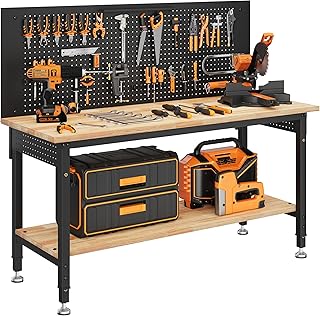
Five feet of deck, a pegboard back, a storage shelf, and a power strip add up to a genuine workshop wall in one purchase. The extra length gives you a press station and an undisturbed scale zone without the two ever competing for space.
CAMMOO 48″ Adjustable Workbench
Solid rubberwood over a carbon steel frame, ETL-listed power with four outlets and two USB ports, and a 28″ to 39″ height range covering both seated and standing work. A clean, well-specified all-rounder for anyone who wants one bench to handle reloading and general projects.
Frequently Asked Questions
How sturdy does a reloading bench actually need to be?
Sturdier than the weight suggests. A press multiplies your arm strength through a long handle, so the bench fights lateral force more than downward load. Prioritize frame bracing, floor contact, and a top thick enough to be bolted through.
Should I bolt my press directly to the top?
Yes, with through-bolts, large washers, and ideally a steel backing plate under the deck. Clamps loosen over repeated strokes, and a shifting press ruins consistency in case sizing and seating depth.
Is an adjustable-height bench worth it?
For reloading, it usually is. Being able to move between a seated height for case prep and a taller setting for full-length sizing reduces fatigue considerably over a long session.
Can one bench cover reloading and general shop work?
Comfortably, if you buy length. A 48″ bench works for a single press; 60″ or more lets you keep powder and scale equipment permanently set up while still leaving room for unrelated projects.
Final Thoughts
For most reloaders, the OLBRUS 48″ Adjustable Workbench hits the right balance of hardwood surface, honest rigidity, and built-in power at a sensible footprint. Step up to the CAMMOO 60″ with pegboard if you want a permanent station with room to grow, or the 120″ Adjustable Heavy Duty Workbench if you’re building out a full wall; the Frankford Arsenal Platinum Series remains the smart choice when space is tight and a purpose-built stand makes more sense than a general bench.