Key takeaways
- Reading overall height as seat height. A “30-inch stool” with a back may have a 30-inch seat (bar height) or a 30-inch overall height with a 19-inch seat. The listing must say “seat height.”
- Buying bar stools for a counter-height island. A 30-inch seat under a 36-inch counter leaves 6 inches. The stool becomes decorative because no adult can sit on it.
- Ignoring the apron. Islands with a deep support rail or drawer front under the overhang reduce clearance by 2 to 4 inches. Measure to the lowest point.
- Forgetting cushion sink. A thickly padded 26-inch stool that compresses 2 inches ends up at 24 inches, which is perfect; a firm 26-inch wood seat stays at 26 inches and may feel high under a 36-inch top.
- Assuming a standard counter. Older homes, custom kitchens, and islands on thick flooring often measure 34 or 38 inches. One quick measurement prevents a return shipment on a 40-pound box.
- Solving height but not depth. Twelve inches of vertical clearance with only 8 inches of overhang still means knees against the cabinet.
What's inside
The Short Answer
The standard clearance between the top of a bar stool seat and the underside of an island counter is 10 to 12 inches (25 to 30 cm). That gap fits an adult’s thighs, lets the legs cross, and keeps elbows at a natural angle on the counter. Because most island counters are 36 inches (91 cm) tall, the correct stool has a seat height of 24 to 26 inches (61 to 66 cm), which is what the industry calls a counter-height stool. A 42-inch (107 cm) bar-height island needs a seat of 30 to 32 inches (76 to 81 cm). Anything under 9 inches of clearance pins the legs; anything over 13 inches leaves the counter at chin level for shorter people.
Standard Sizes
| Counter type | Counter height (in / cm) | Stool seat height (in / cm) | Resulting clearance (in / cm) | Stool label to shop for |
|---|---|---|---|---|
| Table-height island | 28 to 30 / 71 to 76 | 18 to 19 / 46 to 48 | 10 to 12 / 25 to 30 | Dining chair or short stool |
| Standard kitchen counter | 35 to 37 / 89 to 94 | 24 to 26 / 61 to 66 | 10 to 12 / 25 to 30 | Counter height |
| Tall counter | 38 to 39 / 97 to 99 | 26 to 28 / 66 to 71 | 10 to 12 / 25 to 30 | Counter height (tall) or adjustable |
| Bar-height island | 40 to 43 / 102 to 109 | 28 to 32 / 71 to 81 | 10 to 12 / 25 to 30 | Bar height |
| Extra-tall or spectator bar | 44 to 47 / 112 to 119 | 33 to 36 / 84 to 91 | 10 to 12 / 25 to 30 | Spectator or extra-tall |
| Minimum acceptable clearance | Any | 9 / 23 | Cramped for adults over 6 ft | |
| Maximum comfortable clearance | Any | 13 / 33 | Counter feels high; shoulders hunch | |
| Footrest height below seat | Any | 16 to 18 / 41 to 46 | Feet flat, knees at 90 degrees | |
| Knee clearance under counter (overhang) | Any | 12 to 15 / 30 to 38 deep | Horizontal, not vertical, but equally important | |
How to Measure Your Space
- Measure from the floor to the top surface of the counter. Use a tape held vertically at the spot where a stool will sit, not at a wall cabinet. Flooring, tile, and rugs can shift the true height by up to an inch.
- Measure the counter thickness and any apron or trim below it. Clearance is to the lowest obstruction, not the countertop surface. A 1.5-inch top with a 3-inch decorative apron below it moves the underside down 4.5 inches, so a 36-inch counter effectively becomes a 31.5-inch clearance line.
- Subtract 10 to 12 inches from the underside height. That range is your target seat height. Use 12 inches if most sitters are tall or long-legged, 10 inches for children and shorter adults.
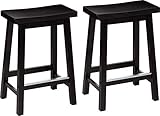
- Measure the seat height of any stool you are considering. Listings state overall height for stools with backs, which can be 10 to 15 inches taller than the seat. Look for the words “seat height” specifically. A stool marketed as 24 inches with a saddle seat, like the solid wood Amazon Basics pair at about $58, has a 24-inch seat; a backed stool listed at 38 inches overall may have a 24-inch seat as well.
- Check cushion compression. Padded seats sink 1 to 2 inches when someone sits. A PU leather counter stool at 24 inches, sold in pairs for about $70, will settle closer to 22.5 inches under an adult, so the effective clearance grows by that amount.
- Confirm the overhang. Measure horizontally from the cabinet face to the counter edge. Twelve inches is the minimum for knees to fit under; 15 inches is comfortable. Perfect vertical clearance does nothing if the knees hit the cabinet doors.
By Room or Use Case
Standard 36-inch kitchen island
This covers the large majority of American kitchens. Shop for stools with a 24- to 25-inch seat height; the sweet spot is 24 inches for a family with children and 25 to 26 inches for tall adults. Industrial counter stools at 24.8 inches, sold as a pair for around $40, and saddle stools at 23.6 inches with footrests, around $54 a pair, both land inside the 10- to 12-inch window under a 36-inch top. Space them 24 inches on center if backless, 28 inches if they have backs.
As an Amazon Associate we earn from qualifying purchases at no extra cost to you. Product prices and availability are accurate as of the date shown and are subject to change.



Raised bar section behind a work counter
Many islands step up to a 42-inch bar on the seating side. That section needs 30-inch seats, and the two heights cannot share stools. If you want one set of stools for both levels, choose adjustable-height models that travel from about 24 to 32 inches; the trade-off is a pneumatic post that can drift down a fraction of an inch over the years.
Island used by young children
Children ages 5 to 10 sit higher relative to the counter than adults because their thighs are thinner, so 10 inches of clearance is plenty and 12 can leave the counter near their chest. Pick the shorter end of the counter-height range, 23 to 24 inches, and prioritize a footrest 16 to 18 inches below the seat so feet do not dangle. A backless saddle stool is easier for kids to climb onto than a tall backed stool.
Home office or homework counter
Long sitting sessions favor 11 to 12 inches of clearance and a stool with a back and footrest. Adults working at a 36-inch counter for two or more hours will be more comfortable at a 25- to 26-inch seat than at 24 inches, because the slightly lower relative counter reduces shoulder tension while typing.
Outdoor or patio bar
Outdoor bar counters are frequently poured or built at 40 to 42 inches. Use 30-inch seats and keep in mind that outdoor stools often have thick composite seats that add 1 to 2 inches to the listed frame height; measure the actual seat, not the frame.
Common Sizing Mistakes
- Reading overall height as seat height. A “30-inch stool” with a back may have a 30-inch seat (bar height) or a 30-inch overall height with a 19-inch seat. The listing must say “seat height.”
- Buying bar stools for a counter-height island. A 30-inch seat under a 36-inch counter leaves 6 inches. The stool becomes decorative because no adult can sit on it.
- Ignoring the apron. Islands with a deep support rail or drawer front under the overhang reduce clearance by 2 to 4 inches. Measure to the lowest point.
- Forgetting cushion sink. A thickly padded 26-inch stool that compresses 2 inches ends up at 24 inches, which is perfect; a firm 26-inch wood seat stays at 26 inches and may feel high under a 36-inch top.
- Assuming a standard counter. Older homes, custom kitchens, and islands on thick flooring often measure 34 or 38 inches. One quick measurement prevents a return shipment on a 40-pound box.
- Solving height but not depth. Twelve inches of vertical clearance with only 8 inches of overhang still means knees against the cabinet.
FAQ
What seat height do I need for a 36-inch island?
A 24- to 26-inch seat. Twenty-four inches suits most households and children; 26 inches suits tall adults. Both keep clearance in the 10- to 12-inch range.
Is 8 inches of clearance enough?
No for adults. At 8 inches, thighs press against the counter underside and legs cannot cross. It is tolerable only for children under about 10 or for a stool used for a few minutes at a time.
Can I use dining chairs at a kitchen island?
Only if the island is table height, 28 to 30 inches. A standard 18-inch dining chair under a 36-inch counter leaves 18 inches of clearance, and the sitter’s chin ends up near the counter surface.
Should I buy adjustable-height stools to avoid measuring?
They solve the height question and are the sensible choice if you might move or remodel, but they cost more, weigh more, and the pneumatic post is the part that fails first. In 2026 a fixed-height stool matched to a measured counter remains the more durable buy, and the measurement takes 30 seconds.