Key takeaways
- Convertible ducted/ductless design offers installation flexibility
- LED light and three-speed fan cover a practical range of cooking tasks
- Mounting hardware and included duct adapter feel lower-grade
Choosing the right exhaust hood for your kitchen is not a cosmetic decision. Grease-laden air, combustion byproducts, and lingering cooking odors accumulate every time you turn on a burner, and a hood that moves too little air or fails to capture smoke at the source leaves residue on cabinets, paint, and walls. Over years of slow buildup, that residue becomes sticky, discolored, and genuinely difficult to remove without stripping finishes.
What separates a strong exhaust hood from a mediocre one comes down to a handful of measurable factors: airflow capacity expressed in cubic feet per minute, the geometry of the capture area relative to your cooktop width, filter design and how often it needs cleaning, noise output at each speed, and whether the unit can handle your existing ductwork or convert to a recirculating setup. Price ranges are wide in this category, from under $70 to well over $700, and the relationship between cost and performance is not linear. This guide compares published specifications, street pricing, and recurring owner feedback across eight models to help you find the right fit for your kitchen layout and budget in 2026.
As an Amazon Associate we earn from qualifying purchases at no extra cost to you. Product prices and availability are accurate as of the date shown and are subject to change.




Quick Picks
| Product | Best for | Price |
|---|---|---|
| Tieasy Wall Mount 30″ Chimney | Ducted or ductless flexibility on a budget | $110.48 |
| COMFEE’ Under Cabinet 30″ | Lowest-cost convertible option | $69.94 |
| VEVOR Commercial 7FT | Full-scale food trucks and concession trailers | $705.90 |
| IKTCH Insert 30″ 900 CFM | High-airflow enclosed cabinetry installs | $299.00 |
| Tieasy Baffle Filter 30″ | Easy grease cleanup under cabinet | $109.81 |
| FIREGAS Under Cabinet 30″ White | Bright kitchens needing a white finish | $74.99 |
| VEVOR Commercial 4FT | Smaller food trucks needing commercial capture | $478.41 |
| VIKIO HOME Wall Mount 30″ 580 CFM | Quiet operation with touch controls | $249.99 |
How We Picked
We prioritized four criteria. First, airflow capacity: a hood must move enough air to keep your cooktop area clear of smoke, with the right balance between CFM and static pressure for your duct length. Second, capture geometry and filter design, because a wide chimney style will trap more airborne grease than a shallow under-cabinet unit even at the same CFM. Third, installation flexibility: models that convert between ducted and ductless configurations serve a broader range of kitchen layouts. Fourth, owner-reported reliability on noise levels, light longevity, and ease of cleaning, which reveal whether published specs translate to daily satisfaction.
The 8 Best Exhaust Hood in 2026
Tieasy Wall Mount Range Hood 30 inch Chimney-Style
Owners who want the visual presence of a chimney-style hood without paying premium-brand prices will find this Tieasy model a solid entry point. The 450 CFM rating handles standard 30-inch cooktops for everyday sautéing and pan-frying, while the ducted/ductless convertible design means you can install it even without external ductwork. LED lighting illuminates the cooking surface without the heat and energy waste of older halogen bulbs. Pros include strong capture area geometry and a price under $110. The three-speed fan gives usable range between quiet simmer work and heavier cooking. The main drawback is that owner feedback notes the included duct adapter and mounting hardware feel basic, and some installers prefer to source their own parts for a secure fit. Skip this if your cooktop runs wider than 30 inches or you routinely do high-heat wok cooking that demands more airflow.
- Convertible ducted/ductless design offers installation flexibility
- LED light and three-speed fan cover a practical range of cooking tasks
- Mounting hardware and included duct adapter feel lower-grade
COMFEE’ Range Hood 30 Inch Under Cabinet 200 CFM
At just under $70, this COMFEE’ model is the most affordable convertible option in our roundup and suits renters or budget renovations where a hood is a code requirement rather than a performance priority. Two hundred CFM is modest but adequate for light cooking—boiling pasta, reheating leftovers, gentle sautés on a small cooktop. The under-cabinet form factor is unobtrusive, and the ductless mode with charcoal filters (sold separately) helps in apartments where cutting through an exterior wall is off-limits. Owners appreciate the simple installation and quiet operation at lower speeds. The primary limitation is capture area: grease splatter and steam escape easily from wider cooktops, and the 200 CFM ceiling means this hood will struggle with high-heat frying or multiple burners firing simultaneously. Skip it if you cook frequently or have a gas range that produces visible smoke on most sessions.
- Lowest price in the group with a dual-configuration design
- Quiet at lower speeds and simple to mount under a standard cabinet
- 200 CFM ceiling limits it to light cooking scenarios
VEVOR Commercial Exhaust Hood 7FT Food Truck Hood
This is a purpose-built commercial exhaust hood for food trucks, concession trailers, and restaurant kitchens where 30-inch residential models simply cannot keep up. The seven-foot width covers large ranges and fryer stations, and the 201 stainless steel construction resists rust in the humid, grease-heavy environment those settings create. Three detachable U-shaped grid oil filter meshes make cleaning manageable between shifts without removing the entire hood. At $705.90 it sits well below what a fabricated commercial hood would cost from a restaurant equipment dealer, and owners running mobile kitchens report it handles deep-frying and griddle work without overwhelming the interior with smoke. The trade-off is obvious: it is oversized, heavy, and overkill for any residential kitchen. Skip this entirely if you have a standard home stove—its dimensions alone require a commercial exhaust fan and dedicated ductwork.
- Seven-foot capture width handles large commercial cooking equipment
- Three detachable U-shaped filters simplify grease management during service
- Requires dedicated commercial ductwork and exhaust fan for proper operation
IKTCH 30 inch Insert Range Hood 900 CFM
The IKTCH insert is built for kitchens with custom cabinetry where the hood hides behind a decorative wood shell. At 900 CFM it moves substantially more air than most under-cabinet or wall-mount units in this price range, making it appropriate for serious gas cooking, high-heat stir-frying, or a 36-inch cooktop that extends past standard hood coverage. Ducted/ductless conversion is available, giving you options if your cabinet layout changes. Owners praise the raw power and the fact that it fits standard 30-inch cabinet openings. The main con is that insert-style hoods require a wood or metal decorative shell to complete the look, adding cost and a custom fabrication step. If your kitchen lacks existing cabinetry around the cooktop, skip this in favor of a self-contained wall-mount or chimney model that works out of the box.
- 900 CFM airflow handles heavy cooking and larger cooktops
- Insert form fits standard 30-inch openings behind decorative shells
- Requires a separate wood or metal enclosure for finished appearance
Tieasy Range Hood 30 inch with Baffle Filters
This under-cabinet Tieasy matches its wall-mount sibling on price and airflow—450 CFM at under $110—but swaps the chimney style for a flush under-cabinet profile and adds baffle filters. Baffle filters are a meaningful upgrade over mesh or charcoal types: grease clings to the metal baffles in an oily layer you can wipe off or run through a dishwasher, and they stay functional longer without the airflow restriction that clogged mesh filters create. Owners specifically call out easier cleanup as the reason they chose this model over pricier alternatives. The LED light and three-speed fan mirror the wall-mount version. Noise at the highest setting is noticeable but not objectionable for a hood this price. Skip this if you prefer a wall-mounted or island aesthetic, or if your cabinet spacing is too shallow for the under-cabinet mount depth.
- Dishwasher-safe baffle filters make grease cleanup genuinely simple
- 450 CFM with LED lighting at a competitive under-cabinet price
- Under-cabinet mount requires adequate cabinet depth for the housing
FIREGAS Range Hood 30 inch Under Cabinet White
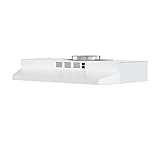
White kitchen appliances and fixtures have seen a resurgence, and finding a matching hood used to mean accepting a smaller airflow rating or paying a premium for a specialty finish. This FIREGAS model at just under $75 fills that gap with a clean white coat that integrates with shaker cabinets and farmhouse-style kitchens. Under-cabinet placement keeps it visually minimal. Published specs are less detailed than some competitors on CFM, which makes it harder to compare airflow directly, but owner feedback suggests it performs adequately for everyday cooking without heavy high-heat work. Installation is straightforward with standard under-cabinet brackets. The con is that the white finish, while attractive initially, shows grease discoloration more visibly than stainless steel in a hood’s working surface. Skip this if you do a lot of frying or want the lowest-maintenance finish over years of use.
- White finish matches bright kitchen color schemes at a low price
- Straightforward under-cabinet mounting with standard hardware
- White surfaces show grease buildup more visibly than stainless steel
VEVOR Commercial Exhaust Hood 4FT Food Truck Hood
A scaled-down version of the seven-foot model above, this four-foot VEVOR commercial hood targets food trucks and concession trailers with smaller cooking stations—a single griddle plus a fryer basket, or a compact range. The same 201 stainless steel construction and rust-resistant finish carry over, and two detachable U-shaped grid filters handle grease at a more manageable cleaning cadence. At $478.41 it undercuts the seven-foot option meaningfully while still providing commercial-grade capture geometry that residential hoods cannot match. Owners in mobile food businesses appreciate that the smaller footprint reduces exhaust fan requirements and duct routing complexity inside tight truck layouts. Skip this if you are outfitting a full line kitchen; the four-foot width leaves gaps on a standard six-foot range setup, and you will still need a compatible commercial exhaust fan.
- Commercial-grade stainless steel capture at a lower price than the 7FT option
- Two detachable filters keep cleaning time short between service periods
- Four-foot width leaves uncovered zones on a full commercial range
VIKIO HOME 30 Inch Wall Mount Range Hood 580CFM
At $249.99 this sits in the upper tier of residential hoods and justifies its price with 580 CFM, a touch-control panel, and low-noise operation. The wall-mount design gives it more visual presence than an under-cabinet unit and a wider capture angle for pulling smoke away from the cooktop. Touch controls are a small but genuinely pleasant daily interaction—no buttons to scrub around or plastic tabs that loosen over time. Owner feedback consistently highlights that the noise level stays tolerable even at higher speeds, which matters in open-plan kitchens where the hood runs during dinner conversation. The con is that at 580 CFM it draws more static pressure, so long horizontal duct runs or tight bends will reduce effective airflow. Skip it if your duct path exceeds ten feet or includes multiple 90-degree turns without a powered boost.
- 580 CFM with low-noise operation suits open-plan living spaces
- Touch-control panel is easier to keep clean than button interfaces
- Higher airflow demand reduces effective capture on long duct runs
Buying Guide
Matching CFM to Your Cooktop and Ductwork
Cubic feet per minute tells you how much air the fan moves, but usable airflow depends on static pressure losses from your duct path. A 450 CFM hood through a short, straight eight-foot duct delivers far more capture than the same unit through fifteen feet with two 90-degree elbows. For gas ranges, aim for roughly 100 CFM per linear foot of cooktop width as a starting point—so a 30-inch gas stove needs at least 300 CFM, and heavy cooking pushes that toward 500 or more. Electric and induction cooktops generate less smoke and grease but more ambient heat, so airflow matters slightly less. Check the manufacturer’s recommended duct size and maximum effective run length before purchasing.
Filter Types and Maintenance Realities
Metal mesh filters, baffle filters, and charcoal filters each serve a role. Baffle filters use a series of angled metal panels that force grease to condense on surfaces you can remove and wash—typically dishwasher-safe and durable for years. Mesh filters trap grease in fine wire layers that clog over time and need regular soaking to maintain airflow. Charcoal filters are used in ductless mode only; they absorb odor but do nothing for grease, and you must replace them every three to six months depending on usage. For a home kitchen, a baffle-filter design is the most practical choice. Commercial hood models use grid-style filters because heavy grease loads make mesh impractical and baffle geometry insufficient at commercial scale.
Mounting Style and Kitchen Layout
Under-cabinet hoods are the most common and easiest to install, fitting directly beneath existing upper cabinets with standard brackets. Wall-mount and chimney-style hoods require stud mounting to an exterior or interior wall and offer wider capture angles but less integration with cabinetry. Insert hoods need a wood or metal shell fabricated around them, making them a two-step purchase but the cleanest look in custom kitchens. Commercial-style hoods demand structural support due to weight and a dedicated exhaust fan rated for the capture area. Before buying, measure the space above your cooktop, check ceiling height, and confirm your duct exit location—rear, top, or convertible—so the physical housing clears your workspace.
Our Verdict
The VIKIO HOME 580 CFM wall-mount hood is the best overall pick for most home kitchens. Its airflow handles real cooking without the noise penalty that larger CFM numbers often bring, the touch controls age well, and the capture geometry suits 30-inch gas or induction ranges.
For budget-conscious buyers who need a functional hood without spending over $110, the Tieasy baffle-filter under-cabinet model offers the best combination of airflow, ease of maintenance, and price in that range.
The IKTCH insert wins in one specific scenario: you have existing upper cabinetry with a 30-inch opening already framed and a decorative shell either built or planned. No other model in this group matches its 900 CFM output within an enclosed cabinet design.
FAQ
How many CFM do I need for a gas range?
A general guideline is 100 CFM per linear foot of cooktop width, so a 30-inch gas range needs at least 300 CFM. If you regularly do high-heat cooking, frying, or work with multiple burners simultaneously, aim for 450 to 600 CFM or higher to maintain capture without overloading the fan on its top speed.
Can I use a ductless exhaust hood as a permanent solution?
Ductless hoods recirculate filtered air back into the kitchen using charcoal media, so they remove odor but not grease vapor, heat, or moisture. They work as a code-compliant minimum in apartments where external venting is impossible, but they will not keep your kitchen walls and cabinets free of grease film the way a ducted connection does.
How often should I clean the filters?
Baffle filters in a home kitchen typically need degreasing every one to three weeks depending on cooking volume. Charcoal filters in ductless mode require replacement every three to six months because they cannot be washed. Commercial grid filters used in food trucks or restaurant hoods demand cleaning after every service or daily, as grease loads are far heavier.
Is a chimney-style hood better than an under-cabinet hood?
Chimney and wall-mount designs have a larger capture area set farther above the cooktop, so they pull more smoke and steam into the intake before it disperses laterally. Under-cabinet hoods sit closer to the source and work well for smaller cooktops or light cooking, but they lose efficiency as your cooking intensity increases.