Key takeaways
- Classic Chef’s Knife (8-inch): The versatile standard with a curved belly for rock-chopping. An 8-inch blade like the imarku Japanese Chef Knife 8 Inch or the HOSHANHO Kitchen Knife 8 inch gives you 7.5 to 8 inches of usable edge, enough to slice a large onion or butternut squash in one stroke while keeping fingertips safe. Best if you have medium to large hands and a cutting board at least 14 x 10 inches.
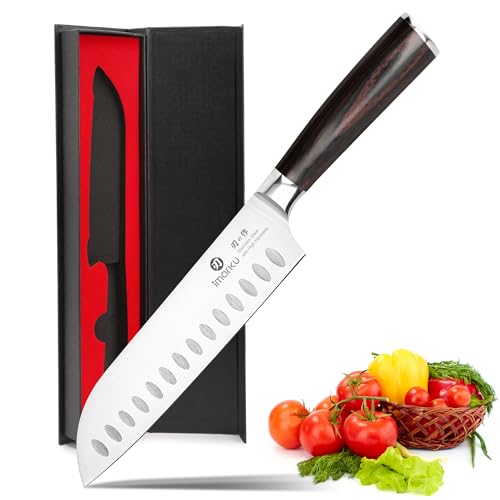
- Santoku (5.5 to 7-inch): Shorter, flatter, with a sheepsfoot tip and Granton divots to reduce sticking. The imarku Santoku Knife 7 Inch excels at straight up-and-down chopping and thin slicing, ideal for smaller hands, compact kitchens, or cooks who rarely rock-chop.
- Nakiri (6 to 7-inch): A straight-edged vegetable specialist. The Sunnecko Nakiri Knife 7 inch is designed for push-cutting and tap-chopping — the flat edge hits the board evenly, so you get clean, uniform cubes of potatoes, cabbage, and peppers with less accordion-cutting.
- Compact Chef’s Knife (6-inch): Nimble and lightweight, around 5.5 to 6.2 inches. The Farberware EdgeKeeper 6 Inch Chef Knife is a good fit for small boards, dorm kitchens, or if an 8-inch blade feels unwieldy. You sacrifice some knuckle clearance and slicing length but gain control.
A great chef’s knife handles about 90% of everyday prep — from mincing garlic and dicing onions to slicing chicken and chopping herbs. If your current knife crushes tomatoes instead of gliding through them, needs excessive force, or leaves your hand fatigued after five minutes, it’s costing you time and safety. The right choice feels like an extension of your hand: balanced, sharp, and predictable.
As of 2026, you don’t need to spend $300 to get that performance. This guide breaks down how to choose the right size, shape, steel, and handle for daily chopping, with concrete specs to look for and where specific popular models fit. Use it to match a knife to your cooking style, hand size, and maintenance preferences — not just marketing claims.
Our top picks


As an Amazon Associate we earn from qualifying purchases at no extra cost to you. Ratings are shown as listed on Amazon.
⚡ Save on Your Next PC — Amazon Prime
Prime members get fast free shipping on the systems above, plus early access to Prime Day & Black Friday PC deals. New members get a 30-day free trial.
Watch: How to Choose the Right Chef’s Knife for Everyday Chopping — Video Review
1. Choose the Right Blade Shape and Length
Length and profile determine how you chop and how much knuckle clearance you have. For everyday use, most home cooks are best served by one of these three profiles:
- Classic Chef’s Knife (8-inch): The versatile standard with a curved belly for rock-chopping. An 8-inch blade like the imarku Japanese Chef Knife 8 Inch or the HOSHANHO Kitchen Knife 8 inch gives you 7.5 to 8 inches of usable edge, enough to slice a large onion or butternut squash in one stroke while keeping fingertips safe. Best if you have medium to large hands and a cutting board at least 14 x 10 inches.
- Santoku (5.5 to 7-inch): Shorter, flatter, with a sheepsfoot tip and Granton divots to reduce sticking. The imarku Santoku Knife 7 Inch excels at straight up-and-down chopping and thin slicing, ideal for smaller hands, compact kitchens, or cooks who rarely rock-chop.
- Nakiri (6 to 7-inch): A straight-edged vegetable specialist. The Sunnecko Nakiri Knife 7 inch is designed for push-cutting and tap-chopping — the flat edge hits the board evenly, so you get clean, uniform cubes of potatoes, cabbage, and peppers with less accordion-cutting.
- Compact Chef’s Knife (6-inch): Nimble and lightweight, around 5.5 to 6.2 inches. The Farberware EdgeKeeper 6 Inch Chef Knife is a good fit for small boards, dorm kitchens, or if an 8-inch blade feels unwieldy. You sacrifice some knuckle clearance and slicing length but gain control.
2. Understand Steel, Hardness, and Edge Geometry
Steel determines how long an edge lasts, how easily it sharpens, and how stain-resistant it is. Look at these numbers rather than vague claims:
- Steel type: High-carbon stainless steel is the sweet spot for everyday use — it resists rust far better than pure carbon steel while taking a keen edge. All the knives referenced here, from the Amazon Basics Classic 8-inch Chef’s Knife to the HOSHANHO Kitchen Knife, use this category.
- Hardness (HRC): Aim for 56-58 HRC for easy maintenance and toughness, or 58-60 HRC for longer edge retention. Softer steel (56-58) like that in the Amazon Basics Classic is more forgiving if you occasionally hit a bone or frozen food and sharpens quickly with a basic whetstone. Harder Japanese-style steel (58-60) like that in the imarku Japanese Chef Knife holds a 15-degree per side edge longer but needs more careful honing.
- Edge angle: Western knives are typically ground to 17-20 degrees per side; Japanese-inspired knives to 15 degrees per side. A 15-degree edge feels sharper for vegetables and fish but will micro-chip faster on hard rinds if you twist the blade.
- Construction: Full tang with triple rivets, as seen on the Amazon Basics Classic 8-inch, adds balance and durability. Stamped blades are lighter and often thinner behind the edge for precise vegetable work; forged blades are heavier and aid rock-chopping through hearty produce.
3. Prioritize Fit, Balance, and Handle Comfort
A knife that doesn’t fit your hand won’t be used safely, regardless of steel quality. Test these points in-store or evaluate carefully online:
- Weight and balance: A good everyday chef’s knife weighs 180 to 280 grams. Balance point should be at or just in front of the bolster where blade meets handle. The HOSHANHO Kitchen Knife 8 inch is weighted slightly blade-forward for smooth forward cuts, while the Amazon Basics Classic is bolster-balanced for a neutral, familiar feel if you’re transitioning from older Western knives.
- Handle shape: Western handles are thicker with a pronounced bolster and suit a handle grip; Japanese wa-style or slim ergonomic handles like on the Sunnecko Nakiri and imarku Santoku favor a pinch grip (thumb and forefinger on the blade). Choose based on how you naturally hold a knife during a 10-minute prep session.
- Size match: If your hand span is under 7 inches or you have limited wrist strength, a 7-inch Santoku or 6-inch chef’s knife reduces strain. If you wear a glove size L or larger, an 8-inch handle with full length prevents your knuckles from hitting the board.
- Knuckle clearance: Blade height at the heel should be 45 to 55mm for an 8-inch knife. This gives you room to chop without rapping knuckles and lets you scoop food with the side of the blade.
4. Consider Maintenance: Sharpening, Honing, and Care
Sharpness is a maintenance decision, not a one-time purchase. Your willingness to sharpen should guide your pick:
- Self-sharpening cover: If you want minimal upkeep, the Farberware EdgeKeeper 6 Inch Chef Knife includes a sheath with a built-in ceramic honing rod that realigns the edge each time you insert and remove the knife. It’s not a substitute for true sharpening every 6-12 months, but it keeps the edge serviceable for busy cooks.
- Honing vs. sharpening: Hone with a ceramic or steel rod for 3-4 light strokes per side before heavy prep to straighten the edge. Sharpen on a 1000/3000 grit whetstone or have it professionally ground 1-2 times per year if you cook 5+ times per week.
- Care rules: Hand wash and dry immediately — even stainless steel can pit if left wet with acidic foods. Never put a good chef’s knife in the dishwasher, on a glass board, or in a drawer unprotected. Store on a magnetic strip or in a blade guard.
- Corrosion and staining: High-carbon stainless minimizes rust, but still wipe clean after cutting citrus, tomatoes, and onions. A 30-second rinse and towel dry prevents the dull gray patina that makes edges feel draggy.
Tips
- Try the pinch grip test: Hold the knife where blade meets handle for 30 seconds. If your forefinger slips or your wrist twists, the handle profile is wrong for you, no matter how good the reviews are.
- Match knife to board: Use a wood or soft plastic cutting board. End-grain wood extends edge life by 30-40% compared to glass, ceramic, or bamboo.
- Start with one workhorse: For most households, one reliable 7 or 8-inch knife covers 90% of tasks. Add a Nakiri or Santoku as a second knife only if you prep vegetables daily.
- Measure your space: If your cutting board is under 13 inches long, an 8-inch chef’s knife will overhang. Choose the imarku Santoku 7 Inch or Farberware EdgeKeeper 6 Inch instead for safer clearance.
Frequently Asked Questions
Is a 6-inch or 8-inch chef’s knife better for everyday chopping?
For most adults, 8 inches is more efficient because the longer edge and taller blade give you longer slices and better knuckle clearance. Choose 6 inches if you have small hands, a small board, or limited storage — you will get more control and less fatigue, especially with a lighter knife like the Farberware EdgeKeeper 6 Inch. If you are between sizes, 7 inches, as with the Sunnecko Nakiri or imarku Santoku, is an excellent compromise.
What is the difference between a chef’s knife, Santoku, and Nakiri?
A Western chef’s knife has a curved belly for rocking and a pointed tip for detail work. A Santoku has a flatter profile, a blunter tip, and Granton hollows for all-purpose chopping and slicing, especially proteins and vegetables. A Nakiri has a completely flat, squared-off edge for straight vertical vegetable chops — it is not designed for rocking or piercing. Choose the motion you use most: rock-chop = chef’s knife, push-chop and slice = Santoku or Nakiri.
How often should I sharpen my everyday knife?
Hone lightly before 2-3 uses and sharpen when the knife slides off a tomato skin instead of biting it. For home cooks preparing 4-6 meals per week, that means professional sharpening or whetstone sharpening every 6 to 9 months for steel around 58-60 HRC, and every 9 to 12 months for softer 56-58 HRC steel. The Farberware EdgeKeeper system extends the time between sharpenings, but does not replace grinding a new edge when the blade is truly dull.
Are high-carbon stainless steel knives dishwasher safe?
No. Even with stainless labeling, high heat, harsh detergents, and rattling in a dishwasher dull the edge, loosen handles, and can cause micro-pitting along the edge. Hand wash with warm soapy water, rinse, and towel dry within a minute. It takes 20 seconds and preserves the factory edge 3 to 4 times longer than machine washing.
Conclusion
The right everyday chopping knife is the one that fits your hand, board, and maintenance habits. If you want one versatile buy, an 8-inch high-carbon stainless chef’s knife like the Amazon Basics Classic 8-inch or the imarku Japanese Chef Knife 8 Inch covers nearly every task. Prefer vegetables and push-cutting? Go for the Sunnecko Nakiri 7 inch or imarku Santoku 7 Inch. Need low upkeep in a small kitchen? The Farberware EdgeKeeper 6 Inch and the ergonomic HOSHANHO 8 inch are smart, forgiving options. Choose based on length, hardness, and handle fit — and you will chop faster, safer, and with far less effort in 2026 and beyond.