Key takeaways
- Use a bow-design knife like the SYOKAMI or Woodever, which includes an adjustable guide for consistent thickness.
- Rotate a round loaf as you go rather than forcing the blade through the widest point.
- Let hot bread cool for 20 to 30 minutes before slicing so it does not tear or gum up.
- Mark your first cut and use the previous slice’s face as a visual guide for the next.
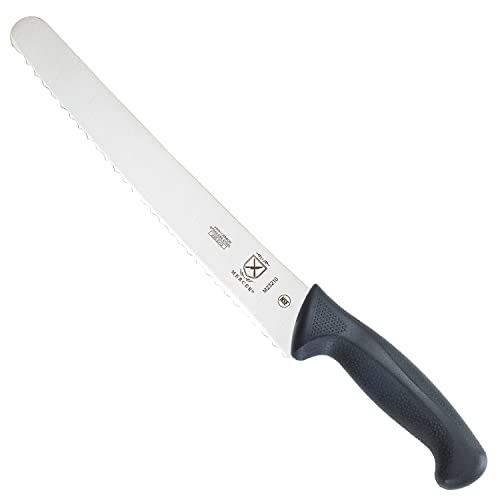
A great bread knife and the right technique are the difference between clean, even slices and a crushed, crumb-scattered loaf. The serrated edge on a knife like the Mercer Culinary Millennia 10-inch grips a crusty exterior and saws through without compressing the soft interior, letting you cut everything from a delicate sandwich loaf to a crackling sourdough with ease.
This guide teaches you how to choose a bread knife and, just as importantly, how to use it: the sawing motion, blade angle, and slicing aids that produce bakery-even slices. Whether you own a classic offset Mercer or a modern bow-design knife like the SYOKAMI, mastering these fundamentals will transform how you cut bread.
Our top picks


As an Amazon Associate we earn from qualifying purchases at no extra cost to you. Ratings are shown as listed on Amazon.
⚡ Save on Your Next PC — Amazon Prime
Prime members get fast free shipping on the systems above, plus early access to Prime Day & Black Friday PC deals. New members get a 30-day free trial.
Watch: How to Master the Art of Slicing with a Bread Knife — Video Review
Choosing the Right Bread Knife
Length and edge style matter most. A 10-inch blade like the Mercer Millennia or imarku spans a large boule in one stroke, while an 8-inch Orblue suits smaller loaves and tighter storage. Wavy or pointed serrations both work; wavy edges like the Mercer’s tend to grip crust aggressively. Bow-design knives such as the SYOKAMI and Woodever add a built-in guide bar that keeps the blade straight for uniform slices.
Mastering the Sawing Motion
The golden rule is to let the knife do the work. Use long, gentle back-and-forth saw strokes and almost no downward pressure; pressing down crushes the crumb. Start with the heel of the blade on the crust, draw the knife back to break the surface, then push forward through the loaf. A serrated edge cuts on the pull and the push, so keep strokes full and unhurried.
Getting Uniform Slices
- Use a bow-design knife like the SYOKAMI or Woodever, which includes an adjustable guide for consistent thickness.
- Rotate a round loaf as you go rather than forcing the blade through the widest point.
- Let hot bread cool for 20 to 30 minutes before slicing so it does not tear or gum up.
- Mark your first cut and use the previous slice’s face as a visual guide for the next.
Caring for Your Bread Knife
Serrated blades stay sharp far longer than straight edges, but they still need care. Hand wash and dry the knife immediately rather than using the dishwasher, which dulls and corrodes the steel. Store it in a block, sheath, or on a magnetic strip so the serrations do not knock against other tools. When it finally dulls, a serrated blade needs a specialized rod sharpener or professional service, not a standard whetstone.
Tips
- Never press down; a light sawing motion protects the soft interior of the loaf.
- Cool fresh bread 20 to 30 minutes before slicing to avoid a gummy, torn crumb.
- Hand wash and dry immediately to protect the serrated edge from corrosion.
- Use an offset or bow-handle knife to keep your knuckles clear of the cutting board.
Frequently Asked Questions
Why does my bread get crushed when I slice it?
Crushing comes from pressing down instead of sawing. Let the serrations do the cutting with long, gentle strokes and almost no downward pressure, and the crumb stays intact.
What length bread knife is best?
A 10-inch blade like the Mercer Millennia handles large boules and sourdough in one stroke, while an 8-inch knife suits smaller loaves and storage. Longer blades give smoother, single-pass slices.
Can you sharpen a serrated bread knife?
Yes, but not on a standard whetstone. Serrated edges need a tapered sharpening rod that fits each gullet, or professional sharpening. Fortunately they hold an edge much longer than straight blades.
Are bow-design bread knives worth it?
For uniform slices, yes. Bow knives like the SYOKAMI and Woodever include a guide bar that keeps the blade straight and even, which is especially helpful for homemade sourdough and bagels.
Conclusion
Slicing bread beautifully is a skill anyone can learn: choose a quality serrated knife sized to your loaves, saw gently without pressing, and let hot bread cool before cutting. A classic offset blade like the Mercer Millennia or a guided bow-design knife like the SYOKAMI makes uniform slices almost automatic. Care for the edge with hand washing and proper storage, and your bread knife will deliver clean, even slices for years.