Key takeaways
- Compare saddle and flat counter stool seats using clear measurement endpoints, shape views and a personal sitting check before ordering.
What's inside
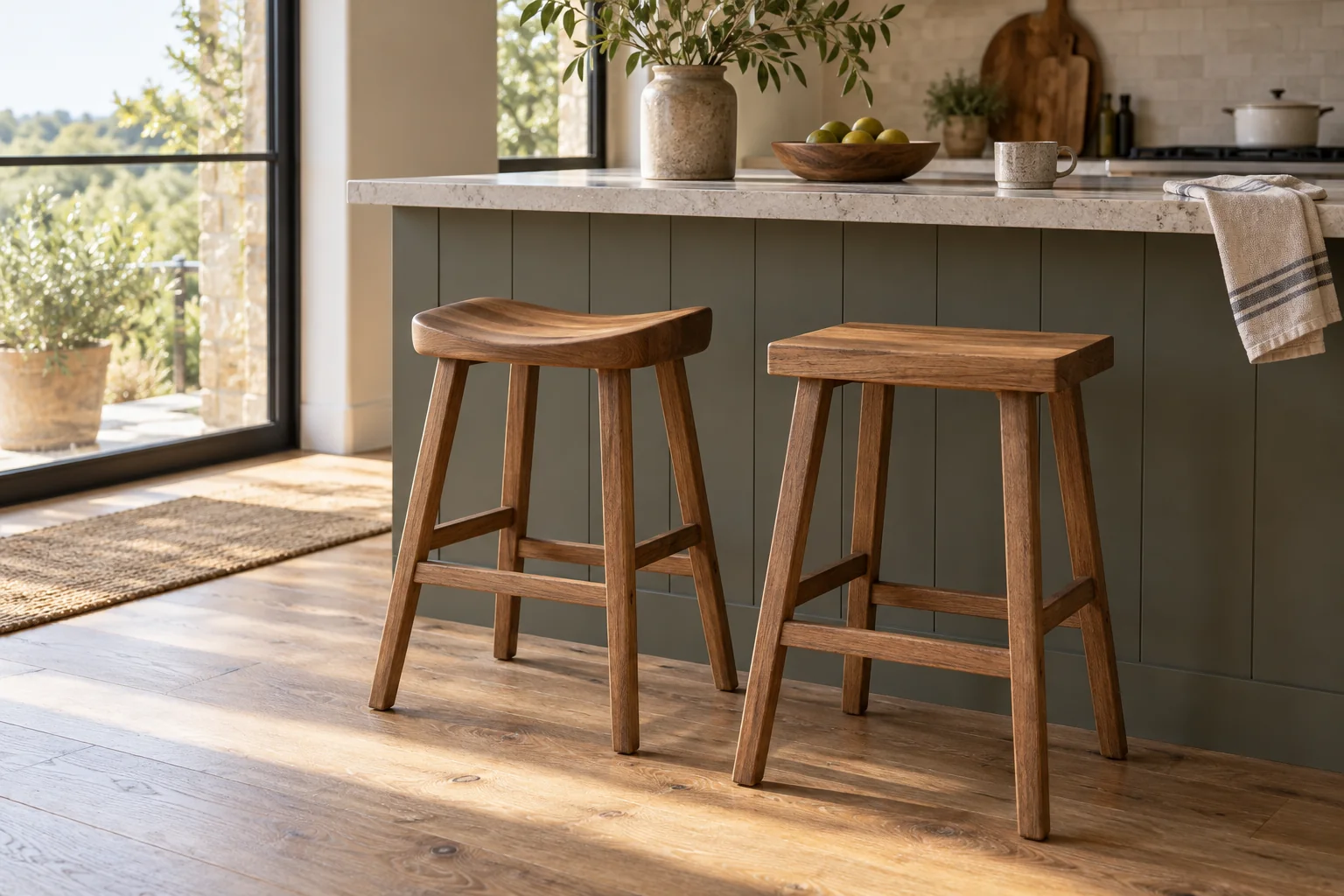
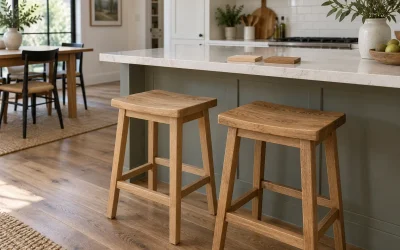
A saddle stool and a flat stool can share the same advertised width while offering quite different places to sit. Compare the actual seat outline, its contour and the points used for each measurement before deciding that one is larger. Overall furniture dimensions alone cannot establish personal comfort.
Start with the part being measured
Separate three outlines: the complete stool seen from above, the seat’s outer edge, and the part of the seat you can comfortably use. Legs can project beyond a small seat. A padded edge can increase outside width without giving the same support as the middle. Neither situation is visible in a single overall-width number.
Use the seller’s drawing to identify which outline its dimensions describe. If there is no drawing, request a photograph with the measurement endpoints marked. Ask for seat width and depth independently rather than asking whether the stool is suitable for an average adult. That question invites an opinion where a dimension would be more useful.
For example, Bassett’s Vail Saddle Counter Stool, SKU 4021-0188F-1, lists overall dimensions separately from seating measurements. This is a useful reminder to keep the fields separate. A product name containing saddle does not define the measurement method for another brand.
Read a contoured seat in two views
A top view helps establish the outline. A side or end view shows the raised edges and the central dip. Ask which direction the curve runs and where the stated seat height is taken. Do not silently assume the highest edge, the center and the occupied cushion height are identical.
For a flat seat, establish whether the listed dimensions include a rounded edge or piping. A rectangular outline may still have curved corners. A round seat needs a diameter, while a shaped saddle may need several widths at different positions. Keep the maker’s terms instead of converting every shape into a misleading rectangle.
Also distinguish a straight measurement between two points from one following the surface curve. These are different quantities. You usually need the maker’s straight seat dimensions for comparison, then an actual sitting check to understand the contour. A flexible tape laid over a dip should not be compared with a straight line across another stool.
Make a comparison that exposes missing information
| Question | Record for each stool | What it resolves |
|---|---|---|
| What is the outside seat shape? | Outline and front direction | Avoids treating all widths as equivalent |
| Where were width and depth measured? | Marked endpoints and units | Makes the numbers comparable |
| How does the seat curve? | End and side photographs | Shows raised edges and center |
| What height is published? | Exact reference point | Separates edge from sitting position |
| What did the intended user notice? | Contact, movement and preferred position | Keeps comfort personal |
| What remains unknown? | Specific question for the seller | Prevents an assumed fit |
A worked comparison without a comfort score
Imagine Stool A has a seat listed as 18 inches wide and Stool B as 17 inches wide. The supplier confirms that A’s number spans its raised outer edges. B’s number describes a flat rectangular top. These numbers establish different outside dimensions; they do not establish that A gives a particular person more comfortable room.
The buyer requests a top photograph and the saddle’s end profile. During an authorized showroom check, they find that their preferred position on A is slightly forward of the deepest part. They record that observation, then try B at a comparable counter. They have learned something about these two configurations, not proved that flat stools suit everyone better.
If only A is available to try, mark B as untested. Do not replace that gap with a paper cutout comfort test. A paper outline can illustrate scale, but it cannot reproduce pressure, upholstery compression or the way a curved edge meets the body.
Try the seat in the intended setting
Ask the showroom to demonstrate the stool’s normal use and identify its front. Sit in the position you expect to use for a meal or a short task. Notice whether the contour encourages one position and whether you can change position comfortably. Stop if the trial feels unstable or requires an awkward movement.
Keep counter height, legroom and foot support as separate checks. An excellent seat shape does not resolve a poor relationship with the counter. Conversely, a correct nominal stool height does not establish that its particular saddle contour suits you. Record both results without collapsing them into one size label.
Confirm the configuration before ordering
Save the precise model, seat option, upholstery and height variant you assessed. A bar-height version, an upholstered version and a wooden version may not use identical seat details. Ask the seller to confirm that the order matches the demonstrated configuration.
Your final decision should explain the seat’s measurement basis and your own experience of its shape. That gives you a useful comparison even when the manufacturers publish different kinds of dimensions.