Key takeaways
- Bevel style: Single bevel tilts one direction, so crown and wide baseboard require flipping the stock. Double bevel lets you cut left and right without moving the workpiece, which removes a whole class of orientation errors on mirrored miters.
- Cut indication: A shadow-line system casts the blade’s actual silhouette onto your pencil mark, so there’s nothing to calibrate. Lasers are useful but need periodic alignment and can drift out of true after a knock.
- Detent quality: Positive stops at common angles should seat with an audible click and zero play. Check that the miter lock clamps independently of the detent, so you can hold an off-angle like 22.5 or a shimmed 45.2 for a tight fit.
- Capacity versus footprint: A 12-inch slider crosscuts wide panels and thick table aprons, but it needs rear clearance. A 10-inch fixed-head saw is lighter, easier to shelve, and plenty for frames, legs, and trim.
- Fence and support: Tall sliding fences and extension wings keep long stock flat and square. Any deflection at the fence face translates directly into an open joint at the corner.
What's inside
Miter joints are the quiet test of any furniture project. A picture frame, a waterfall-edge nightstand, a run of shadow-gap trim around a built-in bookcase — none of it forgives a corner that’s off by half a degree. That gap catches light, and once you see it, you can’t unsee it. Most buyers discover this the hard way, after assuming that any saw sold as a “miter saw” will deliver a joint tight enough to glue up without filler.
The difference comes down to design: how rigidly the pivot is built, how repeatably the detents land, how honestly the cut line is shown to you before the blade drops. This guide looks at six saws through that lens — sliding versus fixed heads, single versus double bevel, shadow-line indication versus laser — and lays out which ones hold a 45 well enough for furniture-grade work in 2026.
As an Amazon Associate we earn from qualifying purchases.


How to Choose a/an The Best Designed Saw For Cutting Miter Joints Is A (2026)
- Bevel style: Single bevel tilts one direction, so crown and wide baseboard require flipping the stock. Double bevel lets you cut left and right without moving the workpiece, which removes a whole class of orientation errors on mirrored miters.
- Cut indication: A shadow-line system casts the blade’s actual silhouette onto your pencil mark, so there’s nothing to calibrate. Lasers are useful but need periodic alignment and can drift out of true after a knock.
- Detent quality: Positive stops at common angles should seat with an audible click and zero play. Check that the miter lock clamps independently of the detent, so you can hold an off-angle like 22.5 or a shimmed 45.2 for a tight fit.
- Capacity versus footprint: A 12-inch slider crosscuts wide panels and thick table aprons, but it needs rear clearance. A 10-inch fixed-head saw is lighter, easier to shelve, and plenty for frames, legs, and trim.
- Fence and support: Tall sliding fences and extension wings keep long stock flat and square. Any deflection at the fence face translates directly into an open joint at the corner.
The Best The Best Designed Saw For Cutting Miter Joints Is A (2026)s Reviewed
DEWALT DWS780 12-Inch Double Bevel Sliding Compound Miter Saw
The XPS shadow light is the standout design decision here — it shows the blade’s true kerf rather than an approximation, which is exactly what you want when you’re splitting a pencil line on a mitered frame stile. Add double bevel, a rigid slide, and effective dust collection, and this is the saw to buy if miter joints are the point rather than an afterthought.
DEWALT DWS779 12-Inch Double Bevel Sliding Compound Miter Saw
Mechanically close to the DWS780 with the same 3,800 RPM motor and generous crosscut capacity, minus the shadow light. If you’re comfortable working to a scribed line or adding your own task lighting, it’s the more sensible spend for cabinet carcasses and wide aprons.
DEWALT DWS715 12-Inch Single Bevel Compound Miter Saw
A fixed-head 12-inch saw with a stainless miter detent plate that holds its angles under real use — the tradeoff is flipping stock for opposing bevels. Excellent value for trim, legs, and stretchers where you rarely need slide capacity.
DEWALT DWS713 10-Inch Single Bevel Compound Miter Saw
Light enough to move between a garage bench and a job site, and precise enough for picture frames, gallery ledges, and small casework. The tall sliding fence supports base molding better than the compact footprint suggests.
DOVAMAN 10-Inch Sliding Miter Saw
An ambidextrous layout, dual speeds, and three TCT blades make this the most versatile pick for mixed-material work — wood one afternoon, aluminum extrusion the next. The 3.5 x 13.4 inch capacity and nine positive stops cover most furniture-scale miters at a friendly price.
Frequently Asked Questions
Why do my miter joints still gap at 45 degrees?
Usually the saw is fine and the reference isn’t. Check that the fence is square to the blade at 0, then cut two test pieces and fold them together — if the gap is at the heel, your angle is slightly under 45; at the toe, slightly over. Adjust in tenths, not degrees.
Do I need a sliding saw for furniture?
Only if you crosscut wide stock. Frames, legs, rails, and most trim fall well within a fixed 10 or 12-inch saw’s capacity; slides earn their keep on shelves, panels, and table aprons over roughly 8 inches.
Is the shadow light genuinely better than a laser?
For repeatable accuracy, yes. It projects the blade itself, so it can’t fall out of calibration and it accounts for kerf width automatically.
Does the stock blade matter for clean miters?
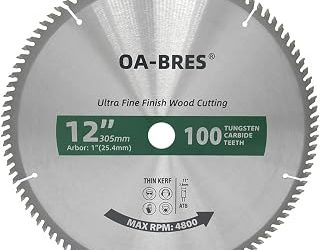
Significantly. A 60 to 80-tooth fine-finish blade reduces tearout on end grain and veneered edges far more than any other single upgrade.
Final Thoughts
For furniture-grade miters, the DEWALT DWS780 remains the most thoughtfully designed option thanks to shadow-line indication and true double bevel. Choose the DWS779 if you want the same capacity for less and don’t mind marking by eye, or the DOVAMAN 10-inch slider if you value multi-material flexibility and a compact bench footprint.