Key takeaways
- Bevel configuration: Single-bevel saws tilt one direction, so you flip the workpiece for opposing cuts — fine for frames and trim. Dual-bevel saws tilt both ways, which matters enormously for crown molding and any long stock you’d rather not wrestle end-for-end.
- Positive stops and micro-adjust: Look for nine detents at the common angles plus a miter-detent override. The override lets you park at 45.2 degrees when your wall isn’t truly square, which is the difference between a tight joint and caulk.
- Slide versus chop: A sliding head buys crosscut width for wide aprons, shelf boards, and stair treads. A fixed chop saw is stiffer, cheaper, and lighter — a reasonable trade if your stock stays under about eight inches.
- Cut-line indication: Shadow-line LED systems cast the blade’s own silhouette on the workpiece and need no calibration. Lasers are effective but require periodic alignment and can wash out under shop lighting.
- Blade and dust management: A 40-tooth general blade is a starting point; expect to upgrade to 60–80 teeth for clean end-grain in hardwood and veneered panels. Also check the dust port diameter against your shop vac hose before buying an adapter.
What's inside
A miter joint is the most unforgiving cut in furniture work. Two boards meet at 45 degrees, and if either one drifts by a fraction of a degree, the seam telegraphs that error straight to the front of your piece — a hairline gap in a picture frame, a lifted corner on a floating shelf, a table apron that never quite sits flush. Most people blame their technique. More often, the culprit is a saw whose detents are vague, whose fence isn’t square to the table, or whose blade deflects under load in dense hardwood.
This guide looks at miter saws through the lens of joinery rather than framing. I’ve weighted the picks toward the things that actually determine whether a corner closes: positive-stop repeatability, blade quality out of the box, cut-line visibility, and how much crown or wide stock the machine can handle without a workaround. Below you’ll find the standouts for 2026 across single-bevel, dual-bevel, and sliding formats, plus the specs worth checking before you commit.
As an Amazon Associate we earn from qualifying purchases.



How to Choose a/an The Best Saw For Cutting Miter Joints Is The (2026)
- Bevel configuration: Single-bevel saws tilt one direction, so you flip the workpiece for opposing cuts — fine for frames and trim. Dual-bevel saws tilt both ways, which matters enormously for crown molding and any long stock you’d rather not wrestle end-for-end.
- Positive stops and micro-adjust: Look for nine detents at the common angles plus a miter-detent override. The override lets you park at 45.2 degrees when your wall isn’t truly square, which is the difference between a tight joint and caulk.
- Slide versus chop: A sliding head buys crosscut width for wide aprons, shelf boards, and stair treads. A fixed chop saw is stiffer, cheaper, and lighter — a reasonable trade if your stock stays under about eight inches.
- Cut-line indication: Shadow-line LED systems cast the blade’s own silhouette on the workpiece and need no calibration. Lasers are effective but require periodic alignment and can wash out under shop lighting.
- Blade and dust management: A 40-tooth general blade is a starting point; expect to upgrade to 60–80 teeth for clean end-grain in hardwood and veneered panels. Also check the dust port diameter against your shop vac hose before buying an adapter.
The Best The Best Saw For Cutting Miter Joints Is The (2026)s Reviewed
DEWALT DWS780 12-Inch Double Bevel Sliding Compound
This remains the benchmark for furniture-grade miters: the XPS shadow line shows your exact kerf without calibration, and the dual-bevel geometry means compound cuts happen without repositioning long stock. It’s heavy and priced accordingly, but the detent repeatability is what you’re paying for.
DOVAMAN 12-Inch Dual-Bevel Sliding Miter Saw
A strong value case for the dual-bevel sliding format, with a 4.2 x 13-inch capacity that swallows wide shelving and nine positive stops for fast returns to common angles. The ambidextrous handle is genuinely useful for left-handed users, a detail most manufacturers ignore.
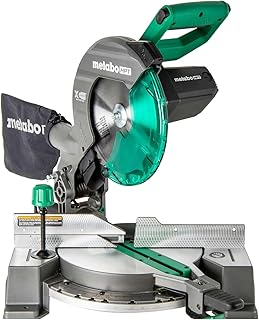
Metabo HPT C10FCG2 10-Inch Single Bevel Compound
At roughly 24 pounds, this is the one I recommend to people building furniture in a garage they also park in — it moves easily and the Xact Cut shadow line delivers premium cut-line visibility at an entry price. Capacity is limited, so treat it as a trim and frame specialist.
DEWALT DWS715 12-Inch Single Bevel Compound
The sensible middle ground: a 12-inch blade gives you real crosscut depth for 4x material without the cost or bulk of a slide mechanism. The tall sliding fence supports base molding up to 6.5 inches vertically, which covers most casework trim.
DOVAMAN 10-Inch Sliding Miter Saw
Notable for its dual-speed motor and three included TCT blades, which lets you move between hardwood, aluminum extrusion, and laminate without a separate purchase. The 3.5 x 13.4-inch capacity is generous for a 10-inch saw.
Frequently Asked Questions
Why do my 45-degree cuts still leave a gap?
Usually the fence isn’t square to the table, or the detent is slightly off. Test with a five-cut method on scrap and adjust the fence rather than compensating with the miter angle.
Is 12 inches always better than 10 inches?
No. A 12-inch blade adds depth and width capacity but also more deflection potential and higher blade costs. For frames, boxes, and trim, a quality 10-inch saw often cuts cleaner.
Do I need a sliding saw for furniture?
Only if you regularly crosscut stock wider than about eight inches. Table aprons, shelves, and bench tops justify it; face frames and picture frames don’t.
Should I replace the included blade?
For visible joinery, yes. A 60- to 80-tooth fine-finish blade dramatically reduces tearout on end grain, plywood edges, and veneered stock.
Final Thoughts
If your work involves visible joinery and you want one saw to cover it all, the DEWALT DWS780 is still the most trustworthy choice — the shadow line and dual-bevel range remove guesswork from compound cuts. Budget-conscious builders should look hard at the DOVAMAN 12-inch dual-bevel for similar capability at a lower entry point, while the Metabo HPT C10FCG2 is the pick for anyone who needs precision from a saw light enough to carry and store.