Key takeaways
- 40° white: painted surfaces, windows, outdoor furniture, vehicle paint
- 25° green: decking, siding, patio slabs, general rinsing
- 15° yellow: concrete, stubborn stains, joint cleaning
- Soap tip: low pressure only, for detergent application
What's inside
PSI is the number printed largest on every pressure washer box, and it is the number most likely to lead you astray. Pressure — pounds per square inch — describes force at the nozzle, but force alone does not clean. It strips, etches, and occasionally ruins. What actually lifts grime off a surface is the marriage of pressure and flow, and the right pairing depends entirely on whether you are rinsing a teak dining set or reviving twenty years of algae from a concrete drive.
This guide breaks down which PSI range suits which job, why GPM deserves equal billing, how electric and gas machines differ in real use, and where nozzles and accessories quietly do half the work. By the end you should be able to look at a spec sheet and know within seconds whether a machine fits your house, your surfaces, and your patience. Below are the picks we keep returning to when outfitting a home for outdoor upkeep.
As an Amazon Associate we earn from qualifying purchases.


The PSI Ranges That Actually Matter
Think in bands rather than exact numbers. Between 1,300 and 1,900 PSI you are in light-duty territory: painted furniture, window screens, garden pots, bicycles, and vehicle bodywork. From 2,000 to 2,800 PSI sits the sweet spot for most homes — siding, fencing, composite decking, patio slabs, and car wheels without the risk of gouging softwood. Push into 2,900 to 3,600 PSI and you are equipped for masonry, oil-stained garage floors, paver joints, and long driveways where dwell time costs you an afternoon. Above roughly 4,000 PSI you are into contractor and industrial work, where the machine outpaces almost every residential surface it touches. For the majority of readers, something in the 2,400 to 3,400 PSI window handles everything without becoming a liability.
Why GPM Deserves Equal Attention
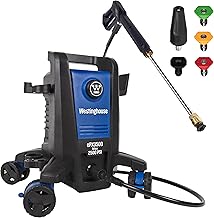
Pressure breaks the bond between dirt and surface; water volume carries the dirt away. Gallons per minute is what determines how fast you finish. A 2,500 PSI machine at 1.76 GPM, like the Westinghouse ePX3500, is well matched for cars, patios, and fence panels. A 3,400 PSI unit at 2.6 GPM, as with the Westinghouse WPX3400, does not just hit harder — it clears a wider path with each pass, which is the difference between an hour and three on a large driveway. Multiply PSI by GPM to get cleaning units, a rough but useful yardstick for comparing machines that look similar on paper. Two thousand PSI at 2.0 GPM will often outwork 2,800 PSI at 1.2 GPM.
Electric Versus Gas: A Practical Split
Electric machines are quieter, lighter, start instantly, and require essentially no maintenance beyond storing them somewhere frost-free. Their ceiling is real, though: most top out below 2,600 PSI and modest flow. Gas engines deliver the pressure and volume that make large hard surfaces manageable — the DeWalt DXPW3300-S at 3,300 PSI and 2.4 GPM with an AAA axial cam pump is a fair example of the residential gas class. The trade-off is noise, fuel, oil changes, and weight. Choose electric if your work is furniture, vehicles, and a modest patio. Choose gas if you have a driveway, long stretches of fencing, or masonry that has never been cleaned.
Nozzles Change Everything
A nozzle can turn one machine into five. The colour-coded set that ships with most units — typically 0, 15, 25, and 40 degrees plus soap — determines how the same PSI lands on the surface. Wider fans spread the force and are safer; narrow ones concentrate it into a cutting line. The 0-degree red tip has almost no place in home use.
- 40° white: painted surfaces, windows, outdoor furniture, vehicle paint
- 25° green: decking, siding, patio slabs, general rinsing
- 15° yellow: concrete, stubborn stains, joint cleaning
- Soap tip: low pressure only, for detergent application
Replacement guns and wands extend that flexibility further. A Sooprinse gun rated to 3,000 PSI with quick-connect tips, or the adjustable GDHXW wand with its extension and adapter set, lets you dial down force for delicate work without swapping machines. For vehicles, a dual-connector foam cannon kit produces the thick clinging lather that loosens road film before you ever apply pressure.
Matching Pressure to Surface
Test on an inconspicuous patch every time, standing at least two feet back and closing in only if needed. Softwood decking, cedar fencing, and painted furniture bruise easily and rarely need more than 1,500 PSI at the surface — distance and nozzle angle give you that control regardless of the machine’s rating. Vinyl siding tolerates around 2,000 PSI with a wide fan and a downward angle to avoid driving water behind the panels. Concrete, brick, and stone are the only common residential surfaces that genuinely reward 3,000 PSI and above. Never point a pressure washer at roof shingles, window seals, electrical fittings, or air conditioning coils.
Tips
- Always start with the widest nozzle and the greatest distance, then work closer — you cannot undo an etched stripe in decking.
- Apply detergent from the bottom upward and rinse from the top down, letting soap dwell for several minutes rather than scrubbing with pressure.
- Connect a full-flow garden hose and open the tap before starting; running a pump dry is the fastest way to kill a machine.
- Anti-tipping designs and stable wheeled frames matter more than they sound, especially when you are pulling a hose across uneven paving.
Frequently Asked Questions
What PSI is safe for washing a car?
Stay between 1,200 and 1,900 PSI at the surface, with a 40-degree tip and a foam cannon doing the heavy lifting. Higher-rated machines are fine provided you back off the distance and never use narrow tips on paint or trim.
Is 3,400 PSI too much for a home?
Not if you understand nozzle control. A higher-rated machine gives you headroom for concrete and masonry, and you simply widen the fan or step back for gentler surfaces. The risk is user habit, not the rating itself.
Do I need a gas model for a driveway?
For anything beyond a short single-car drive, gas is a meaningful time saver because of flow rate as much as pressure. A quality electric unit will do the job, but expect to spend considerably longer on it.
Can I clean wooden garden furniture with a pressure washer?
Yes, cautiously. Use the widest nozzle, keep 18 to 24 inches of distance, move with the grain, and let the wood dry fully before oiling or sealing. Hardwoods like teak handle this far better than softwoods.
Conclusion
The best PSI is the lowest one that finishes the job, paired with enough flow to make it quick. For most homes that means a mid-range electric machine around 2,500 PSI for furniture, vehicles, and patios, or a 3,300 to 3,400 PSI gas unit if driveways and masonry dominate your list. Invest in nozzles and a decent gun before you chase a bigger number on the box — control is what protects your surfaces and delivers the finish worth looking at.