Key takeaways
- No stated clearance requirement. Every OTR unit must specify minimum distance to the cooktop. If it does not, the manufacturer skipped the safety documentation.
- “Under-cabinet” in the title but no mounting kit listed or sold. A countertop microwave cannot be hung without a bracket designed for its exact model.
- CFM not listed on an OTR unit. Usually means under 300, which will not clear steam from a boiling pot.
- Wattage listed as “output” over 1,200 on a compact unit. Compact cavities cannot dissipate that heat; the number is likely input wattage, which runs 40 to 50 percent higher than cooking output.
- Depth over 14 inches on a compact hanging model. It will project past a 12-inch cabinet by more than 2 inches and block counter use.
- Push-button door release on an OTR unit. These latches see thousands of cycles and are the most common failure point after the magnetron.
- Only a single fan speed. Full blast for a simmering pot is unnecessarily loud.
Under-cabinet microwaves fail for reasons that have nothing to do with cooking power. Buyers measure the cabinet opening but not the depth, so the door will not clear the counter edge. They mount a 700-watt unit and discover it takes twice as long as the countertop model it replaced. They buy an over-the-range model for a wall with no range and end up venting nothing while paying for a fan. Or they skip the mounting kit and try to hang a microwave designed to sit on a counter. Getting this right comes down to a handful of measurements and knowing which of three mounting styles you actually need.
Decide These 3 Things First
1. Which mounting style fits your cabinet. There are three kinds of under-cabinet microwave. An over-the-range (OTR) unit is 30 inches wide, mounts to the wall and the cabinet bottom above a cooktop, and includes an exhaust fan. A hanging-kit countertop model is a compact 0.7- to 0.9-cubic-foot microwave, typically 17 to 20 inches wide, that bolts to the underside of a standard cabinet with a bracket sold separately or included. A built-in microwave slides into a cabinet cutout with a trim kit. Only the first two truly hang under a cabinet.
Our top picks



As an Amazon Associate we earn from qualifying purchases at no extra cost to you.
2. Whether it must vent. If the unit goes over a cooktop, it needs an exhaust fan rated at least 300 CFM, and you must decide between ducting outside or recirculating through a charcoal filter. Over a counter with no cooktop, a fan is wasted money and noise.
3. How much you cook in it. Reheating coffee and defrosting occasionally is fine at 700 watts and 0.7 cubic feet. Cooking full meals or heating a 9 by 13 inch casserole needs 1,000 watts and 1.6 cubic feet or more, which only OTR and built-in sizes provide.
Size and Clearance
For an OTR unit, the cabinet above the range must be 30 inches wide, and the bottom of that cabinet must sit 66 to 72 inches above the floor to leave 13 to 18 inches of clearance between the microwave bottom and the cooktop surface; most manufacturers require at least 13 inches, and many ranges require 18. OTR units are 15 to 17 inches deep and 16 to 17 inches tall, with capacities of 1.6 to 1.9 cubic feet. Check for a 120-volt outlet inside the upper cabinet, which is where the cord runs.
For a hanging compact model, measure the width of the cabinet underside (usually 18, 24, or 30 inches), the depth (12 inches for standard uppers), and the height from the cabinet bottom to the counter (typically 18 inches). A 0.7-cubic-foot unit is about 17.3 inches wide, 13 inches deep, and 10.3 inches tall. After mounting, it leaves roughly 7 to 8 inches of usable counter height beneath it, and it projects 1 to 2 inches past a 12-inch cabinet. Anything deeper than 14 inches will overhang the counter edge and look wrong.
Power and Capacity
Wattage sets speed. A 700-watt unit heats a cup of water to boiling in about 2.5 minutes; a 1,000-watt unit does it in about 1.75. Recipes and frozen-food instructions assume 1,000 to 1,100 watts, so at 700 watts you add roughly 40 percent to every stated time. Compact hanging models are limited to 700 to 900 watts because of their size. OTR units run 1,000 to 1,100 watts almost universally. Capacity matters for dish size: a 0.7-cubic-foot cavity has a 10-inch turntable and will not take a standard dinner plate wider than 10.5 inches; a 1.7- to 1.9-cubic-foot OTR cavity has a 12- to 13-inch turntable and fits a 9 by 13 dish. Ten power levels are standard; fewer than five makes defrosting clumsy.
Ventilation
OTR fans are rated in cubic feet per minute. A 300 CFM fan is the minimum for a standard 30-inch electric range; 400 CFM handles a gas range or frequent frying. Ducted installations (out the top or back) remove grease and moisture; recirculating installations pull air through a charcoal filter and blow it back into the room, which reduces odor but not humidity. The charcoal filter is a $10 to $20 part replaced every 6 to 12 months, and the aluminum grease filter underneath should be washed monthly. Fan noise runs 55 to 65 decibels on high, roughly a loud conversation. Two-speed fans are common at the low end; three or four speeds give a quiet setting for light simmering.
Controls, Door, and Interior
Look for a door that opens downward or to the left with a handle rather than a push-button release; button latches fail more often under repeated use. Interior finishes are painted steel, stainless, or ceramic enamel; enamel and stainless wipe clean of splatter far better than paint and resist staining from tomato sauce. Sensor cooking, which detects steam and adjusts time automatically, is worth having on a 1,000-watt unit used for real meals but rarely matters on a compact reheat-only model. LED cooktop lights on OTR units draw a few watts and last the life of the unit; halogen bulbs need replacing every 2 to 3 years. A child lock and a mute option for the beep are small features that matter daily.
Price Tiers
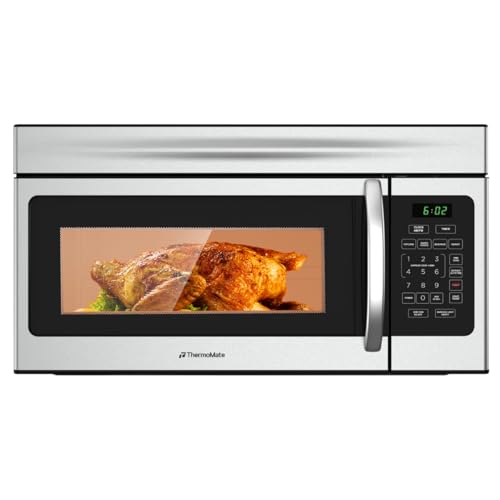
Compact hanging models with 0.7 cubic feet and 700 watts run $150 to $250, with the mounting kit adding $30 to $60 if not included. A GE Spacemaker-style 0.7-cubic-foot, 700-watt countertop model with an optional hanging kit sits at about $199. Entry OTR units with 1.6 to 1.7 cubic feet, 1,000 watts, and 300 CFM run $250 to $400; the ThermoMate 30-inch 1.7-cubic-foot model at about $370 is typical. Larger 1.9-cubic-foot OTRs with 400 CFM fans, such as the Black+Decker model at about $295, range from $280 to $500, and premium OTRs with convection, sensor cooking, and stainless interiors reach $600 to $1,000. Built-in models with trim kits start around $600. If mounting proves impossible, a rolling microwave cart with a cabinet at around $100 is the fallback that gets the appliance off the counter without any drilling.
Warranty
One year parts and labor is standard across all tiers. Some manufacturers extend the magnetron, the component that generates microwaves, to 5 or 10 years; this is the part most likely to fail after year three, so a longer magnetron warranty is meaningful. Check whether the warranty requires professional installation for OTR units, which some brands do. Mounting brackets for compact units usually carry no warranty at all, so buy the manufacturer’s kit rather than a generic one.
Delivery and Installation
OTR units weigh 55 to 70 pounds and ship in boxes about 33 by 20 by 19 inches. Installation is a two-person job that takes 1.5 to 3 hours: mounting a wall plate, drilling three holes through the cabinet bottom for the cord and bolts, lifting the unit onto the plate, and securing it. Ducted installations add cutting a 3.25 by 10 inch duct opening. Professional installation runs $100 to $250. Compact hanging units weigh 20 to 30 pounds and take about an hour with a drill; the bracket screws into the cabinet bottom, and the cabinet must be at least 3/4 inch thick plywood or solid wood to hold it. Particleboard cabinets need a reinforcing plate.
Spec Checklist
| Spec | Budget ($150 to $250) | Mid ($250 to $450) | Premium ($450 and up) |
|---|---|---|---|
| Type | Compact with hanging kit | Over-the-range | Over-the-range or built-in with trim kit |
| Capacity | 0.7 to 0.9 cu ft | 1.6 to 1.9 cu ft | 1.9 to 2.2 cu ft |
| Wattage | 700 to 900 W | 1,000 W | 1,000 to 1,200 W plus convection |
| Turntable | 10 in | 12 to 13 in | 13 to 14 in or flatbed |
| Exhaust fan | None | 300 to 400 CFM, 2 speeds | 400 CFM and up, 3 to 4 speeds |
| Power levels | 5 to 10 | 10 | 10 plus sensor cooking |
| Interior | Painted steel | Painted or ceramic enamel | Stainless or enamel |
| Cooktop light | None | LED or halogen | LED, dimmable |
| Weight | 20 to 30 lb | 55 to 65 lb | 65 to 80 lb |
| Warranty | 1 year | 1 year, some 5-year magnetron | 1 to 2 years, 10-year magnetron |
| Installation | DIY, 1 hour | Two people, 2 to 3 hours | Professional recommended |
Red Flags
- No stated clearance requirement. Every OTR unit must specify minimum distance to the cooktop. If it does not, the manufacturer skipped the safety documentation.
- “Under-cabinet” in the title but no mounting kit listed or sold. A countertop microwave cannot be hung without a bracket designed for its exact model.
- CFM not listed on an OTR unit. Usually means under 300, which will not clear steam from a boiling pot.
- Wattage listed as “output” over 1,200 on a compact unit. Compact cavities cannot dissipate that heat; the number is likely input wattage, which runs 40 to 50 percent higher than cooking output.
- Depth over 14 inches on a compact hanging model. It will project past a 12-inch cabinet by more than 2 inches and block counter use.
- Push-button door release on an OTR unit. These latches see thousands of cycles and are the most common failure point after the magnetron.
- Only a single fan speed. Full blast for a simmering pot is unnecessarily loud.
FAQ
Can any microwave be mounted under a cabinet?
No. Only models with a manufacturer-approved hanging kit or OTR units designed for wall and cabinet mounting can be hung. Generic brackets do not account for vent locations and can block airflow.
What is the minimum clearance between an OTR microwave and the cooktop?
Thirteen inches from the cooktop surface to the microwave bottom is the minimum most microwave manufacturers specify; many range manufacturers require 18 inches for gas. Check both manuals and use the larger number.
Is 700 watts enough for an under-cabinet microwave?
For reheating drinks, leftovers, and defrosting, yes, with about 40 percent more time than package directions. For cooking meals or heating large dishes, 1,000 watts is the practical minimum.
Do I need a vented microwave if I do not have a range under it?
No. A fan over a counter with no cooktop adds cost, depth, and noise for nothing. Choose a compact hanging model instead. In 2026 the 0.7-cubic-foot class remains the only compact size widely sold with hanging kits, so plan dishes around a 10-inch turntable.