Key takeaways
- Buying a 7-quart pot for a 450-gram loaf. The dough spreads across 11 inches and bakes into a flat disk 2 inches tall. Big pots need big recipes.
- Confusing exterior and interior diameter. A pot marketed as 10.5 inches is often 9.5 inches inside. The interior measurement determines loaf width.
- Ignoring lid knob temperature. Phenolic knobs rated to 400 degrees crack or off-gas at bread temperatures. Swap for a metal knob or buy a pot with one.
- Choosing a shallow braiser. Braisers and shallow casseroles at 3 to 3.5 inches deep are too short for oven spring; a boule will hit the lid and stick.
- Trusting quart size alone for shape. Two 5-quart pots can differ by an inch in diameter. Wider pots yield flatter loaves; narrower pots yield taller ones.
- Preheating an empty enameled pot for over an hour. Thirty to 45 minutes is plenty; longer soaks stress the enamel and add nothing to the crust.
The Short Answer
A 5-quart round Dutch oven (4.7 liters) is the right size for a standard home loaf of bread made from 400 to 500 grams of flour, which is the recipe most sourdough and no-knead instructions assume. Its interior measures about 9 to 10 inches across (23 to 25 cm) and 4 to 4.5 inches deep, which lets a boule spread to a wide base and still rise 3 to 4 inches without touching the lid. A 6-quart pot gives more room for higher hydration doughs and larger 600-gram loaves; a 4-quart pot produces a taller, rounder loaf from the same dough. Anything over 7 quarts is too wide, so the dough spreads into a flat disk instead of rising. For oblong batards, a 5- to 6-quart oval or a dedicated loaf-shaped cast iron bread pan works better than a round pot.
Standard Sizes
| Capacity | Liters | Interior diameter (in / cm) | Interior depth (in / cm) | Flour per loaf | Loaf result |
|---|---|---|---|---|---|
| 3.5 qt | 3.3 | 8 / 20 | 3.5 / 9 | 300 to 350 g | Small, tall boule; risk of lid contact |
| 4 qt | 3.8 | 8.5 to 9 / 22 to 23 | 3.75 / 9.5 | 350 to 450 g | Compact, high-rising loaf |
| 5 qt | 4.7 | 9 to 10 / 23 to 25 | 4 to 4.5 / 10 to 11 | 400 to 500 g | The standard boule; best all-around |
| 5.5 qt | 5.2 | 10 to 10.25 / 25 to 26 | 4.5 / 11 | 450 to 550 g | Slightly wider, still tall |
| 6 qt | 5.7 | 10.5 / 27 | 4.5 to 5 / 11 to 13 | 500 to 600 g | Room for wet doughs; slightly flatter with small recipes |
| 7 qt | 6.6 | 11 to 11.5 / 28 to 29 | 5 / 13 | 600 to 750 g | Large loaves only; small doughs spread flat |
| 5 to 6 qt oval | 4.7 to 5.7 | 11 to 12 x 8 to 9 / 28 to 30 x 20 to 23 | 4 / 10 | 450 to 600 g | Batards and oblong loaves |
| Cast iron loaf pan with lid | about 3 qt | 10 x 5 / 25 x 13 | 4 / 10 | 400 to 500 g | Sandwich-style loaf with crust |
Exterior dimensions run about 2 inches wider than the interior because of walls and handles; a 5-quart round pot is typically 12 to 13 inches handle to handle and 6 to 7 inches tall with the lid on.
Our top picks


As an Amazon Associate we earn from qualifying purchases at no extra cost to you.
How to Measure Your Space
- Weigh the flour in your go-to recipe. Most sourdough and no-knead recipes call for 400 to 500 grams (about 3.25 to 4 cups). Match that to the table above; 5 quarts covers the whole range.
- Measure your oven interior. Check the width between the walls and the height from the rack to the top element. A 5-quart round pot with lid needs about 13 inches of width and 7 inches of height on the middle rack. A 7-quart pot at 14 inches wide can crowd a 24-inch oven.
- Measure your storage shelf. Enameled 5-quart pots weigh 11 to 14 pounds and stand 6 to 7 inches tall with the lid; 6-quart pots weigh 13 to 16 pounds. Confirm the cabinet shelf holds the weight and height.
- Check the lid clearance. Interior depth minus the height of your proofed dough should be at least 1.5 inches. A dough that stands 3 inches tall in the banneton needs a pot at least 4.5 inches deep once oven spring is factored in.
- Check the handle. Lid knobs on many pots are rated to 400 or 450 degrees, but bread bakes at 450 to 500. Look for a stainless steel knob or a listing that states the lid is safe to 500 degrees.
- Measure the banneton. A 9-inch round proofing basket produces a dough that fits a 5- to 6-quart pot. A 10-inch oval banneton needs an oval pot or a 7-quart round.
By Room or Use Case
Weekly sourdough for a household of two to four
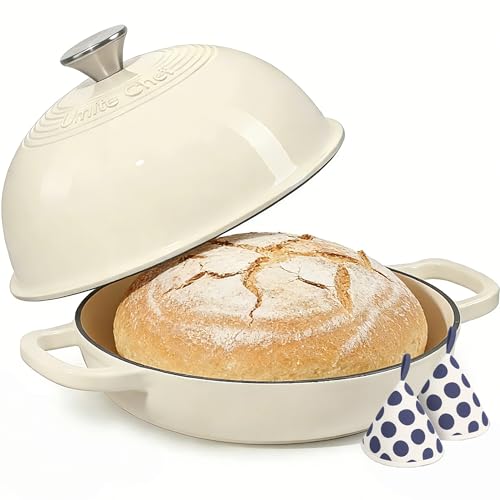
The 5-quart round is the workhorse. An enameled cast iron 5-quart pot with lid and cotton potholders sells for about $36, and bread-focused bundles that add a banneton, lame, and scraper run around $46. Bake a 450-gram loaf with the lid on for 20 to 25 minutes at 475 degrees, then 20 to 25 minutes uncovered.
High-hydration or larger loaves
Doughs above 78 percent hydration spread more before they spring, and 600-gram loaves need extra headroom. A 6-quart round bread oven with a domed lid, around $40, gives the extra inch of diameter and depth. The dome adds vertical space that lets tall boules expand without a flattened top.
Sandwich loaves and oblong batards
Round pots force a boule shape. If your family wants slices that fit a toaster, a lidded cast iron loaf pan, roughly 10 by 5 inches inside, bakes a crusty sandwich loaf from 450 grams of flour. For rustic batards, choose a 5- to 6-quart oval so the loaf can stretch to 11 inches long.
Small kitchen or single baker
A 4-quart pot saves 2 pounds of weight and an inch of shelf space and produces a tall loaf from 350 to 400 grams of flour. Interior diameter is about 8.5 inches, so use a 7- or 8-inch banneton. Do not go below 3.5 quarts for bread; the dough touches the lid and the crust scorches.
Camping or outdoor oven
A 5-quart pre-seasoned bare cast iron Dutch oven, about $33, tolerates coals and open flame that would chip enamel. Bare iron needs a light coat of oil before each bake and dries immediately after washing, but the loaf size and shape are identical to an enameled pot of the same capacity.
Common Sizing Mistakes
- Buying a 7-quart pot for a 450-gram loaf. The dough spreads across 11 inches and bakes into a flat disk 2 inches tall. Big pots need big recipes.
- Confusing exterior and interior diameter. A pot marketed as 10.5 inches is often 9.5 inches inside. The interior measurement determines loaf width.
- Ignoring lid knob temperature. Phenolic knobs rated to 400 degrees crack or off-gas at bread temperatures. Swap for a metal knob or buy a pot with one.
- Choosing a shallow braiser. Braisers and shallow casseroles at 3 to 3.5 inches deep are too short for oven spring; a boule will hit the lid and stick.
- Trusting quart size alone for shape. Two 5-quart pots can differ by an inch in diameter. Wider pots yield flatter loaves; narrower pots yield taller ones.
- Preheating an empty enameled pot for over an hour. Thirty to 45 minutes is plenty; longer soaks stress the enamel and add nothing to the crust.
FAQ
Is a 5-quart Dutch oven big enough for sourdough?
Yes. A 5-quart round pot handles loaves made from 400 to 500 grams of flour, which is the standard household recipe. It is the most common size recommended in sourdough instructions for that reason.
Is a 6-quart Dutch oven too big for bread?
No. Six quarts gives about half an inch more diameter than a 5-quart, which slightly widens a 450-gram loaf but comfortably fits 500- to 600-gram doughs. If you plan to bake larger loaves or wetter doughs, 6 quarts is the better long-term buy.
Do I need an oval Dutch oven for bread?
Only if you want oblong batards. Round pots produce round boules, which is what most recipes expect. An oval 5- to 6-quart pot is the right tool if your bannetons are oval.
Does the pot need to be enameled?
No. Bare cast iron bakes identical bread and costs slightly less, around $33 versus $36 to $46 for enameled in 2026, but it requires oiling and immediate drying. Enamel is easier to clean and shows the crust color, which is why most home bakers choose it.