Key takeaways
- No weight capacity listed. Manufacturers who tested their island publish the number.
- Stools shown tucked under a top with no visible overhang. Staged photos often use child-size stools or pull the island away from the cabinets.
- “Solid wood” in the title but “engineered wood” or “MDF” in the specifications. Only the legs may be solid.
- Top thickness not stated. Usually means under 1 inch.
- Shipping weight under 80 pounds for anything over 55 inches long. Hollow construction that will wobble when loaded.
- Casters with no load rating or diameter. Small plastic wheels crack under a loaded island within a year.
- A pub set bundling table and stools for under $150. Fine for a breakfast nook, but it is a table, not a storage island, no matter what the listing says.
Most kitchen island regrets trace back to the same three errors. People buy an island that fits the empty floor but forget the 36 inches of walkway it needs on every working side. They fall for a listing photo showing four stools tucked under a 48-inch top, then discover that four adults need at least 96 inches of counter. And they pick stools before the island arrives, so seat heights are 6 inches off. This guide covers the specs that actually decide whether an island with seating works in your kitchen, with the numbers you need to check before you click buy.
Decide These 3 Things First
1. Fixed or mobile. A rolling island on locking casters can be pushed aside for parties and moved out when you leave a rental. A fixed island with a cabinet base holds more, feels more solid, and supports a deeper overhang. Mobile units top out around 63 inches long and 200 pounds; fixed units go bigger.
Our top picks


As an Amazon Associate we earn from qualifying purchases at no extra cost to you.
2. Counter height or bar height. A 36-inch top matches standard kitchen counters and takes 24- to 27-inch stools. A 40- to 42-inch top is bar height and takes 28- to 32-inch stools. Counter height is easier for kids and older adults and lets the island double as prep space at the same level as the rest of the kitchen.
3. How many people must sit, really. Each backless stool needs 24 inches of counter; each stool with a back or swivel needs 28 to 30 inches. Two seats fit on a 48- to 60-inch island. Three need 72 to 84 inches. Four need 96 inches or more. Decide the honest number, then size everything else from it.
Size and Clearance
Measure your floor, then subtract the walkways: 36 inches minimum on every side where someone will work or walk, 42 to 48 inches on the side facing the range or sink so two people can pass, and 44 inches behind the seating side so a seated person plus a walker both fit. A 10 by 12 foot kitchen usually supports an island no larger than about 60 by 30 inches once those clearances are taken. Depth matters as much as length: a 24-inch-deep top gives no seating overhang, a 30-inch top over 24-inch cabinets gives a 6-inch overhang, and a 36-inch top gives the 12 inches that lets knees fit. Compact models solve this with a fold-down drop leaf, like the Shintenchi rolling island at about $130, which stays narrow for cooking and flips out an extra 12 inches of eating surface when needed.
Top Material
Butcher block (rubberwood, acacia, birch, or bamboo) is the most common top on islands under $600. It can be cut on if oil-finished, sands back to new, and needs a coat of mineral oil monthly. Check thickness: 1.5 inches is solid, 1 inch is acceptable, and 3/4 inch will flex. Laminate or faux marble over MDF is waterproof and maintenance-free but chips at edges and cannot be repaired; a 47-inch faux marble pub-set table with two stools sells for around $120, which tells you the surface is a thin print. Stainless steel tops resist heat and water but scratch and show fingerprints. Genuine stone or quartz appears only on islands above $1,000 and adds 100 to 200 pounds.
Construction and Weight Capacity
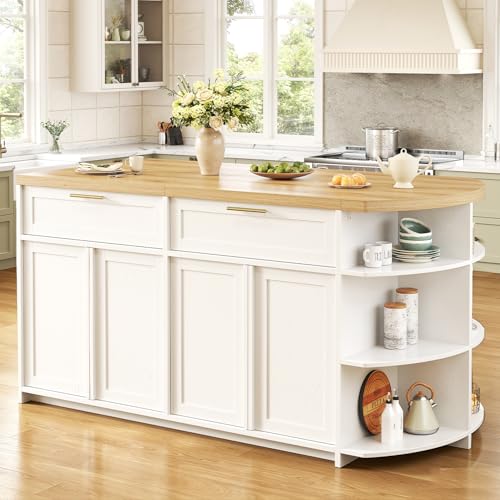
Look for a stated total weight capacity of at least 200 pounds for the top and 60 to 100 pounds per shelf. An island that lists no capacity is a warning sign. Base material ranges from particleboard with paper veneer at the bottom, to MDF with laminate in the middle, to solid rubberwood or oak frames at the top. Solid wood legs at least 1.75 inches square resist racking; thin metal tube legs under 1 inch wobble once the island is loaded. Casters should be at least 3 inches in diameter with two or more locking, and each should be rated for 75 pounds or more. Shipping weight is a useful proxy: a 63-inch island that ships under 100 pounds is mostly hollow board, while a well-built one like the HSH 63-inch light oak model with storage and seating at around $500 will arrive closer to 150 pounds.
Comfort and Seating Performance
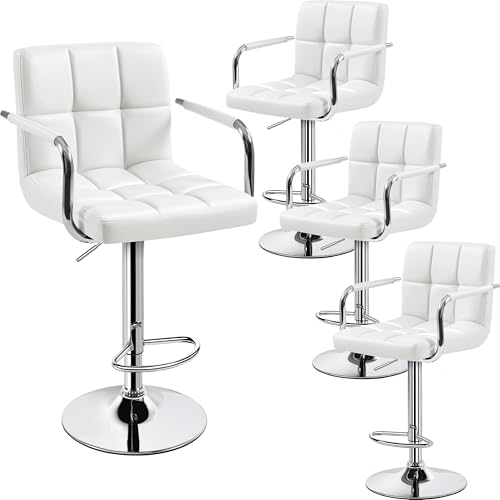
Comfort comes down to three numbers. First, seat-to-counter clearance: 10 to 12 inches between the top of the stool seat and the underside of the counter. Second, overhang: 12 inches minimum, 15 inches for adults who will sit through a meal. Third, footrest height: 16 to 18 inches below the seat. Stools with backs add real comfort for sessions over 20 minutes; swivels help people get in and out in tight spaces but need the wider 28- to 30-inch spacing. Adjustable-height stools with backs and swivels, such as a set of four for around $170, solve the height-matching problem when you are buying stools before the island arrives, but confirm their range covers your target seat height with a few inches to spare on both ends.
Storage
Count what you will actually store. Open shelves hold small appliances and cookbooks but collect dust and look cluttered fast. Drawers should run on metal glides, not wood-on-wood; a 20-inch drawer should extend at least 16 inches. Cabinets with adjustable shelves fit tall items. Towel bars and spice racks on the end panels add function without footprint. A wine rack looks appealing in photos but is the first feature people wish they had traded for a drawer. Islands with seating give up storage on the seating side, so a 63-inch island with two stools typically offers half the storage of the same island without an overhang.
Price Tiers
Under $200 buys a mobile cart or small drop-leaf island, 36 to 48 inches long, with a 1-inch top, particleboard or MDF body, and room for one or two backless stools. This tier makes sense for renters and studios. From $200 to $600 you get 48- to 63-inch islands with 1.5-inch tops, solid wood or thick laminate frames, real drawers, and enough overhang for two or three seats; this is where most households should shop. From $600 to $1,500, expect solid hardwood frames, 72-inch tops, soft-close hardware, and built-in outlets. Above $1,500 you are into custom cabinetry with stone tops. Stools add $50 to $60 per pair for basic wood saddles, $150 to $200 per set of four for backed metal stools, and $100 or more each for upholstered swivels.
Warranty, Delivery, and Assembly
Most flat-pack islands carry a 1-year limited warranty; anything offering 3 to 5 years signals sturdier construction. Check whether the warranty covers the top separately, because tops warp and delaminate more often than bases fail. Delivery for a 60-inch island means a 100- to 160-pound box, often 66 inches long, so confirm it fits through your door and that two people will be home. Assembly runs 1.5 to 3 hours for a mobile cart and 3 to 5 hours for a full island with drawers and doors. Listings that include pre-assembled drawers and pre-drilled holes save an hour. Read the manual preview if one is offered; a manual with hardware bagged and labeled by step is a strong sign of a well-engineered kit.
Spec Checklist
| Spec | Budget (under $200) | Mid ($200 to $600) | Premium ($600 and up) |
|---|---|---|---|
| Length | 36 to 48 in | 48 to 63 in | 63 to 84 in |
| Top thickness | 3/4 to 1 in | 1.25 to 1.5 in | 1.5 in wood or 1.25 in stone |
| Top material | Laminate or thin rubberwood | Solid rubberwood, acacia, bamboo | Maple, oak, quartz, stone |
| Seating overhang | 0 to 8 in (or drop leaf) | 10 to 12 in | 12 to 15 in with brackets |
| Seats | 1 to 2 backless | 2 to 3 | 3 to 4 with backs |
| Weight capacity (top) | 100 to 150 lb | 200 to 300 lb | 300 lb and up |
| Frame | Particleboard or MDF | MDF with solid wood legs | Solid hardwood |
| Drawer glides | Wood or plastic | Metal ball-bearing | Soft-close full extension |
| Casters | 2 in, plastic | 3 in, 2 locking | Leveling feet or 4 in locking |
| Power | None | Optional strip | Built-in outlets and USB |
| Warranty | 90 days to 1 year | 1 to 2 years | 3 to 5 years |
| Assembled weight | 40 to 80 lb | 100 to 160 lb | 180 lb and up |
Red Flags
- No weight capacity listed. Manufacturers who tested their island publish the number.
- Stools shown tucked under a top with no visible overhang. Staged photos often use child-size stools or pull the island away from the cabinets.
- “Solid wood” in the title but “engineered wood” or “MDF” in the specifications. Only the legs may be solid.
- Top thickness not stated. Usually means under 1 inch.
- Shipping weight under 80 pounds for anything over 55 inches long. Hollow construction that will wobble when loaded.
- Casters with no load rating or diameter. Small plastic wheels crack under a loaded island within a year.
- A pub set bundling table and stools for under $150. Fine for a breakfast nook, but it is a table, not a storage island, no matter what the listing says.
FAQ
What is the minimum kitchen size for an island with seating?
Roughly 10 by 12 feet for a small 48 by 24 inch island with two stools, keeping 36-inch walkways. Below that, a rolling cart with a drop leaf you can park against a wall is the better option.
Should I buy the island and stools together or separately?
Separately, after the island arrives and you have measured the actual counter height and overhang. Bundled stools are often undersized. If you must buy together, choose adjustable-height stools whose range covers 24 to 30 inches.
How much overhang do counter stools need?
Twelve inches minimum for adults to sit, 15 inches to sit comfortably through a meal. Many mobile islands have 8 inches or less, which works only with backless stools for short sessions.
Is a rolling island stable enough to eat at?
Yes, if it weighs over 100 pounds assembled, has 3-inch or larger casters with at least two locks, and you engage the locks. Lightweight carts under 60 pounds will shift when someone leans on the overhang, which is why most 2026 mid-range models add leveling feet alongside the wheels.