Key takeaways
- Separate dining table product weight, carton weight and delivery scope with a package worksheet and a clearly illustrative comparison.
What's inside
A dining table can have several legitimate weight figures: the assembled product, each shipping package and the complete shipment. They answer different questions. Before arranging collection or delivery, label each number and identify what it includes. A shipping weight is not a tabletop load rating, and dividing a total by the number of cartons does not tell you the heaviest carton.
Give every weight a name
Start with the exact table model, size and top option. A collection name may cover several lengths or different materials. Save the retailer’s specification with the selected configuration, then separate any figure labeled product weight, net weight, package weight or shipping weight. If a listing simply says weight, ask what was weighed.
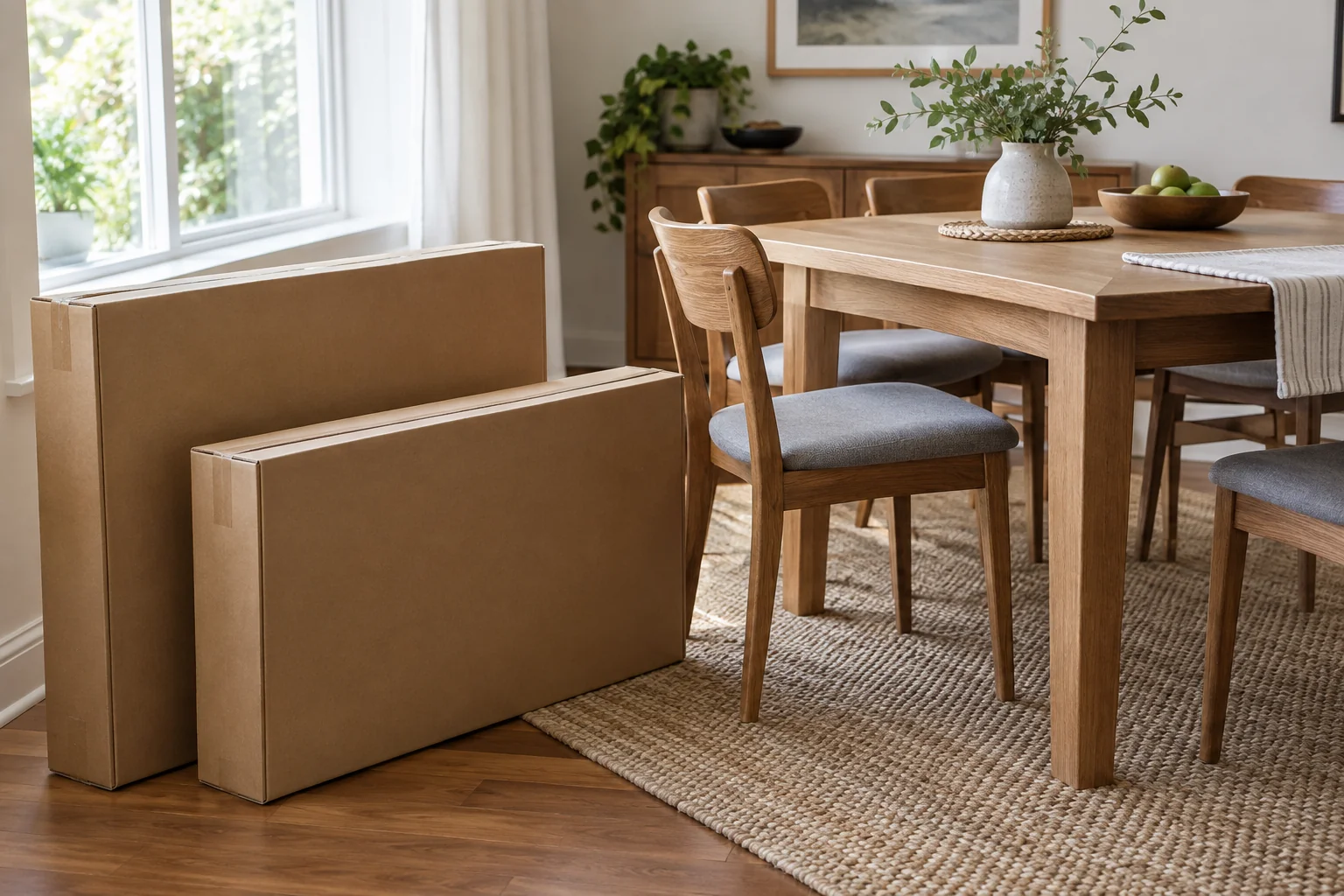
A package includes whatever the supplier puts into that carton, potentially including protective packaging and hardware. A complete shipment may include several cartons or other transport materials. Do not subtract an assumed packaging percentage to invent the assembled weight. Request the missing figure if it matters to the delivery arrangement.
Read the packaging section independently
For a specific example, the IKEA SKOGSTA table page for article 004.526.43 lists three packages and gives dimensions and a separate weight for each. The assembled length, width and height appear in a different section. This is a useful format to request from another seller, not a universal packing arrangement for wooden dining tables.
Keep each package’s dimensions beside its weight. A broad, shallow box and a compact box with the same weight create different handling questions. Neither a total weight nor an overall tabletop dimension tells a delivery team what will pass along the actual route in its packaging.
| Record | What to obtain | What it does not establish |
|---|---|---|
| Exact product | Model, size and top option | The specification of another version |
| Assembled weight | Confirmed weight of the completed table | Weight of its largest loose component |
| Package list | Each carton identifier, dimensions and weight | That all cartons are equally heavy |
| Total shipment | What the total includes | A safe lifting plan or vehicle fit |
| Service arrangement | Delivery location, assembly and packaging removal | Services not expressly included |
| Table load information | Separate manufacturer use limits, if needed | A limit derived from the table’s own weight |
Illustrative example: a total hides the difficult package
Suppose a fictional table ships in two cartons weighing 28 and 12 kilograms. Their total is 40 kilograms. Dividing by two produces an average of 20 kilograms, but there is no 20-kilogram carton: the heavier item is still 28 kilograms. A collection plan based on the average would describe neither object correctly.
Now suppose the retailer confirms that the assembled table weighs 35 kilograms. The five-kilogram difference from the carton total belongs to the difference between these documented measures; it is not an extra usable load allowance for the tabletop. None of these invented values establishes how many people should carry an item or what equipment is appropriate.
The practical worksheet entry is therefore a package-by-package list, with the heaviest and most awkward item identified for discussion with the delivery provider. Keep the actual weights rather than replacing them with a reassuring average.
Ask what arrives at your door
Confirm whether the table arrives flat-packed, partially assembled or fully assembled. Ask which parts the delivery service handles and whether assembly is included at the destination. “Delivery available” alone does not say where the item is placed or who removes transport packaging.
If the seller proposes removing packaging before a difficult access point, ask who authorizes and performs that step and how the item remains protected. Do not assume an unboxed tabletop can be carried by an edge, extension rail or decorative feature. Follow the table maker’s handling instructions and use an appropriately equipped service where needed.
Pair the weight record with the route record
Give the delivery provider the relevant door, stair, landing or elevator measurements and the package list. Keep access restrictions, such as an elevator booking requirement, separate from the furniture measurements. A package that fits a doorway geometrically can still need an assessment of turning space and handling arrangements.
Do not calculate a safe building or elevator load from the furniture figure alone. Where a building has restrictions, obtain the applicable requirements from the building operator and discuss the complete delivery with the provider. Likewise, do not promise that a table will fit a vehicle just because its total weight seems manageable.
Check the labels when delivery arrives
Compare the received carton identifiers with the expected list before discarding packaging. Record an apparent missing package, mismatched model or visible damage through the seller’s delivery process. A correct total carton count does not by itself confirm that every carton belongs to the selected finish and size.
Keep the specification and delivery record with the assembly instructions. If you later move the table, its assembled weight will not necessarily describe the pieces your approved disassembly process produces. Obtain appropriate handling advice again rather than relying on an old shipping total.
A clear weight comparison ends with named, sourced numbers: actual product, actual packages and actual service scope. That removes the ambiguity from planning while leaving lifting methods, transport limits and structural questions to the people responsible for those decisions.