Key takeaways
- Read dining table top thickness separately from its visible edge shape and underside clearance. Includes a specification comparison worksheet.
What's inside
- A slim-looking edge does not tell you the full top thickness
- Read the selected configuration, not only the collection name
- Make a profile comparison sheet
- Compare the edge at the position you will use
- A worked example: two different clearances
- Do not infer material quality from the perimeter alone
- Use the profile record when ordering accessories
- A slim-looking edge does not tell you the full top thickness
- Read the selected configuration, not only the collection name
- Make a profile comparison sheet
- Compare the edge at the position you will use
- A worked example: two different clearances
- Do not infer material quality from the perimeter alone
- Use the profile record when ordering accessories
A slim-looking edge does not tell you the full top thickness
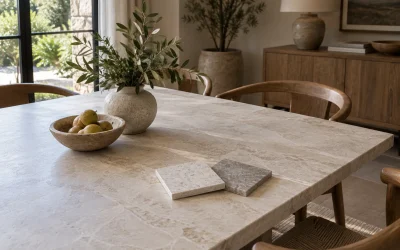
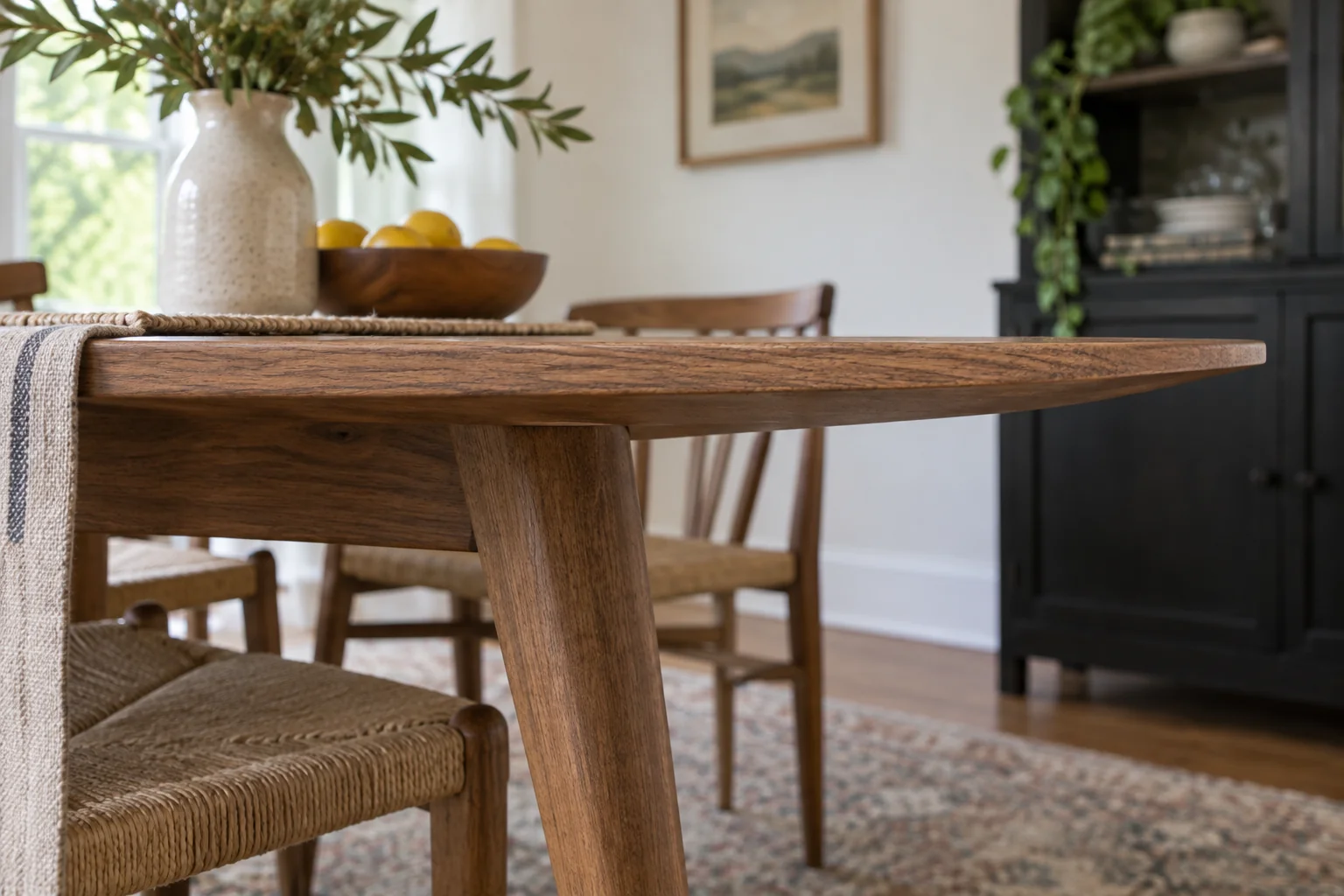
When comparing dining tables, separate the thickness of the tabletop from the shape of its outer edge. A bevel can make the perimeter look slimmer, while a built-up edge can make it look deeper. Neither appearance alone identifies the material beneath the finish or the table’s load capacity.
Ask for a dimension drawing and a side view of the exact top option. Then record three different things: the full section thickness, the visible edge profile and the lowest structure beneath the table. They answer construction, appearance and clearance questions respectively.
Read the selected configuration, not only the collection name
A table collection can offer several top materials and shapes. The Room & Board Aria product page, for example, lists top thickness separately from floor-to-bottom clearance and offers different top selections. A measurement associated with one selection should not be copied to every table carrying the Aria name.
Save the top material, size, shape and item code together. If changing a swatch or size changes the specification panel, save the final version rather than the first one you viewed. A photograph may show another configuration in the same collection.
Use the seller’s terminology, but ask for a drawing if a term is unclear. Beveled describes an angled edge treatment; it does not tell you its exact angle, width or whether the bevel is above or below the perimeter. A close-up side view can resolve those distinctions.
Make a profile comparison sheet
| Field | Record | Question answered |
|---|---|---|
| Top option | Material, size and item code | Which construction are we discussing? |
| Full thickness | Dimension and measurement location | How deep is the specified top section? |
| Edge profile | Side drawing or clear photograph | What does the perimeter look like? |
| Underside structure | Apron, mounting plate or support position | What projects below the top? |
| Floor-to-bottom clearance | Lowest relevant point at each seat | What affects chair and leg fit? |
| Surface instructions | Care and permitted accessories | What may contact the finish? |
Mark an unpublished value as unknown. A ruler photographed beside a table can clarify scale, but perspective may distort a measurement. Prefer a dimension confirmed by the manufacturer or seller rather than estimating millimeters from an angled lifestyle photograph.
Compare the edge at the position you will use
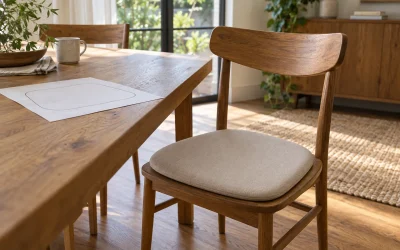
In a showroom, view the table both standing and seated. The underside may be much more visible from a low chair than from the product photograph’s camera position. Check the end seats as well as the long sides, particularly if the top has a changing outline.
Notice where your forearms normally meet the edge during a meal or desk-like task. Record a personal observation rather than declaring one edge universally comfortable. A softly rounded appearance is not a safety certification, and a heavy-looking top is not proof of strength.
For an extension table, inspect the leaf edges too. Ask whether their profile and finish match the fixed top. Do not infer a manufacturing fault from an intentional design difference; compare the delivered parts with the approved specification.
A worked example: two different clearances
Illustrative tables, not real product specifications: Table A is 75 cm high with a 3 cm thick top. Its top underside is therefore 72 cm from the floor at a location without other structure. But an apron at the seating position extends down to 66 cm. For a chair arm approaching that apron, 66 cm is the relevant obstacle height.
Table B also stands 75 cm high and has a 3 cm main section, but its outer edge tapers to a thinner visible line. That visual taper does not establish more clearance beneath an apron or mounting plate. You still need the lowest actual obstruction at the intended seat.
The comparison sheet should therefore show the same nominal top thickness alongside different edge drawings and separately verified clearances. It should not turn the slimmer-looking perimeter into an assumed extra amount of knee room.
Do not infer material quality from the perimeter alone
A visible edge can be part of solid construction, an applied border or another engineered assembly. Ask for the published materials description. Do not scratch, sand or remove a covering to identify it, and do not use a thickness threshold as a substitute for construction information.
Similarly, the thickness does not establish whether the top can be refinished. Follow the maker’s care and repair guidance for the complete surface. A veneer, finish or composite layer may impose restrictions that a photograph cannot reveal.
Use the profile record when ordering accessories
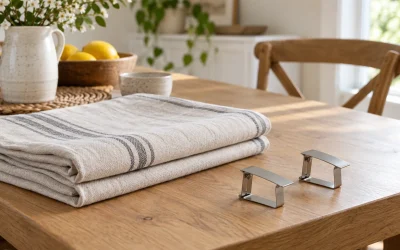
If you plan to use a table pad, cloth clip or another edge-contact accessory, send its supplier the profile drawing and applicable finish restrictions. Maximum opening alone may not describe contact on a bevel or rounded lip. Keep that accessory decision separate from choosing the table’s appearance.
Before checkout, save one page containing the selected configuration, side profile, thickness and relevant underside clearance. That record makes a retailer’s answer reviewable and gives you something precise to compare at delivery. The useful result is a known construction and usable shape, not a table chosen by apparent thickness alone.