Key takeaways
- Verify that a removable kitchen cart top is intended as a cutting board, then plan handling, cleaning and replacement with a product-specific checklist.
What's inside
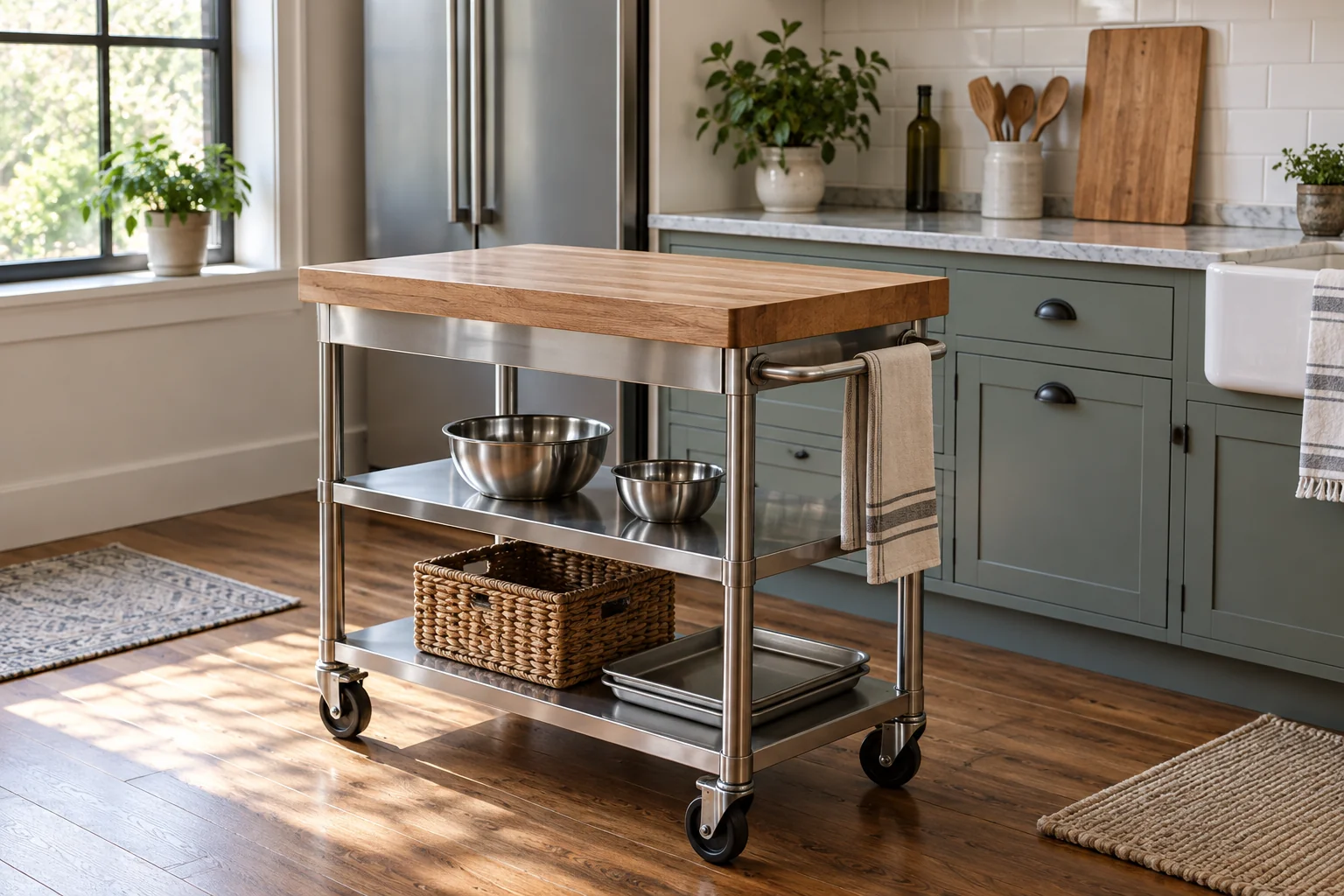
Removable does not automatically mean a cutting surface
Before buying a kitchen cart with a removable wooden top, verify that the manufacturer intends that exact component to be used as a cutting board. A top may detach for shipping or assembly without being suitable for chopping, washing at a sink or repeated removal during everyday use.
Look for an explicit product statement and the matching care instructions. Keep the cart frame, wooden top, any removable board and optional accessories on separate lines. Their materials and permitted uses can differ even when they arrive in one box.
Find a clear statement of intended use
John Boos’s Maple Cucina Culinarte CU-CULART30 is an example with unusually clear wording: its specifications identify an oil-finished maple top as removable, reversible and usable as a cutting board. That statement belongs to the named product. It is not permission to cut directly on every wood-topped cart.
Save the model number, selected size and finish alongside the statement. Ask whether the same permission applies to the underside if you plan to reverse the board. Do not infer reversibility from a smooth-looking surface; feet, grooves, fittings or a different finish may change how a component is intended to sit.
If the listing says only butcher-block style, wood look or prep station, ask for clarification. Those phrases do not identify the finish or distinguish an actual board from a decorative furniture surface. Until the maker confirms the use, plan to use a separately approved cutting board according to its own instructions.
Plan handling before planning chopping
Find the component’s weight rather than using the packaged cart weight as a substitute. Ask how the top is retained and how it is removed and replaced. A board can be removable in principle yet too awkward for one person to handle comfortably in a crowded kitchen.
Identify a stable, suitable place for the board during permitted cleaning and drying. Measure that work area and its approach. A board that overhangs a small sink cannot be assumed safe to balance across it, and a wet board should not be propped where it can slide onto someone.
Also identify what remains on the cart when the board is removed. Do not use an exposed frame, fastener or shelf as a substitute worktop. The instructions should govern whether the cart may be moved in that state and how its components are secured.
| Question | Evidence to save | Unresolved decision |
|---|---|---|
| Is it a cutting board? | Exact model’s intended-use statement | Do not infer from wood appearance |
| Can both faces be used? | Reversibility and finish instructions | Which face belongs upward? |
| How is it removed? | Retention and handling instructions | Help or special procedure required? |
| Where is it cleaned? | Approved method and suitable work area | Can all surfaces be handled safely? |
| How is it dried? | Drying and replacement sequence | Where does it rest without slipping? |
| What maintains the finish? | Named care products and directions | Any food-contact or curing conditions? |
Use the board’s care instructions, not a generic furniture recipe
John Boos’s block-care guidance describes wiping with mild soap and water, removing soap with a clean damp cloth and drying thoroughly. It specifically excludes putting its wooden cutting boards in a dishwasher and warns against harsh detergents. These are product-family instructions, not a cleaning recipe for every finish.
Copy the applicable method into your own care record without substituting a stronger cleaner or a different oil. If a separate coating has been applied, ask the manufacturer how that affects the original instructions. Do not assume a product labeled food safe permits every cutting, heating or cleaning task immediately after application.
Keep the frame’s maintenance separate. Stainless steel shelving, painted rails and wood can need different products. A cleaner suitable for one part should not run onto another merely because both belong to the same cart.
Illustrative example: two similar-looking carts
Imagine Cart A has a wooden top described only as removable for assembly. Cart B’s manual identifies a removable cutting board and explains how it seats on the frame. Both appear similar in photographs, but only Cart B currently provides evidence for the proposed cutting use.
The buyer asks Cart A’s seller for the missing intended-use and finish information. Meanwhile, they check whether Cart B’s board can be handled and dried in their kitchen. If the board is awkward to remove, its documented cutting permission does not solve the handling problem.
This fictional comparison contains no ranking or invented dimensions. It shows two independent decisions: permission to use the component as proposed, and a practical way to care for it. Either can rule out a purchase.
Make replacement and everyday use straightforward
Ask whether a replacement board is available by model code and whether dimensions or retention details changed between versions. Save that answer with the receipt. A roughly similar loose board is not automatically a suitable replacement for a retained top.
Before normal use, reinstall the board exactly as directed and follow the cart’s positioning and caster instructions. Keep hot cookware, electrical appliances and heavy loads within their separate permissions. A removable cutting surface is a specific useful feature; it does not expand every other limit of the cart.