Key takeaways
- Read reversible placemat descriptions by usable face, backing and complete construction. Compare explicit two-sided use with a cork-backed board.
What's inside
A reversible placemat needs two documented usable faces, not simply a front that looks decorative and a back that looks tidy. Read the material description, the statement about reversibility and the care instructions together. They answer different questions: what the mat contains, which face may be placed upward and how the complete item should be maintained.
Distinguish cork from cork-backed
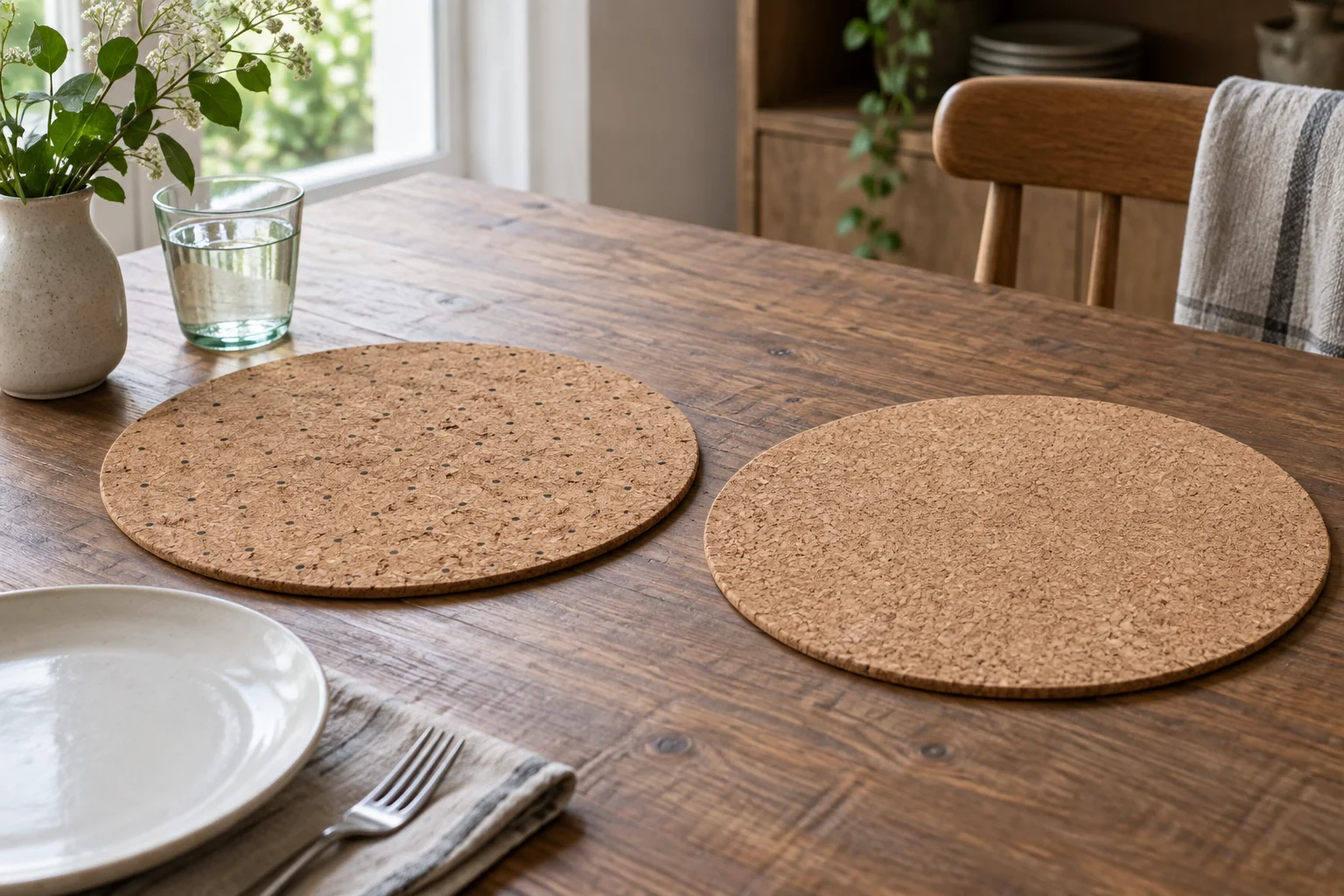
A short product title can hide a substantial construction difference. One mat may be made from cork throughout; another may have a rigid board, a decorative coating and a cork underside. The word cork appears in both descriptions, but it does not establish that they can be used or cleaned the same way.
IKEA’s Bahrain page for SOLABBORRE 805.525.87 identifies cork and explicitly describes a patterned side and a plain side that can face upward. That is useful evidence of reversibility for the named article. It is stronger than inferring two-sided use from a photograph.
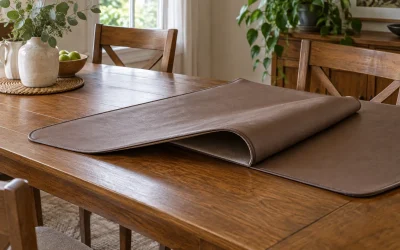
By contrast, Spode describes Pimpernel Classic Burgundy X0010568043 as MDF with a cork back and a coated board surface. Its description assigns different roles to the layers. That information should not be translated into a claim that the back is a second dining face.
Read the selected variant, not the collection photograph
Open the material and care sections for the exact item number and color you intend to order. A shop may group woven mats, printed mats and backed mats on one collection page. A photograph showing several coordinated designs does not show that their construction is identical.
When a listing uses a slash, such as cork/patterned, check whether the words describe material and appearance or two different materials. Likewise, two photographs may show alternative color options rather than opposite sides of one mat. Look for an explicit sentence about both sides instead of relying on the image order.
| Listing detail | Question it answers | What remains separate |
|---|---|---|
| Material composition | What is the item made from? | Whether every layer is disclosed |
| Backing or coating | Are front and underside different? | Whether the underside is a usable face |
| Reversible statement | May either documented face be upward? | Heat, liquid and table-finish compatibility |
| Care directions | How should the finished item be cleaned? | Permission for unlisted washing methods |
| Exact article number | Which product do the statements describe? | Other colors, sizes or newer versions |
A change of face is not a change of care method
If the maker gives one care instruction for a reversible mat, use that instruction for the finished item. Do not decide that the plain face can be soaked while the printed face can only be wiped. Moisture can reach edges and other layers even when you intend to treat only one side.
The two official examples above give wiping instructions. They do not provide a reason to put either article in a washing machine or dishwasher. The narrow lesson is to follow the listed method for that product, rather than creating a cleaning rule from the material name.
Look at the edge as well as the faces without bending or peeling it. Bound fabric, a sealed board edge and an exposed cork edge are different details to ask about if instructions are incomplete. Do not separate layers to discover what they are made from.
Work through an ambiguous listing
Imagine an online mat described as “natural cork, two looks.” One photograph shows a floral front; another shows a brown underside. The specification mentions a board core, while the seller has not actually said either side may face upward. This fictional listing is insufficient to establish reversibility.
A useful question is: “For article A in the selected floral version, is the brown underside intended as a second dining face? Please confirm the material layers and whether the same care directions cover both sides.” That requests a concrete product fact rather than asking whether the mat is generally good quality.
If the seller confirms only a protective backing, choose the mat as a one-face product or select another with a clear reversible statement. If two-sided use is confirmed, save that answer with the exact variant. Neither outcome requires guessing from the color of the underside.
Check the face that will touch the table
Reversing a mat changes which surface rests on the furniture. Before each use, inspect both faces and remove loose debris using the permitted care method. Turning a dirty face downward does not complete the cleaning task. Let the mat reach the condition required by its drying instructions before placing it back.
Keep tabletop compatibility separate from decorative reversibility. The mat maker’s intended-use statement does not identify the finish on your own table. Follow the furniture maker’s protection guidance, especially where a coating, print or backing will remain in contact for a long period.
Similarly, two usable faces do not turn a placemat into a trivet, cutting board or waterproof barrier. Any such function needs its own explicit product guidance. Avoid borrowing a temperature limit or moisture claim from a different model that happens to use the same main material.
Make the two looks easy to use
Once the construction and permitted faces are clear, choose the appearance you prefer and check the complete place setting. Save the care information with the order details so someone else does not mistake a backed mat for the reversible one. The useful purchase is a clearly identified item whose two faces work as described, with no missing assumptions about the layers between them.