Key takeaways
- Compare ladder-back and spindle-back dining chairs by contact points, seat configuration and actual use, with a repeatable showroom comparison.
What's inside
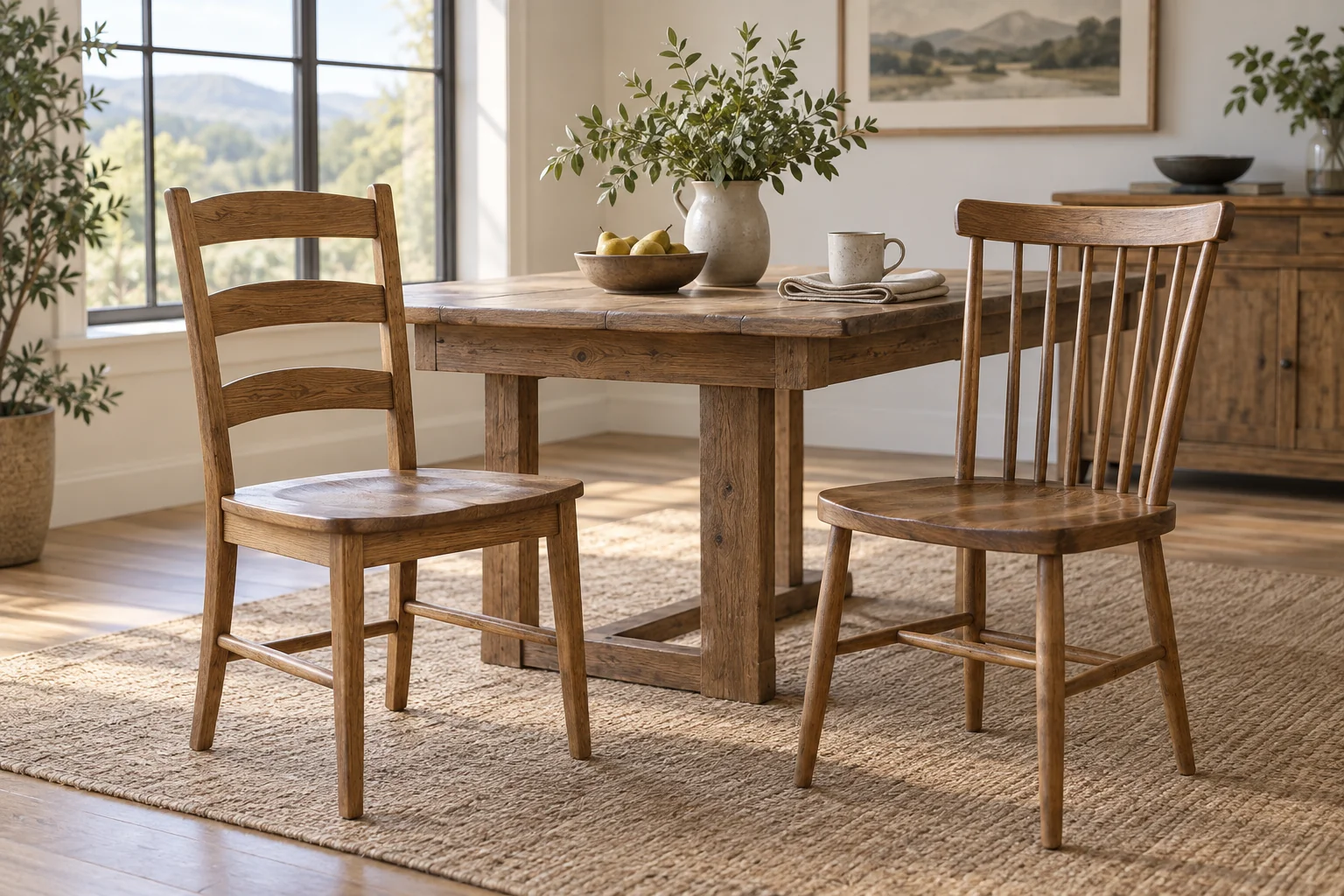
A ladder-back chair and a spindle-back chair describe the arrangement of the backrest, not how either will feel against your body. Horizontal rails, narrow vertical members, the upper rail and the curve of the whole back can meet you in different places. Compare those contact points on the actual chairs before choosing a full dining set.
Separate the design name from the shape you will use
Ladder-back generally describes a series of horizontal back rails. A spindle-back has slender upright members, usually beneath an upper rail. Neither name tells you the spacing, edge profile, angle or amount of shaping. Photographs from directly in front can conceal those differences, especially when two chairs have similar overall heights.
For a concrete example of the distinction, Vaughan Bassett lists a Horizontal Slat Side Chair and a Spindle Side Chair in its Dovetail Dining range. Those are separate designs. The names identify their construction pattern; they do not establish a comfort winner for every diner.
Request a side view and a close view of the backrest. Look for where the members curve, how their edges are finished and whether the upper rail projects toward the seat. Do not estimate these details from a lifestyle photograph with a cushion or jacket covering the chair.
Compare contact at the same table
If a showroom allows a sitting trial, use the chairs normally with both feet supported comfortably and the chair resting on all its legs. Do not rock onto the rear legs to imitate a reclined posture. Try the same table position for each chair so a change in table height or distance does not dominate your impression.
Notice which part of the back you meet first when sitting as you would during a meal. On one chair, a horizontal rail might be prominent. On another, the upper rail or a pair of curved spindles might be more noticeable. Write down the actual location in your own words rather than assigning a universal ergonomic score.
Then change from eating position to the relaxed upright position you normally use for conversation. This is a check of ordinary use, not a stress test. A chair that feels agreeable in one posed photograph may feel different when you reach toward your plate or turn slightly to speak.
| Feature | Chair A | Chair B |
|---|---|---|
| Exact model and seat version | Record identifiers | Record identifiers |
| First noticeable contact | Rail, spindle, upper rail or broad area | Describe the actual contact |
| Change during a meal posture | Comfortable, intrusive or uncertain | Use the same posture |
| Seat cushion used | None or exact permitted cushion | Keep the comparison explicit |
| Cleaning access | Which gaps and joints are reachable? | Check front and back |
| Other household user | Separate observations | Do not average away disagreement |
Do not let the seat hide the backrest comparison
Seat shape and depth influence where you sit relative to the back. If one sample has a thick cushion and the other has a bare wooden seat, you are comparing whole configurations. That is useful when those are the exact versions you might buy, but it does not isolate the effect of horizontal rails versus spindles.
Record any cushion you expect to use at home. An added cushion may change your height and your distance from the backrest. Obtain the chair maker’s guidance before treating an accessory as part of the intended configuration, and do not assume a cushion will solve an uncomfortable back contact.
Use a fictional two-person comparison carefully
Imagine two household members trying the same ladder-back and spindle-back chairs at one showroom table. One prefers the broad contact of the ladder-back. The other notices its middle rail and prefers the second chair. Neither observation makes the first person mistaken; the intended users differ.
They repeat the comparison with the exact seat cushions offered for purchase. The second person’s preference remains, while the first now finds both acceptable. Their decision can reflect that result: select the configuration both accept, continue looking, or deliberately mix compatible chairs. This illustrative example reports no product test and predicts no medical benefit.
If a household member cannot try the chair, save the exact model details and ask about a sample or the applicable return conditions before ordering. A family member’s impression is helpful context, but it cannot substitute for the absent person’s experience.
Inspect the spaces between the members
Backrest gaps are also a maintenance question. Look at the junctions where rails or spindles meet the frame and consider access with the maker-approved cleaning tool. A narrow decorative opening may be harder to reach than it appears from the front. This is about access, not a claim that one design accumulates more dirt.
Finish and upholstery instructions still govern care. Do not choose a stronger brush or soak a joint just because the back has an open structure. The pattern also does not establish a load rating, durability or child-safety performance; those require the exact manufacturer’s information.
Order the chair you actually compared
Save the model, finish, seat option and any approved cushion together. Similar product photographs can conceal a different rail curve or seat version. Before buying the complete set, confirm that the ordered variant matches the sample you assessed. A useful comparison ends with a specific chair configuration and named users, not a blanket verdict that every ladder-back or spindle-back is more comfortable.