Best Cheese Knife Sets for Entertaining
The best cheese knife set for entertaining is usually a four-piece stainless-steel set with a wide cheese cleaver, perforated soft-cheese knife, narrow hard-cheese blade, and serving fork; it covers the broadest range of cheeses without overcrowding a small board.
Quick Picks by Entertaining Situation
| Situation | Best set type | Why it works | Typical price range |
|---|---|---|---|
| Small apartment or compact board | Three-piece set with a compact stand | Takes less counter space and avoids duplicate tools | $20–$60 |
| Mixed cheese board for 6–10 guests | Four- or five-piece stainless-steel set | Offers separate tools for soft, semi-hard, and hard cheeses | $35–$100 |
| Children or frequent casual use | Rounded-tip stainless set with broad handles | Less intimidating and easier to control | $25–$70 |
| Formal dinner or host gift | Forged or high-polish set with wood box | Looks presentable on the table and stores neatly | $80–$250 |
| Traveling, picnics, or renters | Lightweight set with a zippered case | Protects blades in a drawer, tote, or moving box | $25–$90 |
Which Blade Types Actually Matter?
Soft cheeses: holes, thin edges, and less surface contact
Brie, Camembert, fresh chèvre, and other soft cheeses tend to cling to a solid blade. A perforated soft-cheese knife reduces contact between the cheese and steel, while a thin, slightly flexible blade can cut through a ripe rind without compressing the center. A narrow cheese spreader is useful for cream cheese and very soft chèvre, but it is not a substitute for a cutting knife.
Our top picks
 Dolly Parton 3-Piece Assorted Cheese Knife Set
- Each handle features a unique pattern—rose, blue butterfly,…
- A CHEESE LOVER’S DREAM: Includes a cheese knife…
- Stainless steel blades handle slicing and serving with…
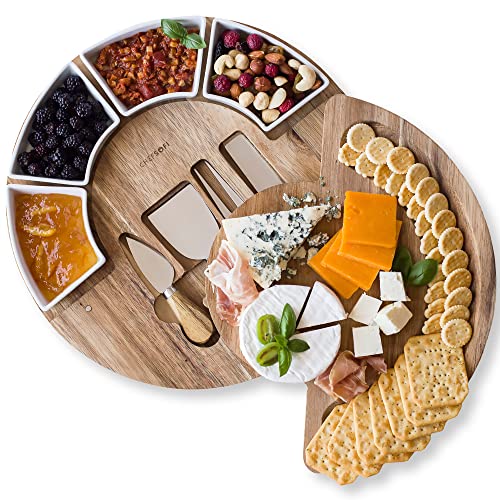 ChefSofi Charcuterie Board Set and Cheese Serving
- Original German Design: Our acacia wood cheese board…
- Elegant Presentation: Meticulously crafted for upscale parties and…
- More Spacious Than Most: Thanks to its wide…
As an Amazon Associate we earn from qualifying purchases at no extra cost to you.
For soft cheeses, look for holes that extend through the working portion of the blade rather than decorative dimples. The blade should be rigid enough not to bend sideways, with a rounded or gently pointed tip for lifting slices.
Semi-hard cheeses: the most versatile knife
Cheddar, Gouda, Havarti, Monterey Jack, and young Manchego are easiest to serve with a medium-width knife or cheese plane. A medium-width blade gives enough support for clean slices but remains maneuverable around a crowded board. A cheese plane is particularly effective when you want thin, even shavings from semi-hard blocks.
If you are buying only one knife, choose a medium-width blade with a sharp edge and a comfortable handle. It will not be perfect for every cheese, but it is more useful than a decorative miniature cleaver that handles only firm wedges.
Hard cheeses: strength and leverage
Aged Parmesan, Pecorino, aged Gouda, and firm Alpine cheeses require a short, sturdy blade rather than a long slicing knife. A cheese cleaver or chisel-style knife lets you press into a wedge and break off controlled pieces. The blade should feel rigid, with no visible flex when moderate hand pressure is applied.
For extremely hard cheeses, a pointed Parmesan knife is designed to pierce and split rather than slice. It is safer and more practical to use this tool with a stable cheese wedge than to force a thin blade through the block.
Head-to-Head: What Should the Set Be Made Of?
| Construction | Advantages | Trade-offs | Best for |
|---|---|---|---|
| Stamped stainless steel | Lightweight, affordable, easy to clean | May feel less substantial; thin blades can flex | Occasional entertaining and everyday drawers |
| Forged stainless steel | More rigid blade, balanced weight, durable handle joint | Usually costs more and can be heavier | Frequent hosts and harder cheeses |
| Stainless steel with wood handles | Warm appearance and comfortable grip | Wood can stain, swell, or crack if soaked | Tabletop presentation and gift sets |
| Stainless steel with resin or composite handles | Consistent shape, moisture resistance, low maintenance | Can feel less traditional or become slippery when wet | Families and frequent washing |
Look for food-safe stainless steel described as corrosion-resistant, preferably with the grade identified. 18/10 or 18/8 stainless steel is common in quality tableware and offers good resistance to staining. A set marked simply “stainless steel” may still be perfectly serviceable, but the description gives you less information about its composition.
Edge sharpness matters less than rigidity and corrosion resistance. Cheese knives are not normally sharpened like chef’s knives, and a serrated or blunt-looking edge can be intentional. Avoid blades with rough seams, peeling coatings, or a loose handle where the metal enters the grip.
Handle Comfort Is a Functional Feature
During a party, a knife may be used repeatedly by people with different hand sizes. Choose handles approximately 3.5–5 inches long with enough thickness to fill the palm without forcing a tight grip. Rounded rectangular handles generally offer better control than very thin, highly decorative handles.
Balance is easy to check: hold the knife near the handle and see whether the blade immediately drops downward. A slight forward balance helps with cutting, but an excessively blade-heavy tool can fatigue the wrist. For guests with arthritis or reduced grip strength, broad handles and rounded edges are more valuable than ornate metalwork.
Be cautious with completely smooth polished handles. They look elegant but may turn slippery when cheese oils or moisture get on them. Textured stainless steel, matte resin, or lightly contoured wood usually provides more dependable control.
How Many Pieces Do You Need?
A three-piece set is enough for a small board: use a soft-cheese knife, a medium or hard-cheese knife, and a serving fork. A four-piece set is the better all-purpose choice because it normally adds a dedicated Parmesan-style tool or cheese plane. Five-piece sets may include a spreader, extra fork, or separate plane.
More pieces are not automatically better. Duplicate knives increase drawer clutter, and very small tools are easy for guests to confuse. For six to ten people, one complete set is generally sufficient if the board contains several cheeses. If you are serving more than ten guests, two medium knives or a second matching set will reduce waiting and cross-contact between strong and mild cheeses.
Useful included tools include a two-prong serving fork for lifting cubes and wedges, a cheese plane for semi-hard cheese, and a spreader for soft cheese. A wire cutter can be useful for logs and fresh cheeses, but it is less versatile than a sturdy knife and should not be the main reason to choose a larger set.
Storage: Box, Stand, or Drawer?
Wooden boxes
A fitted wood box protects edges and makes a set suitable for gifting or formal storage. Allow roughly 10–14 inches of drawer or shelf length for a boxed four-piece set, depending on the handle design. Wood should be wiped clean rather than submerged, and the knives must be completely dry before closing the box.
Countertop stands
A stand keeps tools visible beside the board, but measure your serving area first. Many stands need about 4–6 inches of counter width and 8–12 inches of vertical clearance. They work well for open-plan kitchens but can become a nuisance in a small apartment or crowded buffet.
Travel cases and drawer trays
A zippered case is practical for picnics, holiday visits, and moves because it prevents blades from scraping other utensils. For an ordinary kitchen drawer, a slim tray or blade guard is safer than placing loose knives together. Do not assume a decorative box is airtight; trapped moisture can leave spots on steel.
Durability and Cleaning Realities
Cheese knives usually wear first at the handle joint, decorative rivets, and thin tips used to pry hard cheese. Never twist a narrow knife sideways inside a hard wedge. Instead, use a short, robust Parmesan-style tool and let the cheese split along its natural grain.
Dishwasher compatibility varies. Stainless-steel blades may tolerate a dishwasher, but wood handles, glued joints, painted details, and hollow decorative handles often do better with hand washing. Rinse away salt, fruit acids, and sticky preserves promptly, then dry each piece before storage. These small habits prevent pitting and keep handles from loosening.
When moving the set, wrap each blade or use the original insert. A small boxed set may weigh only 1–3 pounds, but sharp tips can puncture cardboard and damage nearby items. Place it in a rigid container rather than an unprotected kitchen-linen bundle.
Best Overall Buying Formula
For most homes, choose a four-piece set containing a perforated soft-cheese knife, medium slicing or plane-style knife, sturdy hard-cheese cleaver, and two-prong serving fork. Prioritize rigid corrosion-resistant stainless steel, handles around 3.5–5 inches long, secure blade-to-handle construction, and storage that matches your kitchen. Spend about $35–$100 for a dependable entertaining set; pay more for forged construction, a well-made presentation box, or refined handle materials rather than for extra pieces you will rarely use.
Frequently Asked Questions
Can one cheese knife handle an entire board?
Yes, if the board contains mostly semi-hard cheeses. A medium-width stainless-steel knife is the best single-tool compromise, but it will be less effective with very soft Brie and very hard Parmesan.
Are cheese knives dishwasher safe?
Some all-stainless sets are dishwasher safe, but hand washing is gentler and safer for wood, resin details, glued joints, and polished finishes. Follow the maker’s care instructions and dry the tools immediately.
Is a cheese fork necessary?
It is not essential, but it improves serving. A two-prong fork lets guests lift wedges without touching the food and is especially useful for semi-hard and hard cheeses that have already been cut.