Building a dedicated board game area is one of those home projects that sounds simple until you realize how many decisions converge at once. You need furniture that holds up to spilled drinks, dice trays that keep components organized, and a play surface that makes every setup effortless. Beyond the table itself, the games you stock matter just as much, because a board game area that only suits two-player strategy evenings will collect dust by the third week. The gap between a functional setup and a great one comes down to matching your actual social circle, your available space, and the types of evenings you want to host.
What separates a worthwhile purchase from a mediocre one in this category is how well each piece fits the real constraints of hosting. A table that seats six but requires thirty minutes of assembly defeats the purpose of a spontaneous game night. A cooperative game that needs forty-five minutes of explanation stalls momentum for first-time players. Throughout this roundup, we compared published specifications, listed prices, and recurring owner feedback to identify which products genuinely earn their place in a board game area and which ones are better skipped.
Our top picks
 Board Game Table with Removable Table Top
- Elevate your game night with this purpose-designed board…
- Crafted from solid Malaysian Oak, our table promises…
- Includes a leatherette mat that's tested to withstand…
 HUES and CUES
- Challenge friends and family to connect words with…
- Perfect for family game nights, parties, or casual…
- No two rounds are the same! Hues and…
 Greater Than Games: Trogdor!! The Board Game
- A Co-Op Puzzle, Area Control Game
- For 2-6 Players
- From The Brothers Chaps And James Ernest Comes…
| Product | Key specs | |
|---|---|---|
| Board Game Table with Removable Table Top | Elevate your game night with this purpose-designed board… Crafted from solid Malaysian Oak, our table promises… Includes a leatherette mat that's tested to withstand… | Check price |
| HUES and CUES | Challenge friends and family to connect words with… Perfect for family game nights, parties, or casual… No two rounds are the same! Hues and… | Check price |
| Greater Than Games: Trogdor!! The Board Game | A Co-Op Puzzle, Area Control Game For 2-6 Players From The Brothers Chaps And James Ernest Comes… | Check price |
 MMC Area 51 MMC Area 51 | Area 51 is known for testing alien tech—but… BE THE DETECTIVE, EXPOSE THE COVER-UP Unlock Noémie’s smartphone through our online portal to… | Check price |
 CGE Czech Games Edition Codenames Boardgame CGE Czech Games Edition Codenames Boardgame | Award-Winning Social Deduction Game Fast-Paced & Easy to Learn Perfect for Parties & Game Nights | Check price |
 SimplyFun Matter Board Game SimplyFun Matter Board Game | Use the competitive forces of fire, water, earth,… Elemental strength depends on placement and surrounding counters,… A strategy board game rooted in balance, no… | Check price |
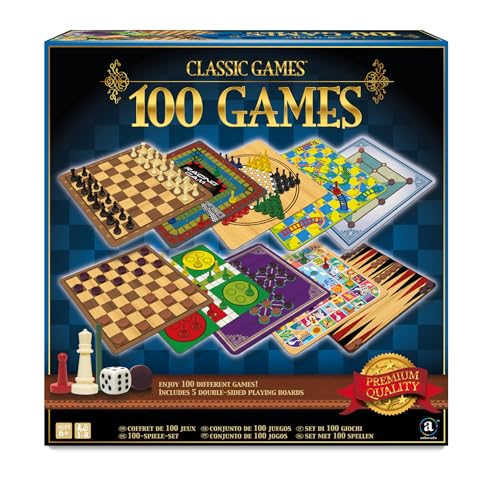 Merchant Ambassador: Classic Games Merchant Ambassador: Classic Games | Collection includes 100 classic board games, from Chess… Full instructions for every game included The widest set of family games available | Check price |
 Herd Mentality Udderly Funny Family Board Game Herd Mentality Udderly Funny Family Board Game | Udderly hilarious board game for family and friends… Easy to learn, quick to play and endlessly… Think the same to win the game | Check price |
As an Amazon Associate we earn from qualifying purchases at no extra cost to you.
Quick Picks
| Product | Best for | Price |
|---|---|---|
| Board Game Table with Removable Top | A dedicated, all-in-one play surface | $599 |
| HUES and CUES | Large-group color and perception games | $24.97 |
| Trogdor!! | Nostalgic co-op play with humor | $49.95 |
| MMC Area 51 | Adult murder mystery nights | $14.99 |
| Codenames | Team-based word association | $19.94 |
| SimplyFun Matter | Strategic area-control gameplay | $36 |
| Merchant Ambassador 100 Games | Introducing young children to board games | $17.99 |
| Herd Mentality | Funny family party evenings | $24.99 |
How We Picked
We evaluated every product against four criteria that matter most when outfitting a board game area. First, setup friction: the best options require minimal assembly or can be played straight from the box without fiddling with components. Second, player range and age flexibility: a game area should accommodate whoever walks through the door, so titles that bridge wide group sizes or age gaps earn higher marks. Third, replay value versus novelty: owner feedback consistently flags whether a game gets pulled out repeatedly or sits unopened after one session. Fourth, value relative to price: we compared each item’s component count, table footprint, and published price to judge whether the asking price reflects what you actually receive.
The 8 Best Board Game Area in 2026
Board Game Table with Removable Top
This table is the anchor piece for anyone serious about creating a permanent board game area. With a 57 by 33 inch play surface, it comfortably seats four to six players and includes a play mat, detachable cup holders, and dice trays as standard. The removable top means you can clear the surface for other uses without moving the entire table. Assembly is described as minimal, which matters for a product at this price tier. Owners praise the included accessories that eliminate the need for separate purchases. The main tradeoff is the footprint: 57 inches of width demands a room with real square footage. Skip this if you lack dedicated space or primarily play two-player games on a kitchen table.
HUES and CUES
HUES and CUES fills a specific gap in a board game area: entertaining a large group without splitting into separate tables. The vibrant color-guessing mechanic works for three to ten players, which is unusually broad for a party game. The 480 color squares create constant conversation and debate over perception differences. Owners highlight how quickly new players grasp the rules, keeping energy high. The downside is depth: color-matching games can feel repetitive after several sessions for groups that prefer strategic complexity. Skip this if your typical game night caps at three or four players, or if your group already owns too many party fillers.
Trogdor!!
Trogdor!! brings the classic Homestar Runner humor to a cooperative format where two to six players unite against a dragon in roughly thirty to forty-five minutes. For a board game area centered on shared storytelling and laughs, it delivers strong personality. The cooperative structure means no player elimination, keeping everyone engaged throughout. Owners appreciate the quick setup and the balance between strategy and silliness. The challenge is that the humor leans heavily into a specific early-2000s web animation era, so younger players outside that context may not connect with the references. Skip this if your group prefers competitive matchups or has never seen the source material and has no interest in the joke.
MMC Area 51
At fourteen dollars, MMC Area 51 is one of the cheapest entry points for adding a mystery element to your board game area. Designed for adult date nights or game nights, this murder mystery format gives each player a role and a set of clues to work through. The value proposition is strong for groups that enjoy deductive puzzles and character play. Owners note it works best as a one-time experience, which limits long-term replay value. The component count is modest for the price, and the Area 51 theme may not appeal to everyone. Skip this if your group prefers games with multiple playthroughs or finds scripted roleplay awkward.
Codenames
Codenames from Czech Games Edition remains a pillar of any board game area because it scales from small teams to larger gatherings with minimal rule overhead. The word-association mechanic rewards lateral thinking and produces memorable moments between partners. The two-team structure means it works best with an even number of players split into groups. Owners consistently cite it as their most-pulled-from-the-shelf game, which speaks to replay value. The limitation is that it rewards groups with shared cultural references, so mixed demographics can create uneven clue-guessing experiences. Skip this if your player pool struggles with abstract wordplay or you already own too many party word games.
SimplyFun Matter
SimplyFun Matter is an area-control strategy game designed for teens and adults ages ten and up, supporting two to four players. The component package includes a game board, ninety-two element tiles, fifty-six elementals, fourteen matter tiles, four player screens, and two carrying bags. This is a meaty box for the price. The area-control mechanic gives it a tactile, territorial feel that rewards planning. Owners praise the portability and the included storage bags. The tradeoff is that area-control games demand more mental energy than party titles, so it suits a board game area focused on strategic nights rather than casual gatherings. Skip this if your group prefers light, fast-paced interactions over multi-turn tactical play.
Merchant Ambassador 100 Games
Merchant Ambassador packs one hundred different games into five double-sided playing boards, making it a strong foundation for a board game area that serves children ages three and up alongside adults. The variety eliminates the need for multiple separate purchases during early gaming years. The double-sided boards are the key feature: one hundred games means most groups will find a format that matches the day’s mood. The downside is that breadth replaces depth; individual games within the set tend toward simplicity. Owners note some rulebook entries are brief enough to require interpretation. Skip this if you already own a collection of dedicated strategy games or your youngest players are older than six.
Herd Mentality
Herd Mentality is a family-oriented guessing game for ages ten and up that works by asking players to predict the most popular answer to prompts. The humor emerges from the social deduction element and the group reactions it provokes. As a party title in your board game area, it excels at getting everyone laughing within one round. The rule explanation takes under two minutes, making it a reliable opener for mixed groups. The limitation is strategic depth: the game rewards social calibration over clever mechanics, so it may not satisfy groups seeking complex decision-making. Skip this if your typical player count exceeds six, as the guessing mechanic can slow down with larger crowds.
Buying Guide
Table Dimensions and Seat Capacity
The single most important spec for your board game area is whether the table physically fits your room and your usual player count. A 57 by 33 inch surface like the board game table above accommodates six players with components spread out, while a standard dining table works for four but creates congestion for strategy games with large boards. Measure your space before buying and match it to the widest game in your current collection. Remember that area-control games with tile layouts demand more lateral room than card-based party games.
Player Range and Age Flexibility
A well-stocked board game area covers the gap between two-player duels and ten-person parties. Look for titles that bridge those extremes: HUES and CUES handles three to ten, while Trogdor!! covers two to six. If your household includes young children, a multi-game set like Merchant Ambassador provides immediate coverage across age groups without buying separate boxes. Prioritize games whose published player range overlaps with your most common group size.
Setup Time and Storage
Owner feedback consistently flags setup friction as a reason games get left in the box. Check whether components arrive organized or require sorting, and whether the product includes storage solutions like bags or trays. Detachable cup holders and dice trays on a dedicated table eliminate clutter that otherwise competes for play space. A board game area functions best when the transition from shelf to table takes under two minutes.
Our Verdict
The best overall pick for building a board game area is the Board Game Table with Removable Top at $599, because it solves the foundational problem of having a purpose-built surface with included accessories and real seating capacity. For the best budget entry, MMC Area 51 at $14.99 offers a complete game-night experience at a fraction of the cost of most strategy titles. However, if your group skews toward two to four serious strategists rather than casual parties, SimplyFun Matter wins out because its area-control depth and portable component set justify the $36 price better than any party filler in this list.
FAQ
How much floor space do I need for a dedicated board game area?
Plan for at least four feet of clearance around a table that seats four to six players so chairs pull back without hitting walls. The 57-inch table in this roundup needs roughly nine feet of wall-to-wall space once you account for seating. Measure before committing.
Can a board game area double as a dining or work surface?
Yes, and that is precisely why the removable top on the leading table matters. A play mat protects the surface during games, and clearing it afterward restores the table for meals or laptops. Multi-use designs are essential when space is limited.
What is the best first game to stock a new board game area?
Codenames is the most versatile starting point because it scales across group sizes, requires no reading beyond the card words, and produces different experiences every session. Pair it with a physical table surface so the cards and mat have a home.
Do cooperative games belong in a board game area designed for groups?
Absolutely. Trogdor!! demonstrates that cooperative play eliminates the awkwardness of one player dominating and brings everyone toward a shared goal. Cooperative titles fill the social niche that competitive games cannot, especially for groups where losing feels personal.