Key takeaways
- When designing a kitchen island, wet bar, or home workshop, homeowners often focus on fabric swatches, wood finishes, and cushion density. However, the most critical daily decision you will make is mechanical: to spin or to stay still? The choice…
What's inside
When designing a kitchen island, wet bar, or home workshop, homeowners often focus on fabric swatches, wood finishes, and cushion density. However, the most critical daily decision you will make is mechanical: to spin or to stay still? The choice between a swivel bar stool and a stationary counter height stool dictates how you interact with your space, how easily guests can slip into a conversation, how safe your children are during breakfast, and how often you will be cleaning scuff marks off your floors.
The core of this decision lies in balancing mobility against stability. Swivel stools offer fluid movement, allowing users to turn 180 or 360 degrees without dragging the chair’s legs across the floor. Stationary stools, on the other hand, offer a grounded, quiet presence and keep your counter space looking visually organized. Additionally, you must navigate height differences—traditional bar stools feature a seat height of 28 to 32 inches to pair with 40- to 42-inch bars, while counter-height stools feature a seat height of 24 to 26 inches for standard 35- to 37-inch countertops.
As an Amazon Associate we earn from qualifying purchases at no extra cost to you. Product prices and availability are accurate as of the date shown and are subject to change.


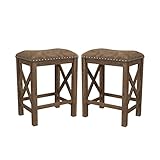
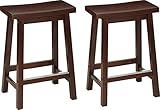
Fortunately, the market offers diverse solutions for every budget. If you lean toward modern, adaptable seating, options like the Nalupatio Modern Bar Stools Set of 2 ($79.99) provide adjustable gas-lift mechanisms wrapped in faux leather. For industrial or workspace settings, a heavy-duty utility stool like the BIG RED Torin Swivel Bar Stool ($45.1) offers rugged, 360-degree rotation. Conversely, if stability and classic aesthetics are your priority, you might opt for the elegant Hillsdale Furniture Willow Bend Stationary Backless Counter Height Stools ($217.99 for a set of 2) or the minimalist, budget-friendly Amazon Basics Solid Wood Saddle-Seat Counter Height Bar Stools ($57.59 for a set of 2).
Quick Verdict
If your kitchen island is the primary social hub of an open-concept living space, or if you have tight clearances between your counter and a wall, choose a swivel bar stool. The ability to pivot eliminates the need to push the stool backward to stand up, saving floor space and physical effort.
If you have young children, delicate hardwood floors, or a preference for clean, symmetrical design lines, choose a stationary counter height stool. Stationary models have no moving parts to squeak or fail, they cannot be spun into the edge of your expensive quartz countertops, and they naturally remain perfectly aligned when not in use.
Side by Side
To help you weigh your options, this side-by-side comparison breaks down the key performance, spatial, and financial factors of both stool types.
| Feature | Swivel Bar Stool | Stationary Counter Height Stool |
|---|---|---|
| Comfort & Ergonomics | High; easy to turn toward conversations or television screens without straining your neck or back. | Moderate to High; provides a highly stable base, though users must physically pivot their bodies to look sideways. |
| Durability | Moderate; swivel plates, ball bearings, and gas lifts can wear out, squeak, or loosen over time. | Exceptional; solid wood or metal joints with zero moving parts face minimal mechanical wear. |
| Price Range | $40 to $350+ per stool (highly dependent on pneumatic lifts and upholstery quality). | $25 to $250+ per stool (typically less expensive for equivalent materials due to simpler construction). |
| Maintenance | Requires occasional lubrication of swivel joints and tightening of mounting screws. | Virtually maintenance-free; occasional tightening of leg stretchers or frame screws. |
| Space Needed | Requires a 28- to 30-inch center-to-center spacing to allow room for the seat to rotate safely. | Requires less clearance (24 to 26 inches center-to-center) as users do not swing outward to exit. |
| Aesthetic Look | Dynamic and modern, but can look messy if seats rest at odd angles when unoccupied. | Clean, orderly, and symmetrical; easily slides completely under the counter lip. |
| Resale Value | Moderate; buyers inspect mechanical wear, gas-lift function, and swivel smoothness. | High; classic wooden frames hold value well due to their long structural lifespan. |
| Best For | Open-concept entertaining, narrow walkways, and dynamic home workshops. | Families with young children, minimalists, and homes with easily scratched flooring. |
Where Swivel Bar Stool Wins
The swivel bar stool is the undisputed champion of social interaction. In modern open-concept homes, the kitchen island is rarely just a place to eat; it is a transition zone between the cooking area, the dining room, and the living room. A swivel stool allows a guest to turn 180 degrees to speak to someone on the couch, and then spin back to face the cook. You do not have to lift, drag, or reposition the entire chair to adjust your gaze.
Furthermore, swivel stools are a spatial lifesaver in tight quarters. In narrow kitchens where the clearance between the counter island and the opposing wall or dining table is less than 36 inches, pulling out a stationary chair to sit down can block the entire walkway. With a swivel stool, you simply turn the seat, slide in sideways, and rotate forward. This is especially true for adjustable models like the Nalupatio Modern Bar Stools Set of 2, which allow you to tailor the height from 24 to 32 inches to fit different members of the family.
Finally, swivel mechanisms offer enhanced accessibility. For elderly individuals or those with restricted mobility, lifting and sliding a heavy wooden chair while trying to sit down is difficult and dangerous. A stable, heavy-duty swivel seat, such as the utility-focused BIG RED Torin Swivel Bar Stool, allows the user to sit down comfortably from an open angle and gently rotate themselves toward the counter surface.
Where Stationary Counter Height Stool Wins
While the swivel stool represents dynamic motion, the stationary counter height stool represents safety, silence, and visual serenity. The most significant drawback of swivel stools in a family home is safety. Young children view spinning bar stools as amusement park rides. This leads to tipped-over chairs, pinched fingers in swivel plates, and the inevitable “countertop collision,” where the backrest of a spinning stool slams directly into the edge of a marble, granite, or quartz countertop, chipping both the stone and the chair.
Stationary stools, such as the solid wood Amazon Basics Solid Wood Saddle-Seat Counter Height Bar Stools, remove this chaos entirely. They provide a solid, unmoving platform. Without mechanical joints, there are no metal ball bearings to dry out, rust, or squeak every time a family member shifts their weight.
From an aesthetic perspective, stationary stools keep a home looking organized. When guests leave a room with swivel stools, the seats are often left pointing in random, chaotic directions. Stationary stools, particularly backless designs like the Hillsdale Furniture Willow Bend Stationary Backless Counter Height Stools, can be tucked completely out of sight beneath the counter overhang when not in use. This maintains a clean line of sight across your kitchen island, a feature highly prized in modern interior design.
Cost Over 5 Years
When calculating the true cost of ownership, you must look beyond the initial retail price tag. A budget-friendly swivel stool and a premium stationary stool may cost the same upfront, but their financial trajectories over five years look very different.
Swivel stools rely on moving components. Lower-priced swivel models often use hydraulic gas cylinders to adjust height. Over three to five years of daily use, these seals can slowly leak pressure, causing the stool to slowly sink when sat upon. Swivel plates can also warp or lose their lubricated ball bearings, resulting in a grinding noise or a tilted seat. Replacing a gas lift cylinder or a swivel plate typically costs between $15 and $35 per stool in replacement parts, not to mention the labor involved. If the frame itself is made of lightweight metal, the weld points around the footrest can fail under constant twisting pressure.
In contrast, a high-quality stationary counter height stool is built like a brick. A solid wood saddle stool or a welded metal stationary frame has zero moving parts. Over five years, your only maintenance cost is occasionally replacing the felt floor pads on the bottom of the legs ($5 for a pack of 16) to protect your flooring. Even if the wood gets dinged, it can be sanded down and refinished, whereas a broken pneumatic lift on a cheap swivel stool often means throwing the entire unit into a landfill. Over a five-year horizon, stationary stools almost always yield a lower cost-per-use and hold a much higher resale value on the secondhand market.
Which One for Your Home
Small Apartment
In a small apartment or studio, space is your most valuable currency. Go with a compact, backless stationary stool or an adjustable, slim-profile swivel stool. If your kitchen island doubles as your work-from-home desk, an adjustable swivel stool is highly beneficial, allowing you to set the perfect ergonomic height for typing. However, if your walkway is highly restricted, a pair of tuck-away saddle-seat stationary stools will keep your walking paths completely clear when you are cooking.
Family with Kids/Pets
For homes with toddlers, young kids, or active pets, the stationary counter height stool is the clear winner. The risk of children climbing onto a swivel stool, spinning it, and losing their balance is high. Furthermore, active dogs and cats can easily knock over lightweight, top-heavy swivel stools. Heavy, wide-legged stationary wooden stools offer a low center of gravity and absolute stability, preventing tip-overs and keeping your children safe during homework and meal times.
Rental
If you are renting, flexibility is key because you do not know the exact height of your next kitchen counter. An adjustable swivel stool set is highly practical for renters. Because they can adapt from counter height (24 inches) to bar height (30 inches), you can pack them up and be confident they will fit your next home, whether it features a low breakfast bar or a high pub table.
Long-Term Home
For a home you plan to live in for a decade or more, invest in high-quality, stationary counter height stools. Look for solid hardwood construction, mortise-and-tenon joinery, and premium upholstery. These classic pieces will survive changing design trends, withstand years of daily family use, and protect your hardwood floors from the aggressive lateral twisting forces that heavy swivel stools exert over time.
FAQ
What is the standard height difference between a bar stool and a counter stool?
The main difference is seat height. Counter stools have a seat height of 24 to 26 inches, designed for standard 35- to 37-inch countertops. Bar stools are taller, with a seat height of 28 to 32 inches, meant for 40- to 42-inch bar tops. Always measure from your floor to the underside of your counter before purchasing; you need 9 to 12 inches of leg clearance between the seat cushion and the counter underside to sit comfortably.
Do swivel bar stools damage hardwood floors more than stationary ones?
Yes, swivel stools can cause more localized wear on hardwood floors. When a user spins, the base or legs of the stool twist against the floor surface under the weight of the rider. If grit or dirt is trapped under the stool legs, this twisting action acts like sandpaper, grinding circular scratches into your wood’s polyurethane finish. Stationary stools are usually lifted or slid straight back, which causes more linear wear that is easier to protect against using standard felt pads.
How much spacing should I leave between stools?
For comfortable dining and socializing, you should allow 26 to 30 inches of space from the center of one stool to the center of the next. For swivel stools, lean toward 30 inches of spacing to ensure that users do not bump elbows or knees when rotating. For stationary, backless stools, you can place them slightly closer together (around 24 inches center-to-center) if you need to maximize your seating capacity.
Can I convert a stationary stool into a swivel stool?
While it is technically possible to buy an aftermarket swivel plate and mount it to a flat-seat wooden stationary stool, it is rarely recommended. Adding a swivel plate raises the seat height by 1 to 2 inches, which can ruin your leg clearance. It also shifts the stool’s center of gravity upward, making a frame that was engineered for stationary stability top-heavy and prone to tipping over when spun.