Key takeaways
- Buying by rim diameter. A 12-inch skillet has a 10-inch floor. If the recipe says four portions need 10 inches, a 10-inch skillet with an 8-inch floor will crowd and steam.
- Buying a 14-inch for “extra room.” It overhangs an 11-inch burner by 1.5 inches per side, so the edges never reach searing temperature and the pan weighs nearly 5 pounds.
- Going too light. Stainless pans under 2.5 pounds at 12 inches have thin aluminum cores that develop hot spots. A good 12-inch tri-ply weighs 3 to 3.5 pounds.
- Skipping the lid. Skillets are usually sold open. If you finish dishes covered, buy a matching lid or a universal lid, or choose a sauté pan that includes one.
- Ignoring handle length. Long 9- to 10-inch handles balance a 12-inch pan but will not fit small ovens. Check total length before buying for oven use.
- Buying a set instead of two sizes. Many sets pair an 8- and a 10-inch skillet, leaving a family of four without the 12-inch they actually need.
The Short Answer
For four people, a 12-inch stainless steel skillet (30 cm) is the right primary pan. Its usable flat cooking surface is 9.5 to 10 inches across, enough for four 6-ounce chicken breasts, four salmon fillets, or a pound of ground beef without crowding, which is what lets stainless steel brown instead of steam. A 10-inch skillet (25 cm) holds two to three portions and is the right second pan for sides and eggs. If you cook a lot of one-pan meals with sauce, pasta, or braised vegetables for four, a 5-quart sauté pan with straight sides and a lid covers more ground than a second skillet. Skip the 8-inch entirely for a family of four except as an egg pan.
Standard Sizes
| Nominal size | Rim diameter (in / cm) | Flat cooking surface (in / cm) | Typical depth (in / cm) | Weight, tri-ply | Serves | Fits in one layer |
|---|---|---|---|---|---|---|
| 8 in | 8 / 20 | 6 to 6.5 / 15 to 17 | 1.5 / 4 | 1.5 to 2 lb | 1 | 2 eggs or 1 chicken breast |
| 10 in | 10 / 25 | 7.5 to 8 / 19 to 20 | 1.75 to 2 / 4.5 to 5 | 2 to 2.5 lb | 2 to 3 | 2 to 3 breasts, 4 eggs, 8 oz vegetables |
| 12 in | 12 / 30 | 9.5 to 10 / 24 to 25 | 2 to 2.25 / 5 to 6 | 3 to 3.5 lb | 4 | 4 breasts, 4 fillets, 1 lb ground meat, 1 lb vegetables |
| 14 in | 14 / 36 | 11.5 to 12 / 29 to 30 | 2.25 / 6 | 4 to 5 lb | 5 to 6 | 6 breasts; too big for most burners |
| 3 qt sauté pan | 10 / 25 | 9 / 23 | 2.5 to 3 / 6 to 8 | 3 lb with lid | 2 to 3 | Shallow braises for 3 |
| 5 qt sauté pan | 11 to 12 / 28 to 30 | 10 to 11 / 25 to 28 | 3 to 3.5 / 8 to 9 | 4 to 5 lb with lid | 4 to 5 | One-pan pasta, 4 thighs plus vegetables, 1.5 lb of anything saucy |
Note that the flat cooking surface, not the rim, is what limits how much fits. Sloped skillet walls take 2 to 2.5 inches off the nominal diameter; sauté pans with vertical sides lose only about 1 inch.
Our top picks

As an Amazon Associate we earn from qualifying purchases at no extra cost to you.
How to Measure Your Space
- Measure your largest burner. Gas burner grates are typically 9 to 11 inches; electric coils 8 inches; induction and radiant zones 7 to 10 inches. A 12-inch skillet with a 10-inch base works well on any burner 8 inches or larger. A 14-inch pan overhangs every home burner and heats unevenly at the edges.
- Measure the distance between burners. On a 30-inch range, front burners sit about 12 inches apart center to center. A 12-inch skillet on one front burner leaves room for a 10-inch pan beside it; two 12-inch pans side by side on the front will touch.
- Check your oven width. Stainless skillets are oven safe, but a 12-inch pan with a 9-inch handle is 21 inches end to end, which fits a standard 30-inch oven on the diagonal but not a 24-inch apartment oven with the door closed.
- Measure cabinet or rack storage. A 12-inch skillet needs a shelf at least 13 inches deep, or a wall rail rated for 4 pounds if you hang it. Lids add 3 inches of height when stacked.
- Weigh your comfort with the pan loaded. A 12-inch tri-ply skillet weighs about 3.5 pounds empty and 5 to 6 pounds with four chicken breasts. If you toss food one-handed, a 10-inch at 2.5 pounds is easier; a 12-inch with a helper handle opposite the main handle solves it.
- Count your portions honestly. Four adults eating 6-ounce proteins need a 10-inch flat surface. Two adults and two small children fit on a 10-inch skillet’s 8-inch surface. Size to the meals you cook weekly.
By Room or Use Case
Family of four, weeknight proteins and vegetables
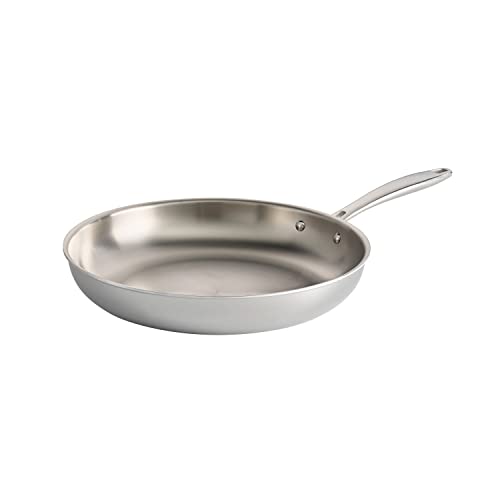
The 12-inch tri-ply skillet is the pan you reach for six nights out of seven. A clad 12-inch frying pan with an aluminum core, such as the Tramontina Signature at about $50, gives the full 10-inch flat surface. Sear four breasts at once, then deglaze for a pan sauce without moving to a second pan.
One-pan dinners, pasta, and braises for four
Straight sides and a lid matter more than diameter here. A 5-quart tri-ply sauté pan with lid, around $31, holds 1.5 pounds of pasta with sauce, four bone-in thighs on a bed of vegetables, or a shallow braise for four. Its 3-inch walls keep liquid in when you stir, which a skillet’s sloped 2-inch sides cannot.
Second pan for sides, eggs, and sauces
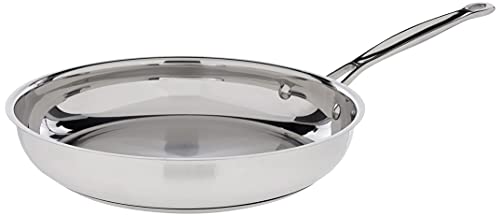
A 10-inch skillet complements the 12-inch. Cuisinart’s 10-inch open stainless skillet at about $45 handles four eggs, a pound of mushrooms, or a side of greens while the main pan is busy. It also fits a 6-inch or 8-inch burner without overhang, which the 12-inch does not.
Small apartment with a 24-inch range or two-burner cooktop
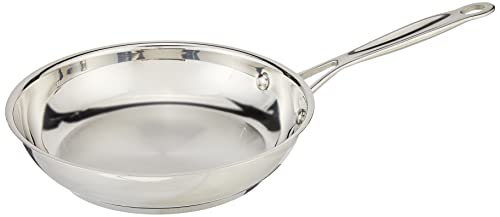
Two-burner cooktops rarely have burners over 8 inches or more than 10 inches apart. A 10-inch skillet as the primary pan plus an 8-inch, such as Cuisinart’s 8-inch open skillet at about $20, covers two people per meal and stacks in a single cabinet slot. Cook four portions in two batches or switch to the 5-quart sauté pan, which sits on an 8-inch burner without much overhang.
Induction cooktop
Induction zones heat only the area of the coil, typically 7 to 9 inches. A 12-inch skillet with a 10-inch base heats evenly on a 9-inch zone but leaves a cooler ring on a 7-inch zone. Check the zone diameter and choose a pan whose base is within an inch of it; on small-zone cooktops a 10-inch skillet performs better than a 12.
Common Sizing Mistakes
- Buying by rim diameter. A 12-inch skillet has a 10-inch floor. If the recipe says four portions need 10 inches, a 10-inch skillet with an 8-inch floor will crowd and steam.
- Buying a 14-inch for “extra room.” It overhangs an 11-inch burner by 1.5 inches per side, so the edges never reach searing temperature and the pan weighs nearly 5 pounds.
- Going too light. Stainless pans under 2.5 pounds at 12 inches have thin aluminum cores that develop hot spots. A good 12-inch tri-ply weighs 3 to 3.5 pounds.
- Skipping the lid. Skillets are usually sold open. If you finish dishes covered, buy a matching lid or a universal lid, or choose a sauté pan that includes one.
- Ignoring handle length. Long 9- to 10-inch handles balance a 12-inch pan but will not fit small ovens. Check total length before buying for oven use.
- Buying a set instead of two sizes. Many sets pair an 8- and a 10-inch skillet, leaving a family of four without the 12-inch they actually need.
FAQ
Is a 10-inch stainless steel skillet big enough for four people?
Not for four adult protein portions. Its 8-inch flat surface holds two to three chicken breasts before crowding. It is enough for four when cooking eggs, sides, or portions for young children.
Is a 12-inch skillet too heavy for everyday use?
At 3 to 3.5 pounds empty, a 12-inch tri-ply skillet is manageable for most cooks. If lifting a loaded 6-pound pan is a concern, choose a model with a helper handle opposite the main handle.
Skillet or sauté pan for a family of four?
Buy the 12-inch skillet first if you mostly sear and sauté. Buy the 5-quart sauté pan first if you mostly make one-pan meals with liquid. Most households end up with both within a year.
Will a 12-inch skillet work on a standard electric coil burner?
Yes. An 8-inch coil under a 10-inch pan base heats the center first, but a tri-ply pan spreads heat to the edges within 2 to 3 minutes of preheating. In 2026 nearly all 12-inch stainless skillets in the $45 to $60 range are fully clad, so this is rarely a problem.