Key takeaways
- Speedlights on AA batteries: 2.5–5 seconds at full power on alkalines, 1.5–2.6 seconds on good NiMH rechargeables.
- Speedlights on lithium-ion packs: 1.5–2 seconds at full power, and well under 0.5 seconds at half power.
- Battery monolights, 200–400 Ws: 0.01–1.5 seconds, with the fastest figures at low power settings.
- Battery monolights, 500–600 Ws: 0.9–2 seconds at full power, but 0.05–0.3 seconds at quarter power.
- AC studio strobes: 0.5–2 seconds at full power, limited partly by how much current the circuit can supply.
The best off-camera flash for a home studio is not the most powerful one you can afford — it is the one whose guide number, recycle time and battery capacity match the distance and modifier you actually shoot at, and most home setups land on a 200–400 Ws battery monolight with TTL and high-speed sync rather than a top-of-the-line hot-shoe speedlight. Everything below explains why, with the numbers that decide it: guide number maths, recycle figures, battery chemistry, and the weight and clearance limits of a real room.
Our top picks


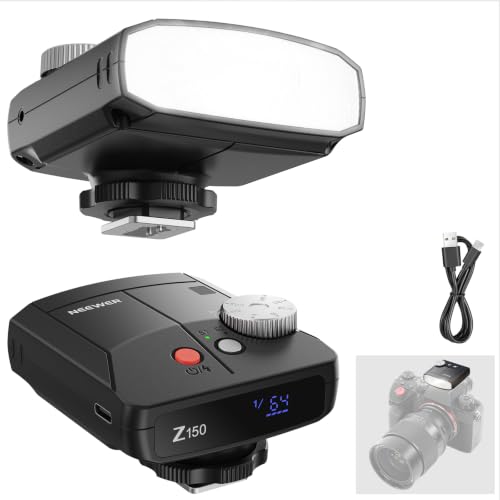
As an Amazon Associate we earn from qualifying purchases at no extra cost to you.
Quick picks by situation
If you want the short version before the detail, start here. Each row assumes a typical home studio — a spare bedroom, a dining room, a converted garage bay — and a single subject or a small product setup.
| Your situation | What to buy | Why it fits |
|---|---|---|
| 10 × 12 ft spare room, 8 ft ceiling, headshots and portraits | One 200 Ws battery monolight + 32 in softbox, plus one speedlight as a hair/kicker light | 200 Ws is enough for f/5.6–f/8 at 6–8 ft through a softbox; the speedlight costs nothing extra in space |
| Rented flat, no drilling, must pack away weekly | Two speedlights on light stands with a TTL trigger | Collapsed stands are 28–30 in long; speedlights fit a shoebox; total kit weight under 5 kg |
| Small products, food, eBay-style listings on a 30 in table | Two manual speedlights at 1/16–1/4 power | Short throw distance means you never need full power; manual keeps exposure repeatable |
| Family portraits with kids and pets who will not sit still | TTL monolight at 300–400 Ws with fast recycle | TTL absorbs the distance changes; 1-second recycle keeps pace with a moving toddler |
| Low 7 ft 6 in ceiling, no room for tall stands | Battery monolight with a short 5 ft stand and a small 24 in modifier | Bare bulb or small softbox close in, angled down; ceiling bounce is unusable at that height |
| High ceiling, big open-plan living space | 400–600 Ws monolight | Longer throw distances and larger modifiers eat 1–2 stops; you need headroom in the power dial |
| Video plus stills from the same room | Battery strobe with a modelling LED, or a dedicated LED panel for video | Flashes only illuminate for 1/1,000 s or less; continuous light is a different purchase |
TTL versus manual: the decision that shapes everything else
TTL — through-the-lens metering — fires a low-power pre-flash, measures the return through the lens, and sets flash power automatically. Manual mode fixes the power at a number you choose. Off camera, this is not a beginner-versus-pro question; it is a question about whether your subject-to-light distance stays constant.
TTL earns its keep when the distance changes between frames. A child who steps 3 ft closer moves from 6 ft to 3 ft from the light, which is two stops of extra exposure by the inverse square law. TTL corrects that in a frame; manual does not. TTL is also faster to set up when you are moving between rooms or shooting a reception where you cannot meter each shot.
Manual earns its keep when the distance is fixed and you want every frame identical — product photography, food, copy work, a locked-off portrait session. Manual is also cheaper. A Godox TT600 has no TTL at all and costs a fraction of a V860 III with identical raw power; the saving is real, and if your light stands never move, you lose nothing.
The practical compromise most home studios settle on: TTL-capable lights used in manual mode once the setup is dialled in, with TTL kept available for the moments when the subject moves. That argues for buying TTL-capable hardware even if you intend to shoot manual, because the price gap has narrowed considerably.
| Factor | TTL | Manual |
|---|---|---|
| Consistency across frames | Varies with subject position and reflective surfaces | Identical every frame |
| Setup speed in a new room | Fast — first frame is usually close | Requires a test frame and adjustment |
| Behaviour with strong backlight or mirrors | Can under- or over-expose badly | Predictable |
| Typical price penalty | Roughly 1.5–2× the manual-only equivalent | Baseline |
| Multi-light ratio control | Usually needs a TTL trigger with group ratio settings | Set each light by hand |
| Battery drain per shot | Slightly higher — pre-flash fires every frame | Lower |
Guide number: turning a marketing figure into feet in your room
A guide number is the aperture multiplied by the distance at a given ISO. A GN of 60 metres at ISO 100 means: at f/8, the light reaches 60 ÷ 8 = 7.5 m (about 25 ft) at that zoom setting. That is the entire calculation, and it is the only number on a spec sheet that tells you how far your light will actually throw.
Two things deflate guide numbers in practice. First, speedlight guide numbers are quoted at the longest zoom setting — usually 105 mm or 200 mm — which narrows the beam to a spot. Zoom out to 35 mm to fill a softbox and you lose roughly 1.5 stops. Second, every modifier costs light.
| Modifier | Typical light loss | Effective GN from a quoted GN 60 m light | Throw at f/8 |
|---|---|---|---|
| Bare head at 200 mm zoom | 0 stops (reference) | 60 m | 7.5 m / 25 ft |
| Bare head at 35 mm zoom | ~1.5 stops | ~21 m | 2.6 m / 8.5 ft |
| 7 in metal reflector | ~0.3–0.5 stops | ~45 m | 5.6 m / 18 ft |
| 32 in shoot-through umbrella | ~1.5–2 stops | ~20 m | 2.5 m / 8 ft |
| 24 × 36 in softbox, double diffused | ~2 stops | ~15 m | 1.9 m / 6 ft |
| 60 in umbrella-style softbox | ~2.5–3 stops | ~10 m | 1.3 m / 4 ft |
| Bounced off an 8 ft white ceiling | ~2–3 stops | ~10–15 m | 1.3–1.9 m / 4–6 ft |
The takeaway is blunt: a 76 Ws speedlight in a 24 × 36 in softbox gives you usable f/8 at roughly 6 ft. If your light stand sits 8 ft from your subject — a common distance in a 10 × 12 ft room when you allow space behind the photographer — you are at f/5.6 or wider, or you are raising ISO. A 200 Ws strobe doubles that distance to about 8.5 ft at the same aperture; a 400 Ws doubles it again to roughly 12 ft.
Doubling power buys you 1.41× the distance, not 2×. That square-root relationship is why going from 200 Ws to 400 Ws feels like a smaller jump than the numbers suggest, and why going from 76 Ws to 400 Ws feels transformative.
Recycle time and battery life: the numbers that decide your shooting rhythm
Recycle time is how long the capacitor takes to refill after a full-power pop. It matters more than raw power for anything involving people, because a subject who waits four seconds between frames loses the expression you wanted.
- Speedlights on AA batteries: 2.5–5 seconds at full power on alkalines, 1.5–2.6 seconds on good NiMH rechargeables.
- Speedlights on lithium-ion packs: 1.5–2 seconds at full power, and well under 0.5 seconds at half power.
- Battery monolights, 200–400 Ws: 0.01–1.5 seconds, with the fastest figures at low power settings.
- Battery monolights, 500–600 Ws: 0.9–2 seconds at full power, but 0.05–0.3 seconds at quarter power.
- AC studio strobes: 0.5–2 seconds at full power, limited partly by how much current the circuit can supply.
Note the pattern: almost nobody shoots at full power. A portrait at f/5.6 with a 32 in softbox at 6 ft typically lands at 1/8 to 1/4 power on a 400 Ws light. At those settings even modest strobes recycle in under 0.3 seconds, which is effectively continuous. Full-power recycle is a spec-sheet contest that rarely reflects the working setting — but it does matter for large groups, high ceilings, and any setup where you are fighting the sun.
Battery life follows a similar pattern. Manufacturers quote full-power pops per charge because it is the worst case and the easiest number to standardise:
| Power source | Typical capacity | Full-power pops | Recharge time | Practical notes |
|---|---|---|---|---|
| 4 × AA alkaline | ~2,000 mAh | 100–150 | Not rechargeable | Recycle slows noticeably as they drain; expensive over a year |
| 4 × AA NiMH (2,500 mAh) | ~2,500 mAh | 200–250 | 4–8 hours for a set | Best budget option; keep two sets and rotate |
| Lithium-ion speedlight pack | ~2,600 mAh at 7.2 V | 450–500 | 2–3.5 hours | One pack replaces roughly 12 AA cells; holds charge for months |
| Battery monolight, 200 Ws | ~2,900 mAh at 14.4 V | 450–500 | 2–3 hours | Spare packs are the single best accessory purchase |
| Battery monolight, 400–600 Ws | ~5,200 mAh at 14.4 V | 300–400 | 3–4 hours | Heavier pack; check it is removable and not internal |
Cold rooms degrade lithium performance — expect 20–30% fewer pops at 5 °C — and AA cells lose capacity faster than lithium packs when stored for months. For a home studio used twice a week, a lithium pack that holds its charge is worth the premium over disposables.
Size and weight: the trade-off nobody puts on the box
Power costs weight, and weight costs stability. A 600 Ws monolight on a cheap 7 ft stand with a 60 in modifier is a tipping hazard in a room where someone might brush past it. The numbers below are the ones to check before buying.
| Class | Typical weight | Minimum stand payload needed | Realistic modifier ceiling | Ceiling height needed |
|---|---|---|---|---|
| Hot-shoe speedlight | 400–700 g | 2 kg / 4.4 lb | 32 in umbrella or 24 in softbox | 7 ft 6 in |
| Compact battery strobe (100–200 Ws) | 0.6–1.2 kg | 3 kg / 6.6 lb | 36 in softbox | 8 ft |
| Mid battery strobe (300–400 Ws) | 1.5–2.5 kg | 5 kg / 11 lb | 48 in softbox or 60 in umbrella | 8 ft 6 in |
| High-power battery strobe (500–600 Ws) | 2.5–3.5 kg | 7 kg / 15 lb, or a C-stand | 60 in softbox with care | 9 ft |
| AC studio strobe (400–640 Ws) | 2–4.5 kg | 7 kg / 15 lb, or a C-stand | 60 in softbox, boom work | 9 ft, plus cable run |
Two calculations that catch people out. First, boom arms: a 2 kg strobe extended 6 ft out on a boom needs a counterweight of roughly 6 kg at 2 ft on the opposite side to balance, plus margin — so plan on a 10 kg sandbag, not a 5 kg one. Second, modifiers act like sails. A 48 in softbox has about 1.2 m² of surface area; a door opening or a window draught will move it, and the torque on the stand is what tips it over, not the head weight.
For a room where children or pets move through, the practical rule is: total head-and-modifier weight should be no more than one-third of the stand’s rated payload, and every stand that carries a modifier over 30 in should have a sandbag on the lowest leg, weighted to at least 7 kg.
Full comparison table: the current field
Guide numbers below are manufacturer-quoted at ISO 100, at the zoom setting where the figure is highest. Weights include batteries where the battery is internal. Prices are general market ranges for the unit alone, not kits.
| Model | Type | Power | GN (ISO 100) | TTL | HSS | Full-power recycle | Pops per charge | Weight | Price band |
|---|---|---|---|---|---|---|---|---|---|
| Godox TT600 | Speedlight | ~76 Ws | 60 m @ 200 mm | No | Yes (with trigger) | ~2.6 s (NiMH) | ~230 | ~400 g | $65–$90 |
| Godox TT685 II | Speedlight | ~76 Ws | 60 m @ 200 mm | Yes | Yes | ~2.6 s (NiMH) | ~230 | ~500 g | $130–$180 |
| Godox V860 III | Speedlight | ~76 Ws | 60 m @ 200 mm | Yes | Yes | ~1.5 s | ~480 | ~530 g | $200–$260 |
| Godox V1 / V1 Pro | Round-head speedlight | ~76 Ws | ~28 m @ 35 mm | Yes | Yes | ~1.5 s | ~480 | ~530 g | $250–$350 |
| Canon Speedlite EL-5 | Speedlight | ~76 Ws class | ~60 m @ 200 mm | Yes | Yes | ~1.5 s | ~350–500 | ~690 g | $400–$500 |
| Canon Speedlite EL-1 | Flagship speedlight | ~76 Ws class | ~60 m @ 200 mm | Yes | Yes | ~1.5 s | ~330 | ~1,000 g | $1,100–$1,300 |
| Nikon SB-5000 | Speedlight | ~76 Ws class | ~55 m @ 200 mm | Yes | Yes | ~2.6 s (NiMH) | ~200–250 | ~420 g | $600–$700 |
| Sony HVL-F60RM2 | Speedlight | ~76 Ws class | ~60 m @ 200 mm | Yes | Yes | ~2.6 s (NiMH) | ~200–250 | ~500 g | $500–$600 |
| Profoto A10 | Round-head speedlight | ~76 Ws class | ~32 m class | Yes | Yes | ~1.5 s | ~350 | ~560 g | $1,100–$1,300 |
| Westcott FJ80 II | Round-head speedlight | ~80 Ws | ~60 m class | Yes | Yes | ~1.5 s | ~500 | ~500 g | $350–$450 |
| Yongnuo YN560 IV | Speedlight | ~76 Ws class | 58 m @ 105 mm | No | No | ~3 s (NiMH) | ~200 | ~350 g | $70–$100 |
| Godox AD100 Pro | Battery strobe | 100 Ws | ~52 m class | Yes | Yes | ~1.5 s | ~360 | ~590 g | $300–$350 |
| Godox AD200 Pro / Pro II | Battery strobe | 200 Ws | 60 m (fresnel head) | Yes | Yes | ~1.8 s | ~500 | ~870 g | $350–$450 |
| Godox AD300 Pro | Battery strobe | 300 Ws | ~bare bulb / reflector | Yes | Yes | ~1.5 s | ~320 | ~1.6 kg | $500–$600 |
| Godox AD400 Pro | Battery strobe | 400 Ws | ~bare bulb / reflector | Yes | Yes | ~1.0 s | ~380 | ~2.3 kg | $700–$800 |
| Godox AD600 Pro / Pro II | Battery strobe | 600 Ws | ~bare bulb / reflector | Yes | Yes | ~0.9 s | ~360 | ~3.0 kg | $900–$1,100 |
| Profoto B10X / B10X Plus | Battery strobe | 250 / 500 Ws | ~bare bulb class | Yes | Yes | ~1.3 s | ~300 | 1.5 / 1.9 kg | $2,000–$2,900 |
| Profoto B1X 500 | Battery strobe | 500 Ws | ~bare bulb class | Yes | Yes | ~1.5 s | ~220 | ~3.0 kg | $2,000–$2,400 |
| Westcott FJ200 / FJ400 | Battery strobe | 200 / 400 Ws | ~round head class | Yes | Yes | ~1.5 s | ~350 / ~300 | ~1.2 / ~2.4 kg | $500–$800 |
| Elinchrom ELB 500 TTL | Pack-and-head | 500 Ws | ~bare bulb class | Yes | Yes | ~1.6 s | ~400 | 3.4 kg pack + head | $2,000–$2,600 |
| Godox SK400 II | AC monolight | 400 Ws | ~65 m with reflector | No | No | ~1.0 s | Mains | ~3.0 kg | $150–$200 |
| Godox DP400 III | AC monolight | 400 Ws | ~68 m class | No | No | ~0.9 s | Mains | ~3.0 kg | $200–$250 |
| Paul C. Buff Einstein E640 | AC monolight | 640 Ws | ~high, IGBT controlled | No | No | ~1.0 s | Mains | ~2.0 kg | $500–$600 |
| AlienBees B800 / B1600 | AC monolight | 320 / 640 Ws | ~reflector dependent | No | No | ~1–2 s | Mains | ~2.5 kg | $280–$450 |
| Broncolor Siros 400 S / 800 S | AC monolight | 400 / 800 Ws | ~reflector dependent | No | No | ~0.5–1.0 s | Mains | ~4.0 kg | $1,800–$2,600 |
The full roundup: every product, in detail
Godox TT600 — the budget manual workhorse
The TT600 is the reference point for anyone who wants raw power without paying for automation. It delivers roughly 76 Ws from four AA cells, quotes a guide number of 60 m at ISO 100 at 200 mm zoom, and recycles in about 2.6 seconds at full power on good NiMH cells. It has no TTL, but it does support high-speed sync when paired with a Godox trigger, and it is built into the same 2.4 GHz radio ecosystem as everything else in the range.
For a home studio shooting products, food or locked-off portraits, this is the cheapest way to own three lights that all work together. The limitations are the AA batteries — 200–230 full-power pops, and recycle slows as they drain — and the lack of TTL for anything that moves. Weight is around 400 g, light enough for a 2 kg stand. If you are building a first three-light kit on a tight budget, this is where the money goes.
Godox TT685 II — TTL without the battery premium
The TT685 II is the TT600 with TTL and a slightly better interface, still running on four AA cells. Power and guide number are effectively identical, so the premium you pay buys metering, not brightness. That is the right trade if your subjects move and your budget will not stretch to a lithium pack.
Off camera it does everything a home studio needs: 2.4 GHz radio, high-speed sync, TTL group ratios with a compatible trigger, and a zoom range wide enough to fill a small softbox. Recycle at full power is about 2.6 seconds on NiMH, dropping well under a second at quarter power — and quarter power is where most indoor portrait work actually lives. Weight with cells is around 500 g.
Godox V860 III — the lithium-ion default
The V860 III is the light most home studios should probably buy first. Same 76 Ws and 60 m guide number as the AA models, but powered by a removable 2,600 mAh lithium-ion pack that delivers roughly 480 full-power pops and recycles in about 1.5 seconds at full power. That is a four-fold improvement in endurance over AA cells, and it eliminates the single most annoying part of speedlight ownership.
It adds a modelling lamp, which is genuinely useful for judging shadow placement before you fire, and a faster interface. The battery charges in two to three hours and holds its charge for months in a drawer, which suits a home studio used irregularly. At around 530 g with the pack fitted, it sits comfortably on a light stand or in a bracket. The main argument against it is price relative to the TT685 II — you are paying for the battery system, not more light.
Godox V1 and V1 Pro — round head, softer falloff
The V1 uses a circular flash tube and a round magnetic mount instead of a rectangular head. The practical benefit is a more even spread of light across a modifier and a rounder catchlight in the eye, plus the magnetic accessory system that snaps a dome, gels and grids on in seconds. Power is the same 76 Ws class as the rest of the range, but the quoted guide number is lower — around 28 m at 35 mm — because the beam is spread wider by design rather than zoomed into a spot.
For off-camera work in a small room, the round head is genuinely better: it fills an umbrella or a small softbox more evenly, and it takes a magnetic dome diffuser that turns it into a bare-bulb-ish source for a very soft, close-in look. The V1 Pro adds a small detachable fill flash and a slightly revised head. Both run on the same lithium pack family, with roughly 480 full-power pops and 1.5-second recycle. Weight is around 530 g.
Canon Speedlite EL-5 and EL-1 — for Canon radio shooters
If your camera is Canon and you want the radio system to just work, the EL-5 is the sensible pick: lithium-ion power, roughly 350–500 full-power pops per charge, around 1.5-second recycle, and full integration with Canon’s radio triggering and in-camera menus. It weighs about 690 g, which is heavier than the third-party equivalents but still stand-friendly.
The EL-1 is the flagship — similar power, a more robust build, a colour-temperature-stable mode, and a price roughly three times the EL-5. It weighs close to a kilogram, which is where a speedlight starts to demand a sturdier stand. For most home studios the EL-5 is the better value; the EL-1’s advantages show up in heavy professional use, not in a spare bedroom. Canon also offers the compact EL-10, which runs on AA cells and suits a tight budget, though with less power and slower recycle.
Nikon SB-5000 — the radio-native Nikon option
The SB-5000 is Nikon’s radio-capable flagship speedlight, running on four AA cells with roughly 200–250 full-power pops per set and about 2.6-second full-power recycle on NiMH. It integrates with Nikon’s radio Advanced Wireless Lighting, which is convenient if you already own a Nikon body with a built-in radio commander or a WR-R11a/WR-R10 adapter.
The trade-off is battery chemistry. In a studio context, four AA cells per light and a 200-pop ceiling means swapping cells mid-session on a three-light setup. It weighs around 420 g, which is light for its class. If you shoot Nikon and value system integration over endurance, it is a solid choice; if you want maximum pops per charge, a lithium-powered third-party unit will outlast it comfortably.
Sony HVL-F60RM2 — for the Sony ecosystem
Sony’s flagship speedlight offers a guide number around 60 m at 200 mm, radio triggering within Sony’s own system, high-speed sync and a fast-recycling mode. It runs on four AA cells, giving roughly 200–250 full-power pops and about 2.6-second recycle on NiMH, at a weight of around 500 g.
For off-camera home studio use, its main value is native integration — no third-party trigger, no firmware guesswork, full menu control from the camera. Its main drawback is the same as Nikon’s: AA power. A hybrid approach works well here — Sony speedlights for on-camera or hair-light duties where integration matters, and a lithium-powered third-party monolight for the key light where endurance matters more than brand matching.
Profoto A10 — premium round-head speedlight
The A10 is Profoto’s round-head speedlight, built around the same magnetic mount as the larger Profoto lights, with AirX radio triggering, TTL and high-speed sync. It quotes a guide number in the low-30s of metres rather than the 60 m figures of zoomed rectangular heads, because the round head spreads light rather than concentrating it.