Key takeaways
- Find the best benchtop drying ovens for academic laboratories, with durable chambers, simple controls, and sizes suited to teaching and research.
Academic laboratories ask a lot of their equipment. One oven may dry glassware for an undergraduate teaching session in the morning, condition samples for a graduate research project in the afternoon, and run a long heat treatment cycle overnight. The best benchtop drying ovens for academic laboratories handle that variety without complicated setup, survive daily use by many different hands, and fit on a standard laboratory bench.


A benchtop drying oven is a compact forced-air unit that sits on a bench rather than taking up floor space. For academic use, the priorities are a durable chamber, controls that students and staff can learn quickly, even heat across the shelves, and safety features such as overtemperature alarms and timers. The models in this guide are all electric laboratory ovens listed for schools, research institutes, and teaching laboratories, with stainless steel interiors and digital controls.
How to Choose a Benchtop Drying Oven for an Academic Laboratory
Durability for shared use
In an academic laboratory, equipment is used by undergraduates, graduate students, technicians, and visiting researchers. Look for a cold-plate steel body with a stainless steel interior, sturdy shelves, and simple button controls rather than delicate touch panels. A viewing window is valuable in teaching settings because students can observe samples without opening the door and disturbing the chamber.
Capacity for teaching and research loads
Teaching sessions often produce large batches of glassware at once, while research projects may need only a few trays. A 45-litre chamber with two shelves is a versatile middle ground for a shared academic laboratory, handling a full class set of beakers and flasks in one run. A smaller 16-litre chamber suits a single research bench or a teaching laboratory that runs short, focused demonstrations.
Temperature range and control
Most academic drying work falls between room temperature and 300 degrees Celsius. That range covers glassware drying, moisture determination, sample conditioning, wax melting, and basic heat treatment. Digital controls with clear displays help students set the right temperature and confirm it at a glance. A temperature resolution of 0.1 degrees Celsius and a fluctuation of around 1 degree Celsius are useful benchmarks when research-grade stability is needed alongside teaching work.
Even heating across shelves
Forced-air convection circulates heated air through the chamber so that samples on the top and bottom shelves dry under similar conditions. This matters in teaching laboratories, where every student group should get comparable results from the same run. Check that the model uses a fan-driven convection system rather than relying on still air.
Safety features for a teaching environment
An overtemperature alarm, a timer with automatic shutoff, and clear operating instructions are essential where students are involved. The oven should never be used for flammable, explosive, toxic, or corrosive substances, and the laboratory should have a clear rule about who may start a run and who monitors it. External grounding and a matched power supply with leakage protection are part of safe installation for these units.
Bench space and power
Confirm the external dimensions and weight before ordering, and check that the bench can carry the unit. A 45-litre steel oven is heavy, so it needs a strong, level bench and clearance around it for heat dissipation. All of the models below run on 110V power, which suits standard North American laboratory outlets.
Product Picks
VAZHSOD 110V 1000W Horizontal Electric Blast Drying Oven 45L — Best Overall for Academic Laboratories
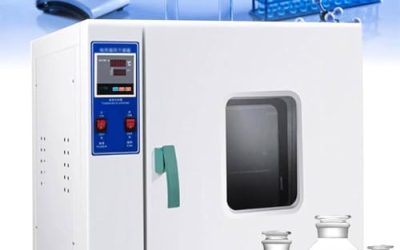
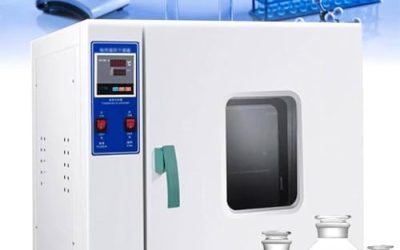
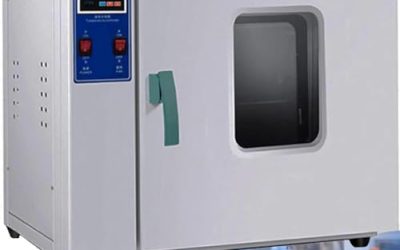
VAZHSOD 110V 1000W Horizontal Electric Blast Drying Oven 45L
This 45-litre forced-air oven is listed for schools, research institutes, and laboratories, which makes it a direct match for academic use. The intelligent temperature controller sets temperatures up to 572 degrees Fahrenheit, with a minimum of 18 degrees Fahrenheit above room temperature, covering drying, baking, wax melting, and heat treatment across teaching and research work.
The two-tier chamber uses two adjustable trays, each rated to carry 33 pounds, so a teaching session can dry a full load of glassware in a single run. Forced-air circulation keeps the heat even across both shelves, and a drainage hole in the top of the chamber helps remove internal moisture during drying. Double-row heat dissipation holes support stable operation during long cycles, and anti-slip feet keep the unit steady on the bench.
The button controls below the display are practical for a shared laboratory: they are easy to operate with gloved hands and simple enough for new users to learn quickly. That combination of capacity, durability, and straightforward operation is why this is the leading pick for an academic laboratory that needs one oven to serve many users.
Best for: Academic laboratories that need a large, durable forced-air oven for teaching sessions and research work alike.
Keep in mind: The unit weighs around 71 pounds, so it needs a sturdy bench, clearance for ventilation, and two people to move it into place.
WEIZIIA 16L Laboratory Drying Oven — Best Compact Pick for Teaching Benches and Small Research Groups
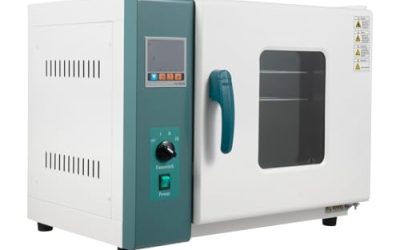
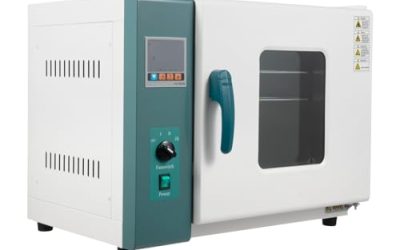
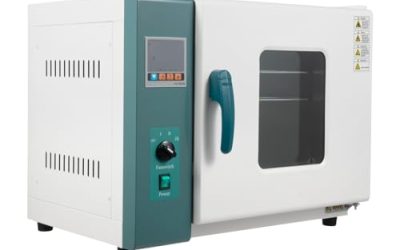
WEIZIIA 16L Laboratory Drying Oven
Not every academic bench needs a 45-litre chamber. The WEIZIIA 16-litre oven is the compact pick in this guide, and its microcomputer intelligent temperature controller uses PID control mode, with temperature calibration, an overtemperature alarm, and a self-optimization function. Those controls make it a good teaching tool in itself: students can see how a modern controller holds a setpoint and responds to calibration.
The temperature control range is 50 to 280 degrees Celsius, with a timer range of 1 to 9,999 minutes, which covers short classroom demonstrations and long drying runs alike. Two trays each carry up to 15 kilograms, and the large double-layer tempered glass observation window lets students watch samples without opening the door. The shelves are removable for cleaning and rearrangement between sessions.
The smaller chamber and lighter construction make this model easier to place on a crowded teaching bench or in a small research room. It is a sensible choice for a single research group, a teaching laboratory that runs small batches, or a department that needs a second oven for overflow work.
A note on configuration: the listing also describes a larger 43-litre option, so confirm the 16-litre configuration when ordering. The article describes the 16-litre version named in the listing title.
Best for: Teaching benches, small research groups, and departments that need a compact second oven with modern PID controls.
Keep in mind: The 16-litre chamber holds small batches only, so a busy teaching laboratory drying full class sets of glassware will need a larger model.
Zivisamt Lab Oven Digital 101-0AB 45L — Best for Precise Temperature Readout in Research-Led Teaching Labs
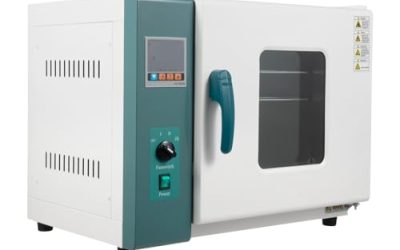
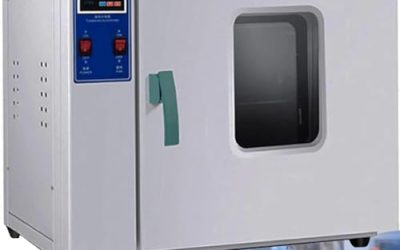
Zivisamt Lab Oven Digital 101-0AB 45L
In departments where teaching and research share the same space, the Zivisamt 101-0AB provides the precision that research work demands. Its digital controller reads temperature in 0.1 degree Celsius increments and holds fluctuation to around 1 degree Celsius, so graduate students can run protocols that depend on exact setpoints while undergraduates use the same oven for routine glassware drying.
The temperature range runs from room temperature plus 10 degrees Celsius up to 300 degrees Celsius, driven by a 1000-watt heater with forced-air convection. Two shelves each carry up to 15 kilograms, and the stainless steel interior stands up to repeated laboratory use. A side-swing door with a viewing window lets users check samples without opening the chamber.
Button controls keep operation simple for new users, and the digital display makes the current temperature easy to confirm at a glance across a busy laboratory. The external dimensions are 46.5 by 65 by 49.5 centimetres, so measure the bench and plan for ventilation clearance before ordering.
Best for: Academic laboratories where research-grade temperature precision matters alongside everyday teaching use.
Keep in mind: This is a heavy benchtop unit, so it needs a strong bench and help to position it safely.
Comparison Table
| Model | Key Features | Best For |
|---|---|---|
| VAZHSOD 110V 1000W Blast Drying Oven 45L | 45L chamber, forced-air convection, up to 572°F, 2 trays rated 33 lbs each | Academic laboratories needing one large oven for teaching and research |
| WEIZIIA 16L Laboratory Drying Oven | PID control mode, 50–280°C, timer up to 9,999 min, overtemperature alarm, glass window | Teaching benches and small research groups |
| Zivisamt Lab Oven Digital 101-0AB 45L | 45L chamber, 0.1°C resolution, around 1°C fluctuation, RT+10°C to 300°C | Research-led teaching labs needing precise readout |
Frequently Asked Questions
What size drying oven does an academic laboratory need?
A 45-litre chamber with two shelves is a versatile choice for a shared academic laboratory because it can dry a full teaching load of glassware in one run and still handle research batches. A 16-litre chamber suits a single research bench, a small teaching group, or a second oven for overflow work. Measure your typical load and check shelf load ratings before deciding.
Are benchtop drying ovens safe for student use?
They can be, with the right setup and rules. Choose a model with an overtemperature alarm and a timer, keep the operating instructions beside the oven, and establish who may start and monitor a run. Never dry flammable, explosive, toxic, or corrosive substances in a standard drying oven, and confirm proper grounding and power protection during installation.
How much bench space does a benchtop drying oven need?
More than the footprint alone. A 45-litre unit measures roughly 46.5 by 65 by 49.5 centimetres externally and weighs around 71 pounds, and it needs clearance around it for heat dissipation.
Conclusion
An academic laboratory needs an oven that is tough enough for shared daily use, simple enough for students to operate, and precise enough for research. The VAZHSOD 45-litre oven is the best all-round pick for that mix, with a large two-tier chamber and controls built for busy laboratories. The WEIZIIA 16-litre model is the compact choice for teaching benches and small research groups, with PID control and a long timer range in a smaller footprint. The Zivisamt 101-0AB adds research-grade readout precision for departments where teaching and graduate research share the same bench. Choose the capacity that matches your typical load, and confirm the bench space and power supply before ordering.
Disclosure: As an Amazon Associate, we may earn from qualifying purchases.
More from Amazon
Programs that pair well with the guide above. Offers and eligibility are set by Amazon and may change.
Collect the home and kitchen items you want in one registry that guests can shop from.
Create a wedding registrySet up recurring deliveries of everyday items on eligible products. Terms and savings are set by Amazon.
Explore Subscribe & SaveFree shipping on eligible items, Prime Video and more. Eligible new members can start with a free trial.
Start a Prime free trialAudiobooks and podcasts to listen to on the go. Eligible new members can start with a free trial.
Try Audible freeAs an Amazon Associate we earn from qualifying purchases.