Key takeaways
- Find the best laboratory drying ovens for materials testing, with PID control, even airflow, and capacities sized for repeatable sample drying.
Introduction
Choosing the best laboratory drying ovens for materials testing starts with one question: can the oven hold a steady temperature across every sample, batch after batch? Materials testing depends on repeatable drying conditions. When moisture content, curing, or heat treatment varies from one run to the next, the test results vary too, and that undermines the whole point of the work.


A laboratory drying oven is not a kitchen oven. It is built to dry, cure, and heat-treat samples such as powders, aggregates, polymers, coatings, ceramics, and metal parts at controlled temperatures, usually between room temperature and around 300 degrees Celsius. Forced-air circulation, a digital PID controller, and a stable chamber are what separate a useful lab oven from a simple heated box.
This guide explains what to look for when buying a laboratory drying oven for materials testing, then compares three models available on Amazon US that cover small, medium, and large sample loads.
How to Choose a Laboratory Drying Oven for Materials Testing
Temperature Range and Control
Most materials testing work falls between 50 and 300 degrees Celsius. Check that the oven reaches the top of your test range with room to spare, and that its controller holds temperature within a narrow band. A PID controller with digital display and temperature calibration is the standard to look for, because it adjusts heating continuously instead of switching fully on and off. A fluctuation figure of around plus or minus 1 degree Celsius is a good benchmark for repeatable work.
Temperature Uniformity
Uniformity matters as much as the set temperature. In materials testing, samples placed near the door, at the back, or on different shelves should dry at the same rate. Forced-air convection, where a fan circulates heated air through the chamber, gives far more even results than still-air heating. Look for a stated uniformity figure, such as within plus or minus 3 degrees Celsius, and for adjustable shelves that let air move freely around the load.
Chamber Capacity and Shelf Load
Match the chamber to your typical sample size. A 16-litre chamber suits small batches of test specimens, powders in trays, and individual specimens. A 45-litre chamber handles several trays at once, while a 70-litre chamber suits larger parts or higher-throughput testing. Also check the maximum load per shelf, often listed around 15 kilograms, so heavy metal or ceramic samples do not overload the trays.
Timer, Alarm, and Safety Features
A programmable timer lets you run drying cycles of a set length without watching the clock, and an over-temperature alarm protects samples and the lab if the controller drifts. A vent or drainage hole that releases moisture from the chamber helps samples dry faster and keeps humidity from building up inside. For shared labs, a clear observation window lets you check samples without opening the door and losing heat.
Build and Power
Look for a stainless steel or galvanized steel interior that resists corrosion and is easy to clean after dusty or resinous samples. Most benchtop lab ovens sold in the US run on 110 volts, which suits a standard lab outlet, but larger chambers draw more power, so confirm the wattage and the circuit available in your workspace. Measure the external dimensions too: a 70-litre oven needs a sturdy bench and clearance around the vents.
Product Picks
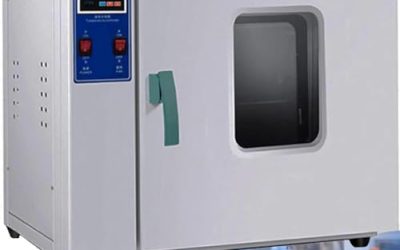
1. WEIZIIA Constant Temperature Blast Drying Oven, 16L — Best for Small Sample Batches
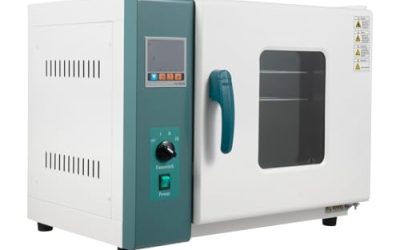
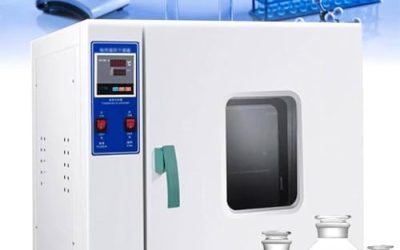
WEIZIIA Constant Temperature Blast Drying Oven, 16L
The WEIZIIA 16-litre oven is the compact pick in this guide, built around a microcomputer temperature controller with PID control. Its stated temperature range is 50 to 280 degrees Celsius, with temperature fluctuation of plus or minus 1 degree Celsius and uniformity within plus or minus 3 degrees Celsius, which are solid figures for small-scale materials testing.
It includes two trays, each rated for a maximum load of 15 kilograms, and a timer range of 1 to 9,999 minutes, so both short drying runs and long curing cycles are covered. The over-temperature alarm, self-optimisation function, and temperature calibration function add useful control for repeatable work. The internal chamber measures 25 by 25 by 25 centimetres, which suits trays of powder samples, small test specimens, and laboratory glassware.
Best for: small labs, teaching labs, and anyone drying modest batches of samples where bench space is limited.
Keep in mind: the 16-litre chamber is too small for large parts or high-volume testing, and the galvanized lining needs wiping down after dusty samples.
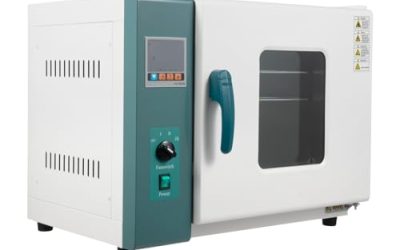
2. Zivisamt Lab Oven Digital, 45L, 1000W — Best for Medium Batches
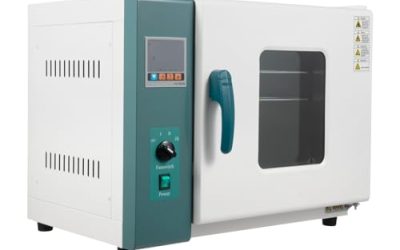
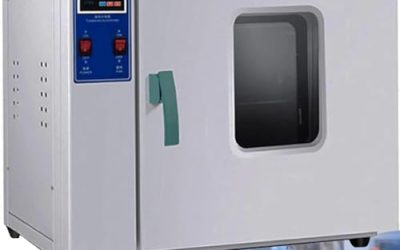
Zivisamt Lab Oven Digital, 45L, 1000W
The Zivisamt 101-0AB is a 45-litre forced-air convection oven rated at 1000 watts on 110 volts. Its temperature range runs from room temperature plus 10 degrees Celsius up to 300 degrees Celsius, with 0.1-degree resolution and fluctuation of plus or minus 1 degree Celsius.
Two adjustable trays, each rated for up to 15 kilograms, give room for several sample trays at once, and the stainless steel plate interior stands up to regular use. The side-swing door and button controls are straightforward, and the unit ships with an English manual and assembly accessories. At roughly 18.3 by 25.6 by 19.5 inches externally, it fits a standard lab bench while holding substantially more than the 16-litre model.
Best for: materials testing labs that run medium batches of samples, including aggregates, polymers, and coated parts, in a single cycle.
Keep in mind: it is a heavy unit at around 71 pounds net weight, so place it on a sturdy bench and plan for two people to move it into position.
3. YANDDEA Laboratory Drying Oven, 70L — Best for Large Parts and High Throughput
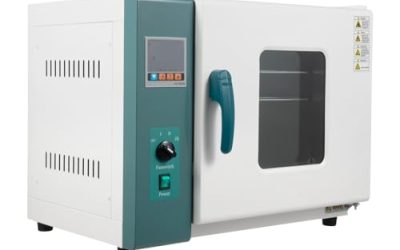
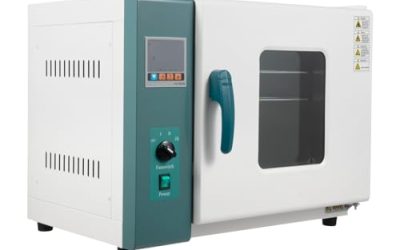
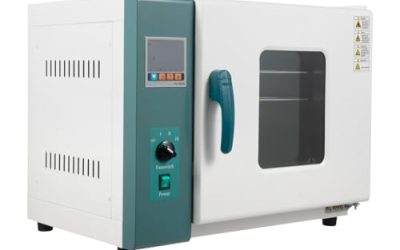
YANDDEA Laboratory Drying Oven, 70L
The YANDDEA 70-litre oven is the large-capacity pick, aimed at labs that dry bigger parts or run higher volumes. It uses an intelligent microcomputer temperature controller with PID accuracy, a stated range of 50 to 300 degrees Celsius, and forced-air convection for uniform heating across the chamber.
The larger chamber suits bulky specimens, multiple large trays, and industrial or research use where a 16-litre or 45-litre oven would need several runs. It includes timer and alarm functions and temperature calibration, following the same control pattern as the smaller models in this guide, with a galvanized steel build.
Best for: research institutes, industrial labs, and materials testing setups that need to dry large or numerous samples in one cycle.
Keep in mind: confirm bench space, ventilation clearance, and power supply before ordering, because a 70-litre oven is a substantial piece of equipment and is not a portable benchtop unit.
Comparison Table
| Model | Key features | Best for |
|---|---|---|
| WEIZIIA Constant Temperature Blast Drying Oven, 16L | PID control, 50–280°C, plus or minus 1°C fluctuation, two trays, 1–9,999 minute timer | Small sample batches and compact labs |
| Zivisamt Lab Oven Digital, 45L, 1000W | Forced-air convection, RT+10–300°C, 0.1°C resolution, two trays rated 15 kg each | Medium batches on a standard bench |
| YANDDEA Laboratory Drying Oven, 70L | PID control, 50–300°C, forced-air convection, timer and alarm, large chamber | Large parts and high-throughput testing |
Frequently Asked Questions
What temperature range do I need for materials testing?
Most drying, curing, and heat-treatment work for common test materials falls between 50 and 300 degrees Celsius. Choose an oven that covers your highest test temperature with margin, and check the low end too if you dry temperature-sensitive samples.
What is the difference between forced-air and gravity convection?
Forced-air ovens use a fan to circulate heated air, which gives more uniform temperatures across shelves and faster, more even drying. Gravity convection relies on natural air movement and can leave hot and cool spots, which is a drawback when samples must be treated identically.
Why does PID control matter for materials testing?
A PID controller continuously adjusts the heater to hold the set temperature, reducing overshoot and drift. That stability is what makes results repeatable from one batch to the next, which is the core requirement of materials testing.
How much capacity do I need?
A 16-litre chamber suits small trays and individual specimens. A 45-litre chamber covers most routine medium batches, while a 70-litre chamber is for large parts or high-volume work. Measure your largest sample tray before deciding, and leave room for air to circulate around the load.
Can I use a laboratory drying oven for food or kitchen use?
No. Laboratory drying ovens are designed for samples, materials, and labware, and they may have been exposed to chemicals or residues. Keep lab equipment separate from food preparation entirely.
Conclusion
For materials testing, the best laboratory drying ovens combine PID temperature control, forced-air circulation, and a chamber sized to the samples you actually run. The WEIZIIA 16-litre model is the sensible starting point for small batches, the Zivisamt 45-litre oven covers most medium-volume testing on a standard bench, and the YANDDEA 70-litre oven handles large parts and high-throughput work. Pick the capacity first, then confirm the temperature range, uniformity, and shelf load against your test methods, and the oven will support consistent, repeatable results.
Disclosure: As an Amazon Associate, we may earn from qualifying purchases.
More from Amazon
Programs that pair well with the guide above. Offers and eligibility are set by Amazon and may change.
Collect the home and kitchen items you want in one registry that guests can shop from.
Create a wedding registrySet up recurring deliveries of everyday items on eligible products. Terms and savings are set by Amazon.
Explore Subscribe & SaveFree shipping on eligible items, Prime Video and more. Eligible new members can start with a free trial.
Start a Prime free trialAudiobooks and podcasts to listen to on the go. Eligible new members can start with a free trial.
Try Audible freeAs an Amazon Associate we earn from qualifying purchases.