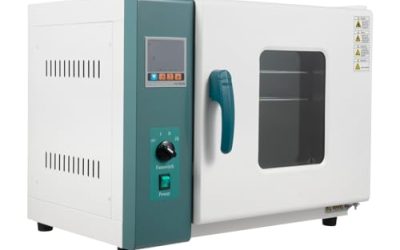
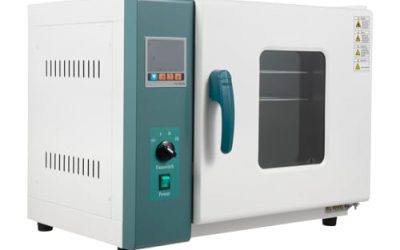
Key takeaways
- Compare the best laboratory drying ovens for steady temperatures, even airflow, and chambers from 16L to 70L for everyday lab drying work.
Introduction
The best laboratory drying ovens share the same strengths: steady temperature control, even airflow, and a chamber that fits the work at hand. Whether a lab dries glassware, cures coatings, heat-treats parts, or prepares samples for analysis, the oven has to hold its set temperature and dry every item in the chamber at the same rate.
Laboratory drying ovens, also called blast drying ovens or forced-air convection ovens, heat air and circulate it around the load. That circulation is what makes them useful for lab work: it removes moisture evenly and avoids the hot and cool spots that appear in a still-air box. This guide covers how to choose one and compares three models on Amazon US, from a compact 16-litre unit to a large 70-litre chamber.
What to Look For in a Laboratory Drying Oven
Temperature Range and Accuracy
Check the full temperature range first. Many lab ovens cover roughly 50 to 300 degrees Celsius, which handles drying, baking, curing, wax melting, and heat treatment for a wide range of materials. Look for a digital controller with fine resolution, often 0.1 degrees Celsius, and a stated fluctuation of around plus or minus 1 degree Celsius. Temperature calibration is a useful feature because it lets you correct the displayed temperature against a reference thermometer.
Forced-Air Circulation
Forced-air convection uses a fan to move heated air through the chamber. It dries loads faster and more evenly than gravity convection, and it matters most when shelves are full. A stated uniformity figure, such as within plus or minus 3 degrees Celsius across the chamber, is a good sign. Adjustable shelves and space around each tray help air reach every sample.
Capacity and Shelf Strength
Chamber size is measured in litres. A 16-litre oven suits small loads and tight benches. A 45-litre oven is a versatile middle size for routine lab work, and a 70-litre oven suits large items or heavy daily use. Check the maximum load per tray as well as the total volume: many models rate each tray at around 15 kilograms, which matters when drying metal parts, ceramics, or dense samples.
Timer, Alarm, and Moisture Release
A timer with a wide range, from minutes to thousands of minutes, supports both quick drying and long curing cycles. An over-temperature alarm protects the load if the temperature drifts, and a vent or drainage hole at the top of the chamber lets moisture escape instead of condensing inside. A tempered glass observation window is helpful because it lets you check the load without opening the door and dropping the chamber temperature.
Construction, Power, and Placement
Stainless steel or galvanized steel interiors resist corrosion and clean up easily after dusty or sticky samples. Most benchtop models in this class run on 110 volts, which suits a standard US lab outlet, but larger chambers draw more power, so confirm the wattage. Measure the external dimensions and the weight before ordering: a 45-litre oven can weigh around 70 pounds, and a 70-litre unit needs a strong bench with clearance around its vents.
Product Picks
1. WEIZIIA Constant Temperature Blast Drying Oven, 16L — Best Compact Lab Oven

WEIZIIA Constant Temperature Blast Drying Oven, 16L
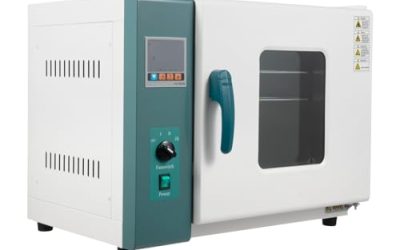
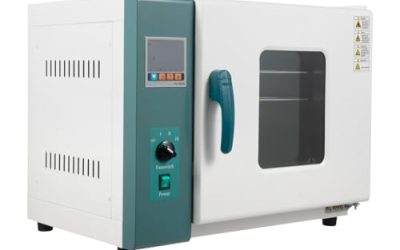
The WEIZIIA 16-litre oven is the compact option in this guide. It uses a microcomputer temperature controller with PID control, an over-temperature alarm, a self-optimisation function, and temperature calibration. Its temperature range is 50 to 280 degrees Celsius, with fluctuation of plus or minus 1 degree Celsius and uniformity within plus or minus 3 degrees Celsius.
Two trays are included, each rated for up to 15 kilograms, and the timer runs from 1 to 9,999 minutes. The internal chamber measures 25 by 25 by 25 centimetres, and the unit runs on 110 or 220 volts depending on the variant, with the 110-volt version suited to US labs. The listing describes it for baking, drying, curing, heat treatment, and high-temperature testing across electronics, agriculture, machinery, and food-related lab work.
Best for: small labs, teaching labs, and benches where space is tight but control still matters.
Keep in mind: the 16-litre chamber fills quickly, so it is not the right choice for large glassware sets or bulky parts.
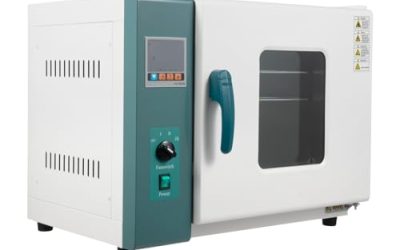
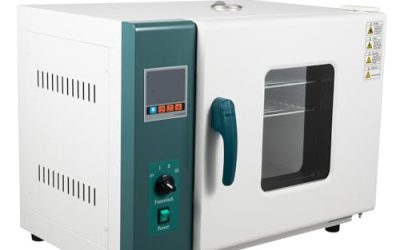
2. VAZHSOD Horizontal Electric Blast Drying Oven, 45L, 1000W — Best Mid-Size Lab Oven

VAZHSOD Horizontal Electric Blast Drying Oven, 45L, 1000W
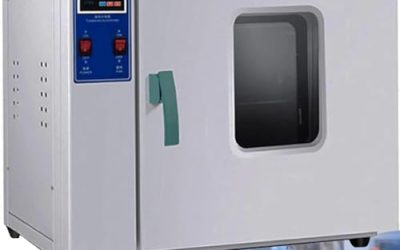
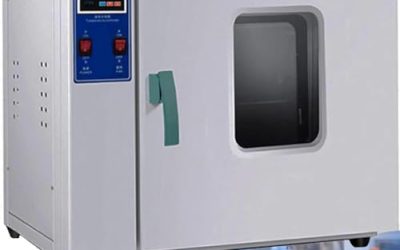
The VAZHSOD 45-litre oven, model 101-0AB, is a horizontal forced-air convection oven rated at 1000 watts on 110 volts. It reaches up to 572 degrees Fahrenheit, which is 300 degrees Celsius, with a minimum around 18 degrees Fahrenheit above room temperature, and it uses an intelligent temperature controller with button controls below the display.
Two adjustable trays, each able to carry up to 33 pounds, give room for several loads at once. A large double-layer tempered glass observation window makes it easy to watch samples without opening the door, and a top drainage hole helps remove internal moisture. Double-row heat dissipation holes support stable long-term operation. The listing describes it for drying, baking, wax melting, and heat treatment in industrial and mining enterprises, schools, research institutes, and pharmaceutical and health laboratories.
Best for: routine lab drying at medium volume, where a single cycle should cover several trays of samples or glassware.
Keep in mind: the button controls are simple by design, and the unit is heavy, so set it in its final position before loading it.
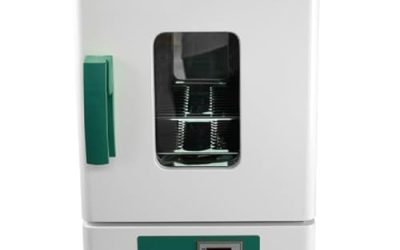
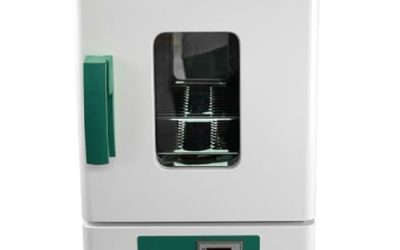
3. YANDDEA Laboratory Drying Oven, 70L — Best Large-Capacity Lab Oven

YANDDEA Laboratory Drying Oven, 70L
The YANDDEA 70-litre oven is the large-capacity pick. It uses an intelligent microcomputer temperature controller with PID accuracy, forced-air convection for uniform heating, and a stated temperature range of 50 to 300 degrees Celsius. Timer, alarm, and temperature calibration functions are included, following the same control pattern as the smaller ovens in this guide.
The galvanized steel build is made for industrial and scientific use, and the larger chamber suits bulky items, large trays, and high-throughput drying that would take several runs in a smaller oven.
Best for: research institutes, industrial labs, and shared facilities that dry large or numerous items every day.
Keep in mind: check bench strength, external dimensions, and ventilation clearance before ordering, and confirm the power requirements for the variant you choose.
Comparison Table
| Model | Key features | Best for |
|---|---|---|
| WEIZIIA Constant Temperature Blast Drying Oven, 16L | PID control, 50–280°C, plus or minus 1°C fluctuation, two trays, 1–9,999 minute timer | Compact labs and small loads |
| VAZHSOD Horizontal Electric Blast Drying Oven, 45L, 1000W | Forced-air convection, up to 300°C, observation window, two trays rated 33 lb each | Medium-volume routine lab drying |
| YANDDEA Laboratory Drying Oven, 70L | PID control, 50–300°C, forced-air convection, timer and alarm, large chamber | Large items and high-throughput labs |
Frequently Asked Questions
What is a laboratory drying oven used for?
It dries, bakes, cures, and heat-treats samples, glassware, and materials at controlled temperatures. Common uses include drying samples before weighing or analysis, curing coatings and resins, and heat-treating parts.
What temperature do laboratory drying ovens reach?
Most models in this class reach around 250 to 300 degrees Celsius, with a lower limit near room temperature plus 10 degrees Celsius. Check the exact range for the model you choose, and make sure it covers your highest routine temperature.
Is forced-air convection better than gravity convection?
For most lab work, yes. A fan circulates heated air so temperatures stay more uniform across shelves, drying is faster, and results are more consistent. Gravity convection can be acceptable for very light loads, but it is more prone to uneven heating.
How do I choose the right size?
Measure your largest tray or item and count how many you dry in a typical cycle. A 16-litre chamber suits small loads, a 45-litre chamber covers most routine work, and a 70-litre chamber is for large items or heavy daily use. Leave space for air to move around the load.
Do laboratory drying ovens need special installation?
Most benchtop models run on a standard 110-volt outlet, but larger units draw more power and need a sturdy bench with clearance around the vents. Read the manual for ventilation, spacing, and safety instructions before first use.
Conclusion
A good laboratory drying oven is defined by control, uniformity, and capacity rather than by size alone. The WEIZIIA 16-litre oven is a strong compact choice, the VAZHSOD 45-litre oven covers most routine lab drying in a single cycle, and the YANDDEA 70-litre oven handles large loads and busy labs. Match the chamber to your typical load, confirm the temperature range and PID control, and choose the model that fits your bench and your daily workflow.
Disclosure: As an Amazon Associate, we may earn from qualifying purchases.
More from Amazon
Programs that pair well with the guide above. Offers and eligibility are set by Amazon and may change.
Collect the home and kitchen items you want in one registry that guests can shop from.
Create a wedding registrySet up recurring deliveries of everyday items on eligible products. Terms and savings are set by Amazon.
Explore Subscribe & SaveFree shipping on eligible items, Prime Video and more. Eligible new members can start with a free trial.
Start a Prime free trialAudiobooks and podcasts to listen to on the go. Eligible new members can start with a free trial.
Try Audible freeAs an Amazon Associate we earn from qualifying purchases.