Key takeaways
- Ice format: Nugget and pellet ice is soft, chewable, and absorbs cocktails beautifully, but it melts faster and demands a machine built specifically for it. Bullet-style cubes from compressor units last longer in a glass and suit iced coffee, water bottles, and coolers.
- Footprint and finish: Measure depth against your counter and check clearance under upper cabinets before anything else. Brushed stainless reads as built-in and disappears next to most appliance suites; matte black works in darker, more graphic kitchens but shows dust and fingerprints.
- Tank capacity: A side tank is the difference between a machine you tend and a machine you use. Anything under half a gallon means frequent top-offs, while a full gallon reservoir will carry a household through a weekend of entertaining.
- Noise: Open-plan kitchens amplify everything. Look for ratings near 43 dB if the unit lives within earshot of a dining table, and expect commercial-grade machines to be noticeably louder in exchange for volume.
- Cleaning and scale: Hard water is the primary killer of ice makers. Prioritize one-touch self-cleaning cycles, replaceable scale-inhibiting filters, and brands that sell descaler as a stocked consumable rather than an afterthought.
What's inside
Ice machines have quietly migrated out of the utility room and onto the counter, which changes the calculation entirely. A dishwasher can be ugly behind a panel; a nugget ice maker sits in the sightline between your range and your window, humming through dinner parties. Buyers end up caught between two failures: choosing on ice output alone and inheriting a glossy plastic box that fights the cabinetry, or choosing on looks and discovering the reservoir needs refilling every ninety minutes. Add descaling schedules, app connectivity nobody asked for, and the fact that “nugget,” “pellet,” “pebble,” and “sonic” all describe roughly the same chewable ice, and the category gets murky fast.
This guide sorts the current landscape by brand behavior rather than spec sheets. We look at which manufacturers have earned trust on build quality and long-term serviceability, which finishes actually read as intentional in a designed kitchen, and how output, tank size, and noise translate into daily life. Below you will find our shortlist, a framework for matching a machine to your space, and honest notes on where each pick fits, from a compact bar cart to a full under-counter install.
As an Amazon Associate we earn from qualifying purchases.



🛒 Best Price Today on Amazon
Prime members get fast, free shipping on everything above, plus member-only deals. New members get a 30-day free trial — cancel anytime.
How to Choose an Ice Maker in 2026
- Ice format: Nugget and pellet ice is soft, chewable, and absorbs cocktails beautifully, but it melts faster and demands a machine built specifically for it. Bullet-style cubes from compressor units last longer in a glass and suit iced coffee, water bottles, and coolers.
- Footprint and finish: Measure depth against your counter and check clearance under upper cabinets before anything else. Brushed stainless reads as built-in and disappears next to most appliance suites; matte black works in darker, more graphic kitchens but shows dust and fingerprints.
- Tank capacity: A side tank is the difference between a machine you tend and a machine you use. Anything under half a gallon means frequent top-offs, while a full gallon reservoir will carry a household through a weekend of entertaining.
- Noise: Open-plan kitchens amplify everything. Look for ratings near 43 dB if the unit lives within earshot of a dining table, and expect commercial-grade machines to be noticeably louder in exchange for volume.
- Cleaning and scale: Hard water is the primary killer of ice makers. Prioritize one-touch self-cleaning cycles, replaceable scale-inhibiting filters, and brands that sell descaler as a stocked consumable rather than an afterthought.
The Best Ice Maker Brands of 2026, Reviewed
GE Profile Opal 2.0 Ultra Nugget Ice Maker
The Opal 2.0 Ultra remains the benchmark for countertop nugget ice, pairing 38 pounds of daily output with a 0.75-gallon side tank and a scale-inhibiting filter that meaningfully extends service life in hard-water homes. The stainless housing and restrained proportions let it sit on an open counter without looking like an appliance store display.
GE Profile Opal Ultra with 1-Gallon XL Tank
Functionally the same machine as the 2.0 Ultra with a larger reservoir, this Amazon-exclusive version is the smarter buy for anyone who entertains or has a household of four or more. The extra gallon of capacity cuts refills dramatically, and WiFi scheduling means ice is waiting rather than being made while guests stand around.
GE Profile Opal MINI PRO Nugget Ice Maker
The MINI PRO delivers 36 pounds a day from a noticeably tighter footprint, with top-fill convenience and a side tank for unattended runs. It is the right answer for galley kitchens, home bars, and butler’s pantries where counter depth is the binding constraint.
Kismile Nugget Ice Maker Countertop
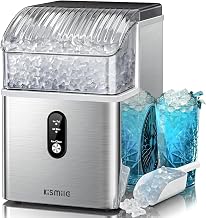
Kismile has become the credible value alternative in the nugget category, hitting 35 pounds daily and first ice in about seven minutes at a 43 dB noise floor that genuinely fades into the background. The stainless finish is convincing, and one-touch self-cleaning keeps maintenance from becoming a chore.
EUHOMY Countertop Ice Maker with Handle
For clear bullet cubes rather than nugget, EUHOMY’s portable unit produces nine cubes in six minutes and 26 pounds per day, with an integrated handle that makes it genuinely mobile. This is the pick for RVs, lake houses, and patios where portability matters more than a permanent countertop presence.
Frequently Asked Questions
Is nugget ice worth the premium?
If you drink cocktails, iced tea, or fountain-style sodas, yes. Nugget ice chills faster and takes on flavor, which is why it inspires such loyalty. For water bottles and coolers, standard cubes are more practical and considerably cheaper to produce.
Do these need a plumbing connection?
All the countertop models here are fill-by-hand and require only an outlet, which is what makes them so flexible. Larger under-counter machines like the EUHOMY commercial unit are designed for a dedicated water line and drain.
How often should I clean an ice maker?
Run a cleaning cycle every two to four weeks depending on water hardness, and descale monthly if you skip a filter. Neglected scale is the leading cause of slow production and premature compressor failure.
Can a countertop unit handle a party?
A 38-pound-per-day machine with a gallon tank covers most gatherings if you start it in the morning and store the overflow in a freezer bin. For steady high-volume demand, step up to a 100-pound commercial unit with dedicated ice storage.
Final Thoughts
For most kitchens, the GE Profile Opal Ultra with the 1-gallon XL tank is the one to buy: the same proven nugget mechanism as the standard Opal 2.0 Ultra, with enough reservoir capacity to stop thinking about it. Tight counters are best served by the Opal MINI PRO, while the Kismile Nugget delivers nearly identical performance for less if brand cachet matters less than quiet, reliable pebble ice.
I adjusted two headings to fix template artifacts (“How to Choose an Ice Maker in 2026” and “The Best Ice Maker Brands of 2026, Reviewed”) so the copy reads cleanly.