Key takeaways
- Find the best laboratory drying ovens for product development, with steady heat, repeatable cycles, and chambers built for prototypes and batches.
Product development runs on iteration. A prototype is dried, cured, or heat-treated, then measured, adjusted, and run again. When the oven drifts between cycles, it becomes impossible to tell whether a change in results came from the design or from the equipment. The best laboratory drying ovens for product development hold a steady temperature across repeated cycles, heat evenly across every shelf, and provide the capacity to run prototype batches side by side.
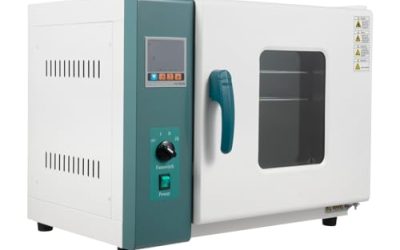
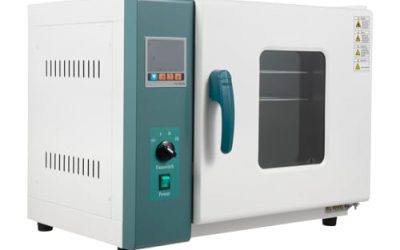
A benchtop laboratory drying oven fits naturally into a product development workflow. It sits on a bench near the work area, runs on 110V power, and handles the core thermal steps of development work: drying components and materials, curing coatings and adhesives, conditioning samples, melting wax for moulds, and heat-treating small parts. The models in this guide are all electric forced-air ovens with stainless steel interiors, digital controls, and temperature ranges reaching 300 degrees Celsius.
How to Choose a Drying Oven for Product Development
Repeatability comes first
In product development, the same cycle may run dozens of times as a design is refined. Look for a controller that holds temperature steadily, with fluctuation around 1 degree Celsius, and a display that reads in 0.1 degree increments so setpoints can be recorded exactly in a development log. PID control, where the listing names it, adjusts heater output continuously for a smoother, more repeatable cycle than a simple on-off thermostat.
Even heating for comparable prototypes
Prototypes tested side by side must experience the same conditions. Forced-air convection circulates heated air through the chamber so that items on the top and bottom shelves dry and cure evenly. A viewing window helps here too, since it lets you check progress without opening the door and disturbing the chamber temperature mid-cycle.
Capacity for prototype batches
Development work often means small batches of several variants at once. A 45-litre chamber with two shelves lets you run multiple prototype variants in a single cycle, which keeps conditions identical across the batch and saves time. A 16-litre chamber suits early-stage work where only one or two prototypes exist, or a development bench that runs many short, focused cycles.
Temperature range for curing and heat treatment
Most development drying and curing falls between room temperature and 300 degrees Celsius. That range covers drying components, curing coatings and adhesives, conditioning polymers and composites, wax melting, and heat treatment of small parts. Confirm the range of the exact model you order, and check that the controller can hold low setpoints steadily for gentle drying as well as high setpoints for curing.
Timer and safety for long cycles
Curing and conditioning cycles can run for hours, so a long timer range is valuable. One model in this guide supports timing up to 9,999 minutes, which covers overnight cycles. An overtemperature alarm protects prototypes and the laboratory if a setpoint is entered incorrectly. Never dry flammable, explosive, toxic, or corrosive substances in a standard drying oven, and follow your facility’s rules for unattended equipment.
Documentation and traceability
Development teams need to record what happened in each run. A digital display that shows the set temperature clearly, a timer that tracks cycle length, and a controller with calibration features all make it easier to keep accurate records. When a prototype result is questioned weeks later, a clear record of the drying cycle is part of the answer.
Product Picks
1000W Electric Blast Drying Oven 110V 2-Tier 45L — Best Overall for Product Development Batches

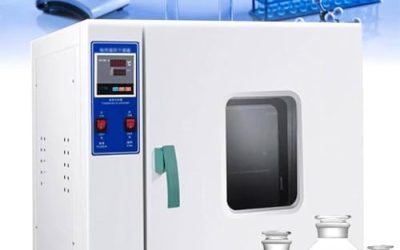
1000W Electric Blast Drying Oven 110V 2-Tier 45L
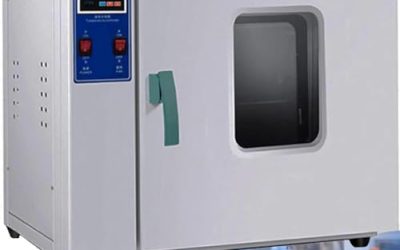
This 45-litre two-tier oven is the best overall pick for product development because its chamber is organized for batch work. Two shelves stack vertically inside an inner space of 34 by 34 by 35 centimetres, with trays measuring 32.5 by 33.5 centimetres and each rated for up to 15 kilograms. That layout lets a development team run several prototype variants in one cycle, under identical conditions, which makes comparison between variants meaningful.
The 1000-watt heater drives forced-air convection across a temperature range from room temperature plus 10 degrees Celsius up to 300 degrees Celsius, covering drying, baking, wax melting, and heat treatment. Button controls keep setup simple and repeatable, and the cold-plate body with a stainless steel interior stands up to daily development use. The side-open door has a window for checking prototypes without opening the chamber mid-cycle.
For a team iterating on a physical product, the ability to run a full batch of variants together is the feature that matters most. It shortens the iteration loop and removes the oven as a source of variation between prototypes.
Best for: Product development teams that run batches of prototype variants side by side in one cycle.
Keep in mind: The unit is heavy at around 71 pounds, so it needs a sturdy bench, ventilation clearance, and help to position it.
VAZHSOD 110V 1000W Horizontal Electric Blast Drying Oven 45L — Best for Heavy Development Workloads

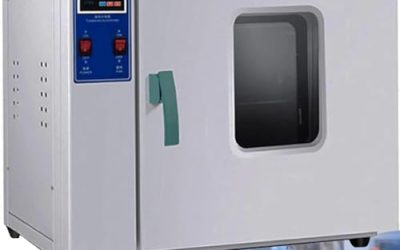
VAZHSOD 110V 1000W Horizontal Electric Blast Drying Oven 45L
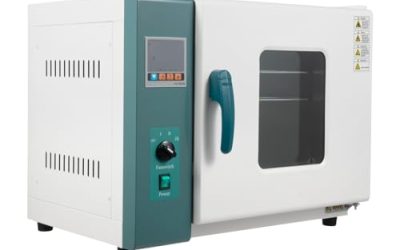
Development laboratories often run an oven through long cycles day after day, and the VAZHSOD 45-litre blast drying oven is built for that workload. Its listing covers industrial enterprises, schools, research institutes, and pharmaceutical and health laboratories, which reflects a design meant for sustained professional use. The intelligent temperature controller sets temperatures up to 572 degrees Fahrenheit, with a minimum of 18 degrees Fahrenheit above room temperature.
Two adjustable trays each carry up to 33 pounds, and the forced-air system circulates heat evenly through the two-tier chamber. A drainage hole in the top helps remove internal moisture during drying, and double-row heat dissipation holes support stable operation during long cycles. The button controls below the display are easy to operate with gloved hands, which suits a development bench where the oven is used between practical assembly steps.
This is the pick for a development laboratory where the oven is a workhorse: drying components in the morning, curing assemblies in the afternoon, and conditioning materials overnight. The 1000-watt heater and stainless steel construction are built for that kind of sustained use.
Best for: Development laboratories with heavy daily oven workloads across drying, curing, and heat treatment.
Keep in mind: Like other 45-litre steel ovens, this unit is heavy, so confirm the bench load rating and leave space around it for ventilation.
WEIZIIA 16L Laboratory Drying Oven — Best for Early-Stage Prototyping and Small Batches

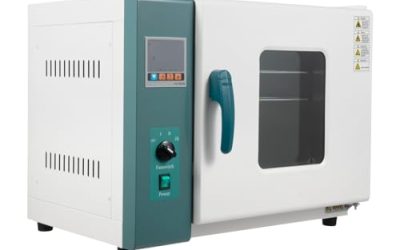
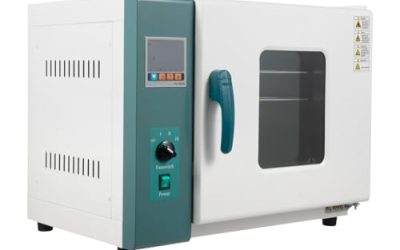
WEIZIIA 16L Laboratory Drying Oven
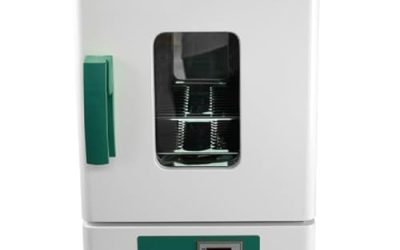
Early-stage product development often means one or two prototypes at a time, and a 45-litre chamber is more than that work needs. The WEIZIIA 16-litre oven is the compact pick for that stage, and it brings serious control features to a small chamber. Its microcomputer intelligent temperature controller uses PID control mode, with temperature calibration, an overtemperature alarm, and a self-optimization function, so early prototypes are dried and cured under the same kind of steady control as later production-scale batches.
The temperature control range is 50 to 280 degrees Celsius, with a timer range of 1 to 9,999 minutes, which covers short test cycles and long curing runs alike. Two trays each carry up to 15 kilograms, and the large double-layer tempered glass observation window lets you watch a prototype cure without opening the door. The shelves are removable for cleaning between different materials and projects.
The compact external dimensions, roughly 55 by 32 by 40 centimetres, make this model easy to place on a development bench beside assembly tools and measurement instruments. It is a sensible choice for a startup, a design studio with a prototyping bench, or a larger laboratory that needs a second oven for small experimental batches.
A note on configuration: the listing also describes a larger 43-litre option, so confirm the 16-litre configuration when ordering. The article describes the 16-litre version named in the listing title.
Best for: Early-stage prototyping, small experimental batches, and development benches with limited space.
Keep in mind: The 16-litre chamber holds small batches only, so teams running full prototype batches will need a 45-litre model.
Comparison Table
| Model | Key Features | Best For |
|---|---|---|
| 1000W Electric Blast Drying Oven 110V 2-Tier 45L | 45L chamber, two-tier batch layout, RT+10°C to 300°C, 2 trays rated 15 kg each | Running prototype variants side by side |
| VAZHSOD 110V 1000W Blast Drying Oven 45L | 45L chamber, forced-air convection, up to 572°F, 2 trays rated 33 lbs each | Heavy daily development workloads |
| WEIZIIA 16L Laboratory Drying Oven | PID control mode, 50–280°C, timer up to 9,999 min, overtemperature alarm | Early-stage prototyping and small batches |
Frequently Asked Questions
What is a laboratory drying oven used for in product development?
It dries components and materials, cures coatings and adhesives, conditions samples before measurement, melts wax for moulds, and heat-treats small parts. In a development workflow, it provides the controlled thermal step between making a prototype and measuring how it performs.
What size drying oven do I need for prototyping?
A 16-litre chamber suits early-stage work with one or two prototypes at a time. A 45-litre chamber with two shelves suits teams that run several prototype variants in a single cycle, which keeps conditions identical across the batch. Match the chamber to the number of variants you usually run together.
How do I keep drying cycles repeatable across a development project?
Record the setpoint, the cycle time, the shelf positions, and the load for every run, and use the same setup for comparable prototypes. A digital controller with a clear display and calibration features makes those records accurate. Running variants together in one cycle, in a two-tier 45-litre chamber, removes the oven as a source of variation between them.
Conclusion
Product development rewards equipment that removes variables instead of adding them. The 1000W two-tier 45-litre blast drying oven is the best overall pick for development work, because its vertical batch layout lets a team run prototype variants together under identical conditions. The VAZHSOD 45-litre oven is the workhorse choice for laboratories that run long cycles every day, and the WEIZIIA 16-litre model with PID control is the right scale for early-stage prototyping and small experimental batches. Choose the chamber that matches how many variants you run at once, confirm the bench space and 110V power supply, and keep a clear record of every cycle so your results stay comparable from the first prototype to the last.
Disclosure: As an Amazon Associate, we may earn from qualifying purchases.
More from Amazon
Programs that pair well with the guide above. Offers and eligibility are set by Amazon and may change.
Collect the home and kitchen items you want in one registry that guests can shop from.
Create a wedding registrySet up recurring deliveries of everyday items on eligible products. Terms and savings are set by Amazon.
Explore Subscribe & SaveFree shipping on eligible items, Prime Video and more. Eligible new members can start with a free trial.
Start a Prime free trialAudiobooks and podcasts to listen to on the go. Eligible new members can start with a free trial.
Try Audible freeAs an Amazon Associate we earn from qualifying purchases.