Key takeaways
- Find the best benchtop drying ovens for small laboratory spaces, with compact footprints, bench-friendly weight, and precise temperature control.
The best benchtop drying ovens for small laboratory spaces prove that a drying oven does not need a large room to do serious work. In a small lab, every centimeter of bench matters. The oven competes with balances, microscopes, glassware racks, and notebooks, and a unit that is too deep blocks access to the bench behind it, while a unit that is too heavy risks the bench itself.
Choosing for a small space means thinking in three dimensions: footprint, height, and weight, plus the clearance the oven needs for ventilation. The picks below are ordered by how little bench they demand, from a genuinely compact 18-liter oven to a larger unit that still earns its place when the workload justifies it.
How to Choose a Benchtop Drying Oven for a Small Laboratory Space
Measure the bench before anything else
Measure width, depth, and the weight the bench can carry. Then add clearance on all sides for ventilation, as the manufacturer recommends, and space in front for loading trays. An oven that fits on paper but leaves no room to open the door fully or slide a tray out is not a fit.
Match capacity to the real load
Small labs often overbuy capacity and then lose bench space to an oven that runs half empty. Count the trays and glassware in a typical daily load. An 18-liter chamber handles a modest daily load. A 45-liter chamber handles larger batches but needs roughly 65 cm of bench depth and a sturdy bench. Choose the smallest chamber that covers the largest regular batch.
Weight matters in a small lab
Compact ovens are lighter and easier to position, and they put less load on a bench that may also carry other equipment. A 45-liter oven can weigh more than 70 pounds, so moving it takes two people and a bench rated for the load. Check the listed weight, not just the footprint.
Temperature control in a compact chamber
Small chambers heat up quickly, which is an advantage, but they also need a controller that prevents overshoot. A digital PID controller holds the set temperature steadily, and a timer with an over-temperature alarm protects samples when staff are working a few steps away in a tight room.
Ventilation and heat in a small room
A drying oven releases heat into the room. In a small lab, that raises the room temperature and can affect nearby instruments. Leave the recommended clearance around the unit, avoid placing it against a wall or under a low shelf, and consider the room ventilation when choosing the size.
Noise and airflow
Forced-air ovens use a fan, which adds a low hum. In a small room where people work close to the bench, that matters. Gravity-convection ovens have no fan and run quietly, which suits a small shared space, though they dry more gently.
Our Top Picks
1. Microyn Digital Bench-top Compact Drying Oven, 18L

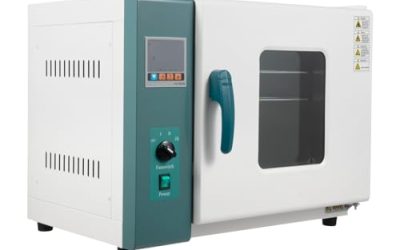
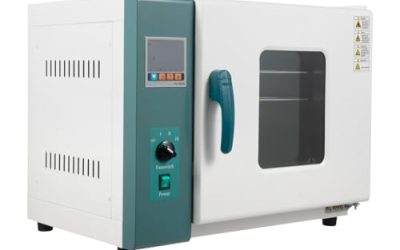
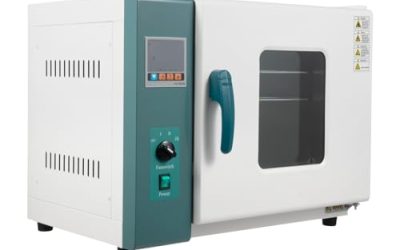
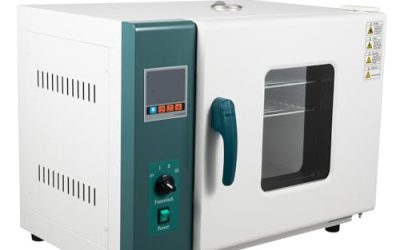
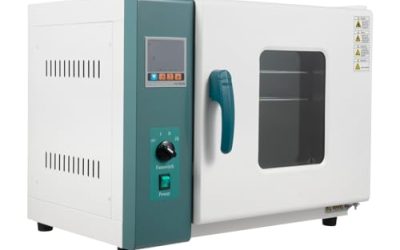
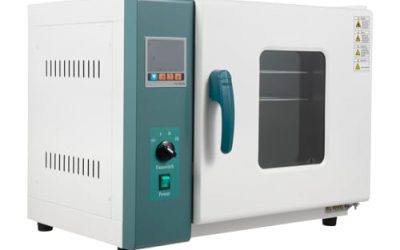
The Microyn MT-WHL-25AB is the first choice for a small laboratory space because it was designed for one. Its 18-liter (0.63 cu ft) chamber fits two shelves of glassware or small sample trays, and its external dimensions of 380 x 455 x 568 mm keep the bench footprint modest. Gravity convection moves warm air naturally, so there is no fan noise in a small room and no airflow to disturb light samples.
The digital constant-temperature controller covers room temperature plus 10°C to 300°C, and the 600W, 110V design runs from a standard bench outlet. A viewing window lets staff check a load without opening the door, which keeps the small chamber at temperature.
Best for: Small labs, shared benches, and daily glassware drying where space is the limiting factor.
Keep in mind: The 18-liter chamber is compact by design. Measure the tallest glassware against the shelf spacing, and load shelves with gaps so warm air can circulate.
2. YANDDEA Laboratory Drying Oven, Smallest Capacity Option

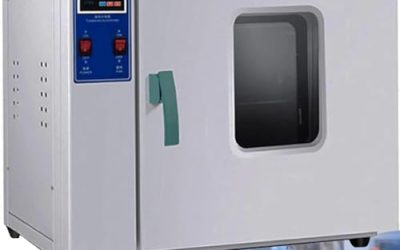
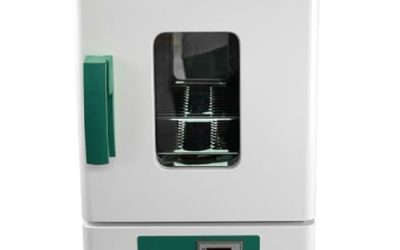
The YANDDEA laboratory drying oven earns a place in this guide because its listing presents several capacities from 15.6L to 136L, so a small lab can choose the smallest option rather than the 70L size. That smallest chamber gives the lab a PID controller covering 50 to 300°C with listed accuracy of 0.1°C, forced-air convection for even drying, and a microcomputer timer, alarm, and temperature calibration, all in a chamber sized for tight benches.
Two trays rated to 15 kg each carry glassware and sample loads, and the galvanized steel body has a corrosion-resistant electrostatic spray finish. Selecting the smallest capacity keeps the footprint and weight down while keeping the modern control features.
Best for: Small labs that want PID precision and forced-air uniformity without a large chamber.
Keep in mind: This listing presents multiple sizes, so select the smallest capacity option on the listing before ordering and confirm the voltage option. Check the external dimensions of the chosen size against the bench, since dimensions vary by capacity.
3. SODONAD 101-0AB 45L Horizontal Electric Blast Drying Oven

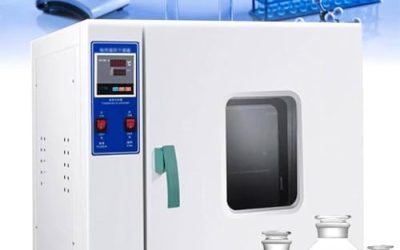
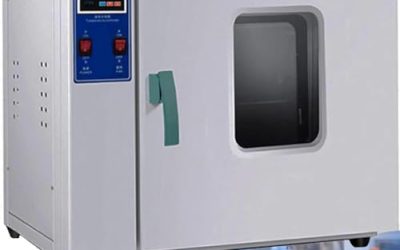
The SODONAD 101-0AB is the largest pick in this guide, included for small labs where the workload justifies the bench space. Its 45-liter chamber holds two adjustable trays rated to 33 pounds each, so a small lab can dry a full day of glassware and samples in one cycle instead of running a compact oven twice. The temperature range runs from room temperature plus 10°C to 300°C (572°F), and the digital PID controller includes timing, an over-temperature alarm, temperature deviation correction, and a self-tuning function.
Forced-air convection keeps the larger chamber even, and the stainless steel liner and double-layer tempered glass observation window support cleaning and visual checks. It runs on 110V at 1000W.
Best for: Small labs with a large daily drying load that can spare one deep bench position.
Keep in mind: At 46.5 x 65 x 49.5 cm and 71 pounds, this oven needs the deepest bench in the room and two people to move. Measure the depth carefully and leave clearance for ventilation before ordering.
Comparison Table
| Model | Capacity | Temperature Range | Key Feature | Best For |
|---|---|---|---|---|
| Microyn MT-WHL-25AB | 18L | RT+10 to 300°C | Compact gravity convection | Tightest benches |
| YANDDEA Laboratory Drying Oven | Smallest option, from 15.6L | 50 to 300°C | PID control, 0.1°C listed accuracy | Precision in a small chamber |
| SODONAD 101-0AB | 45L | RT+10 to 300°C | Forced-air PID control, glass window | Large daily load, one deep bench |
FAQ
What is the smallest practical benchtop drying oven for a lab?
An 18-liter chamber is a practical minimum for routine glassware drying and small sample batches. Smaller chambers exist, but they often lack the shelf space for standard glassware racks.
How much clearance does a benchtop drying oven need?
Follow the manufacturer guidance on the listing and manual. As a rule, leave space on all sides for ventilation, keep the top clear of shelves and stored items, and leave room in front to open the door fully and slide trays out.
Is a fan-assisted oven too noisy for a small lab?
Forced-air ovens produce a low fan hum. Most labs find it acceptable, but if the oven sits beside a desk or a quiet instrument, a gravity-convection model runs silently and may be the better choice.
Can a heavy oven sit on a standard lab bench?
Check the bench weight capacity and the oven weight before ordering. A 45-liter oven can weigh more than 70 pounds, and a bench that also carries other equipment may need reinforcement or a different position.
How do I keep a small lab cool when running a drying oven?
Run the oven at the lowest temperature the procedure allows, keep the room ventilation working, avoid placing the oven beside heat-sensitive instruments, and schedule long drying cycles for times when the room is less crowded.
Conclusion
For small laboratory spaces, the Microyn 18L is the most bench-friendly choice, combining a compact footprint with quiet gravity convection and a full 300°C range. The YANDDEA oven adds PID precision in its smallest capacity option for labs that need tighter control, while the SODONAD 45L is worth its larger footprint only when the daily load is big enough to justify one deep bench position. Measure the bench, count the real daily load, and choose the smallest oven that covers it. In a small lab, the right oven is the one that fits the work and still leaves room to do it.
Disclosure: As an Amazon Associate, we may earn from qualifying purchases.
More from Amazon
Programs that pair well with the guide above. Offers and eligibility are set by Amazon and may change.
Collect the home and kitchen items you want in one registry that guests can shop from.
Create a wedding registrySet up recurring deliveries of everyday items on eligible products. Terms and savings are set by Amazon.
Explore Subscribe & SaveFree shipping on eligible items, Prime Video and more. Eligible new members can start with a free trial.
Start a Prime free trialAudiobooks and podcasts to listen to on the go. Eligible new members can start with a free trial.
Try Audible freeAs an Amazon Associate we earn from qualifying purchases.