Key takeaways
- Find the best laboratory drying ovens for quality-control labs, with PID control, even heating, and repeatable results for moisture and drying work.
Choosing the best laboratory drying ovens for quality-control labs begins with one question: will the same drying cycle give the same result tomorrow, next week, and next month? In quality control, a drying oven prepares samples for moisture determination, dries glassware before weighing, and conditions materials before testing. When temperature drifts, when one shelf runs hotter than another, or when a timer is hard to repeat, the data drifts with it. That is why control stability, temperature uniformity, and clear, repeatable settings matter more in a QC lab than raw heating power alone.
A good QC drying oven also fits the way a QC bench actually works. Loads arrive in batches, procedures are written down, and more than one person may run the same method. A digital controller with a clear display, a timer that can be set the same way every time, an over-temperature alarm, and a calibration function all help different operators follow the same procedure. Capacity matters too, but only in relation to the batch: an oven that is too small forces split batches, while an oven that is far larger than the usual load wastes bench space and warm-up time.
How to Choose a Drying Oven for Quality Control
Temperature stability and repeatability
Look for a digital PID controller rather than a simple dial thermostat. PID control adjusts heater output as the chamber approaches the set point, which reduces overshoot and helps the chamber hold a steady temperature. Check the stated temperature fluctuation and temperature resolution in the listing. A fluctuation of around plus or minus 1 degree Celsius and a resolution of 0.1 degrees Celsius are useful benchmarks for routine QC drying work. Ask how the oven behaves after the door is opened and closed, because recovery time affects repeatability when samples are loaded in stages.
Temperature uniformity across shelves
A sample on the top shelf should dry under the same conditions as a sample on the bottom shelf. Forced-air convection, where a fan circulates heated air through the chamber, generally gives more even results than still air, especially in larger chambers. Gravity convection can work well in a small, well-designed chamber, but it depends more on load placement. Whichever type you choose, leave space between containers, avoid blocking air paths, and keep loads similar in size and moisture content within a single run.
Capacity, shelves, and load limits
Capacity in liters tells only part of the story. Check the number of shelves, the space between them, and the load limit per shelf. Two adjustable trays that each hold 15 kilograms allow heavier glassware and larger sample batches than a single thin shelf. Measure your tallest containers with lids or covers in place, and confirm that the internal height leaves room for air to move above them. For QC work, a chamber that holds one full batch at a time is usually better than a larger chamber that is routinely run half empty.
Safety, alarms, and calibration
An over-temperature alarm and an over-temperature cut-off protect samples and the lab when a set point is entered incorrectly or a sensor fails. Temperature calibration matters in QC because the displayed temperature and the true chamber temperature can differ. An oven with a calibration function lets a lab align the display with a reference thermometer and document the check. A viewing window helps operators confirm that samples are in place without opening the door and disturbing the run.
Product Picks
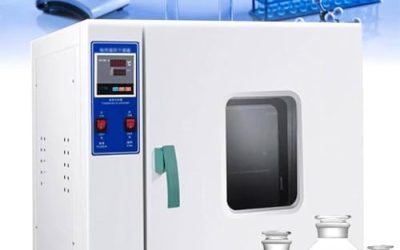
1. SODONAD 45L Horizontal Electric Blast Drying Oven, Model 101-0AB

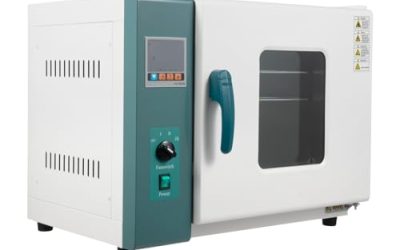
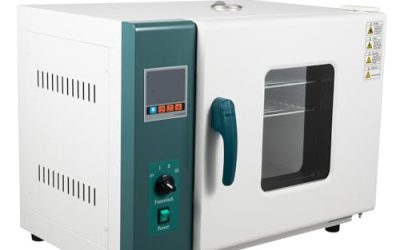
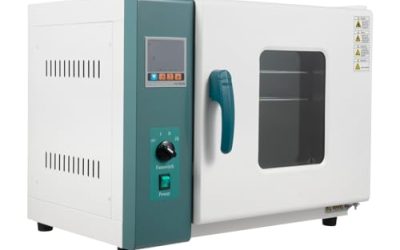
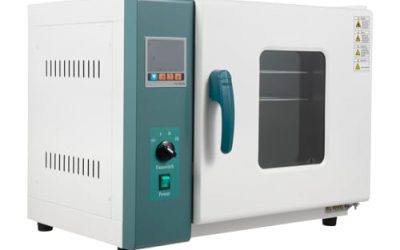
The SODONAD 45-litre model is the most practical starting point for a QC lab that runs regular batches. It is a forced-air convection oven rated at 110 volts and 1000 watts, with a temperature range from room temperature plus 10 degrees Celsius to 300 degrees Celsius, or room temperature plus 18 degrees Fahrenheit to 572 degrees Fahrenheit. The listing states a temperature fluctuation of plus or minus 1 degree Celsius and a temperature resolution of 0.1 degrees Celsius, which are the figures a QC team wants to see when a method depends on a stable set point.
Capacity is a clear strength. The 45-litre chamber holds two adjustable trays, each rated to carry 15 kilograms, so a full batch of glassware or sample containers can go in at once instead of being split across runs. A large double-layer tempered glass observation window lets an operator check the load without opening the door. Heat dissipation holes and a top drainage hole help moist air leave the chamber during drying, which supports consistent drying across the load.
This oven suits a QC lab that dries glassware, prepares samples for moisture work, and runs repeated cycles at temperatures up to 300 degrees Celsius. The main limitation is size and weight: at 71 pounds and with external dimensions of 46.5 by 65 by 49.5 centimetres, it needs a sturdy bench and a fixed home, not a shared trolley.
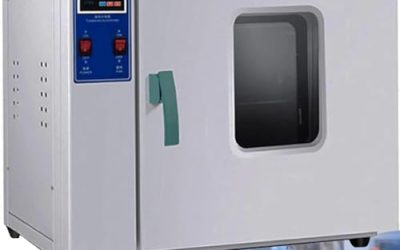
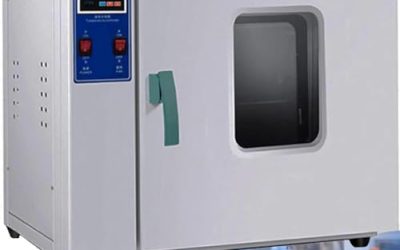
2. YANDDEA 42L Laboratory Drying Oven

The YANDDEA 42-litre oven is built around a digital PID controller with a stated range of 50 to 300 degrees Celsius and timing up to 9999 minutes. That long timer range is useful in QC when a drying step runs overnight or across a long conditioning period and the team wants the cycle to end at a defined time. The forced-air convection system is designed to keep heat distributed through the chamber, and the listing describes a galvanized steel body with an electrostatic spray shell for corrosion resistance.
At 42 litres, this oven sits close to the SODONAD in capacity, so it suits a similar batch size, while its 50-degree lower limit is stated directly rather than as room temperature plus a margin. That makes it easier to plan gentle drying steps. The unit weighs 39.6 pounds, which is lighter than the 45-litre SODONAD, so it is easier to position during installation, though it still needs a stable bench.
This oven suits a QC lab that wants PID control as the headline feature and that runs long, timed drying cycles. A limitation to plan around is documentation: confirm the exact shelf count, shelf load limit, and calibration steps in the manual on arrival, and run a temperature mapping check with a reference thermometer before the oven is used for reportable work.
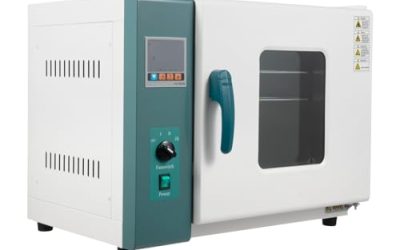
3. Microyn 18L Digital Bench-Top Gravity Convection Drying Oven, Model MT-WHL-25AB

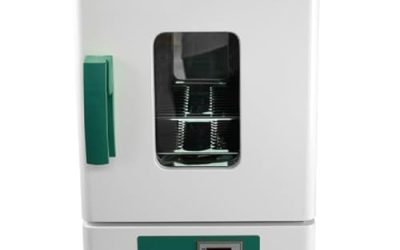
The Microyn 18-litre oven is the compact option for a QC bench with limited space or for a second oven dedicated to a single method. It is a gravity convection oven rated at 600 watts and 110 volts, with a temperature range from room temperature plus 10 degrees Celsius to 300 degrees Celsius, controlled by a PID micro-computer controller with over-temperature protection. The inner chamber measures 260 by 260 by 260 millimetres, and the unit includes two shelves, each rated to 15 kilograms.
This oven suits a small QC lab, a satellite testing bench, or a team that needs a dedicated oven for one routine drying method. The limitation is capacity: 18 litres will not hold a large batch, and gravity convection is more sensitive to crowded loading than forced air. Keep loads small, leave gaps between containers, and validate uniformity with a thermometer in each corner before relying on it for critical work.
Comparison Table
| Product | Key Features | Best For |
|---|---|---|
| SODONAD 45L, Model 101-0AB | 45L forced-air convection, 110V, 1000W, RT+10 to 300 degrees C, plus or minus 1 degree C fluctuation, 0.1 degree C resolution, 2 trays at 15 kg each, observation window | Regular QC batches and glassware drying |
| YANDDEA 42L Laboratory Drying Oven | 42L forced-air convection, digital PID control, 50 to 300 degrees C, timer up to 9999 minutes, galvanized steel body | Long timed QC cycles with PID control |
| Microyn 18L, Model MT-WHL-25AB | 18L gravity convection, 600W, 110V, RT+10 to 300 degrees C, PID control, over-temperature protection, 2 shelves at 15 kg each, viewing window | Small QC benches and single-method drying |
Frequently Asked Questions
What temperature range does a QC drying oven need?
Most routine QC drying falls between 100 and 150 degrees Celsius, with gentle drying near 50 to 60 degrees Celsius and heat treatment up to 250 or 300 degrees Celsius for some methods. Choose an oven that covers your written methods with margin at both ends, and check whether the low end is stated as room temperature plus a margin.
Is forced-air convection better than gravity convection for QC?
Forced air usually gives more even temperatures across shelves in a larger chamber, which helps repeatability when a batch fills the oven. Gravity convection can work well in a small chamber with light, well-spaced loads. Whichever type you choose, validate uniformity with a reference thermometer before using the oven for reportable work.
Why does PID control matter in quality control?
PID control adjusts heater output as the chamber approaches the set point, which reduces overshoot and helps hold a steady temperature. That steadiness supports repeatable drying times and comparable results between runs and between operators.
How often should a QC drying oven be checked?
Check the displayed temperature against a calibrated reference thermometer at the temperatures you actually use, and record the result. Repeat the check after the oven is moved, after maintenance, and at the interval set by your lab quality system. Also check door seals, shelves, and vents as part of routine care.
Conclusion
For quality-control labs, the best laboratory drying ovens for quality-control labs are the ones that hold a set temperature, heat evenly across every shelf, and let every operator repeat the same cycle. The SODONAD 45-litre model is the strongest all-round pick for regular batches. The YANDDEA 42-litre oven adds PID control and very long timed cycles. The Microyn 18-litre oven is the right choice when bench space is tight or a single method needs its own dedicated unit. Whichever model you choose, confirm the voltage, measure the bench, and validate temperature with a reference thermometer before the oven enters routine QC use.
Disclosure: As an Amazon Associate, we may earn from qualifying purchases.
More from Amazon
Programs that pair well with the guide above. Offers and eligibility are set by Amazon and may change.
Collect the home and kitchen items you want in one registry that guests can shop from.
Create a wedding registrySet up recurring deliveries of everyday items on eligible products. Terms and savings are set by Amazon.
Explore Subscribe & SaveFree shipping on eligible items, Prime Video and more. Eligible new members can start with a free trial.
Start a Prime free trialAudiobooks and podcasts to listen to on the go. Eligible new members can start with a free trial.
Try Audible freeAs an Amazon Associate we earn from qualifying purchases.